Business Valuations & Advisory

Business Valuation for Solvency & Insolvency Opionions

Valuation icon for solvency opinions and fraudulent conveyance protection

This page explains how solvency and insolvency opinions are used to assess a company’s financial condition in connection with transactions, financing decisions, and legal proceedings.

Solvency and insolvency opinions are specialized, valuation‑based analyses used to assess a company’s financial condition at a specific point in time, typically in connection with transactions that materially affect capital structure, leverage, or creditor interests.

Unlike general business valuations, solvency and insolvency opinions are often prepared because they are required or expected—not merely helpful. In many situations, the absence of a solvency opinion can expose companies, directors, lenders, or transaction parties to significant legal and financial risk.

When Solvency or Insolvency Opinions Can Be Mandatory

Solvency and insolvency opinions may be required or effectively mandated in several contexts. The requirement typically does not come from valuation standards themselves, but from transaction documents, lender requirements, fiduciary duties, or legal exposure.

Transactions That Increase Leverage or Reduce Creditor Protection

Solvency opinions are frequently required in connection with transactions that materially change a company’s financial position, including:

  • Leveraged acquisitions or recapitalizations
  • Significant debt financings or refinancings
  • Dividend distributions or owner redemptions funded with debt
  • Asset transfers or spin‑offs

In these cases, solvency opinions are often requested or required by transaction counsel, lenders, or boards to confirm that the company can meet its obligations after the transaction.

Lender, Investor, or Counterparty Requirements

Financial institutions and sophisticated counterparties may require a solvency opinion as a condition of closing, particularly when:

  • New debt is incurred based on enterprise value rather than assets
  • Existing creditors are subordinated or refinanced
  • Transactions rely on cash‑flow support rather than collateral

Here, the solvency opinion functions as a risk‑management and underwriting tool, and must be prepared with third‑party reliance in mind.

Board and Director Fiduciary Duty Considerations

Company directors and officers may require a solvency opinion to demonstrate fulfillment of fiduciary duties, particularly when approving transactions that could later be challenged.

This commonly arises when:

  • Companies are operating near financial distress
  • Transactions benefit insiders or related parties
  • Distributions or redemptions occur despite limited liquidity

A properly documented solvency opinion helps create a contemporaneous record that decisions were made with due care and informed judgment.

Insolvency, Restructuring, and Distressed Situations

Insolvency analyses become critical—and sometimes unavoidable—when a company faces financial distress. These analyses are often required or relied upon in connection with:

  • Forbearance agreements and creditor workouts
  • Restructuring negotiations
  • Bankruptcy or pre‑bankruptcy planning
  • Allegations of fraudulent conveyance or preferential transfers

In these contexts, the valuation supports conclusions about whether and when insolvency occurred, which can materially affect liability and creditor rights

Litigation and Dispute Contexts

Courts, arbitrators, and opposing parties may require or scrutinize solvency or insolvency opinions in disputes involving:

  • Fraudulent transfer claims
  • Breach of fiduciary duty allegations
  • Challenges to dividends, redemptions, or asset transfers
  • Creditor disputes or bankruptcy litigation

In these situations, the solvency opinion is treated as expert‑level financial evidence, not as an advisory estimate.

The Three-Test Framework in Solvency and Insolvency Analysis

Solvency and insolvency opinions are typically evaluated using a well-established three-test framework. These tests are complementary and are often applied together to assess a company’s financial condition at a specific point in time, particularly in transaction and litigation contexts.

Balance Sheet Test (Insolvency Test)

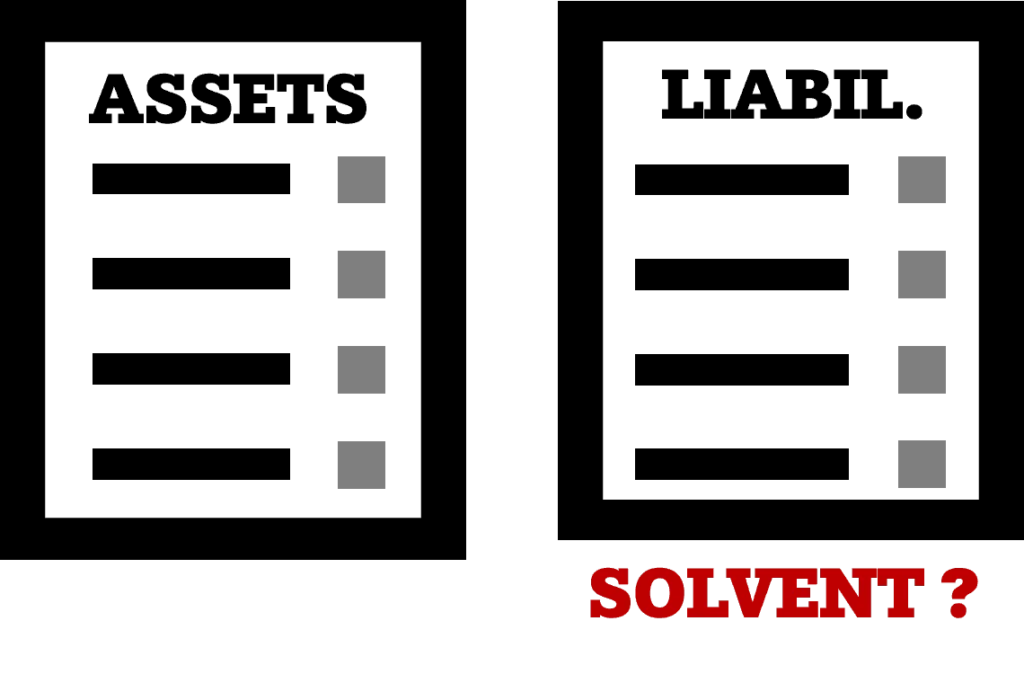
This test evaluates whether the fair value of the company’s assets exceeds its liabilities.

  • Assets are considered at fair value, not book value
  • Liabilities include all obligations, including contingent or off-balance-sheet items

A company is considered insolvent under this test if liabilities exceed the fair value of its assets.

Cash Flow Test (Ability to Pay Debts)

This test evaluates whether the company can meet its obligations as they come due.

  • Focuses on liquidity and projected cash flows
  • Requires analysis of timing and sufficiency of cash generation

A company may be considered insolvent if it is unable to pay its debts in the ordinary course of business.

Capital Adequacy Test (Unreasonably Small Capital)

This test evaluates whether the company has sufficient capital to operate its business given its risk profile and industry conditions.

  • Forward-looking and dependent on reasonable projections
  • Considers volatility, leverage, and operational risk

A company may fail this test if it is left with “unreasonably small capital” to sustain operations.

These tests are not accounting constructs but valuation-based and legal concepts. Which tests apply—and how they are interpreted—depends on the specific transaction, legal framework, and purpose of the analysis.

Why Business Valuation Is Central to These Opinions

Solvency and insolvency opinions cannot rely solely on book values or historical financial statements. Business valuation is essential because:

  • Asset values may materially differ from accounting values
  • Enterprise value and intangible assets may be relevant
  • Forward‑looking assumptions affect capital adequacy and cash‑flow tests

As a result, these engagements require careful valuation judgment, scenario analysis, and documentation suitable for adverse review.

Engagement Scope and Documentation Expectations

Because solvency and insolvency opinions are frequently relied upon by lenders, boards, counsel, or courts, they are performed exclusively as Valuation with a Conclusion of Value and a Detailed Report.

These engagements are not appropriate for:

  • Calculation engagements
  • Rule‑of‑thumb estimates
  • Internal planning‑only analyses


Closing Perspective

Solvency and insolvency opinions are most often required when financial decisions carry legal, fiduciary, or creditor consequences. When performed properly, they provide a defensible record of financial condition at a specific point in time and help manage risk for companies, boards, and transaction participants.

Because these opinions are frequently reviewed under adverse or contested circumstances, independence, analytical rigor, and disciplined documentation are essential. Additionally, timing in these cases is usually of the essence – at Gato Consulting, we guarantee our timelines.

     What sets Gato Consulting logo valuations apart

Certified & Standards-Driven

Real Transaction & Continuous Valuation Experience

Independent Peer Review on Every Engagement

Powered by Institutional-Grade Databases

Court-Ready Work

Guaranteed Timelines - or you pay less

A Valuation you can Trust • A Report you can defend • A process that follows your timeline