

About the Publication
Business Valuation Quarterly Brief is an independent editorial publication that summarizes recent developments in business valuation. Each quarterly edition highlights significant court decisions, professional guidance, regulatory developments, books, and practitioner insights that may be relevant to attorneys, accountants, lenders, wealth advisors, business owners, business valuation professionals, and others who encounter valuation issues.
Whenever available, each entry includes a link to the original source. The summaries, commentary, practical applications, editorial observations, and opinions are independently prepared and reflect the views of the editor solely. They do not necessarily reflect the views of any author, publisher, court, professional organization, credentialing body, or other party referenced in the publication.
Disclaimer
The information in this publication is provided solely for educational and informational purposes and should not be construed as legal, tax, accounting, valuation, investment, or other professional advice.
Court decisions are discussed only insofar as they present issues relevant to business valuation. The discussions are not intended to provide complete summaries of the facts, procedural history, judicial reasoning, or legal conclusions contained in the underlying opinions.
Readers should review the original source materials and exercise their own professional judgment when evaluating the matters discussed or applying them to particular facts and circumstances. No person should act or refrain from acting based on this publication without obtaining advice from appropriately qualified professionals.
Personal Note
Beyond its educational purpose, this publication also serves two personal goals.
First, it encourages me to continually review current business valuation literature and deepen my own professional knowledge.
Second, as I build this open “living reference library,” I intend to use it as a technical resource whenever I encounter specialized valuation issues that arise only occasionally in practice.
I hope you will find it useful for those purposes as well.
– Luis Gato, Editor
Business Valuation Quarterly Brief - Q1 2026

5 Quarterly Highlights - Editor's Choice
1. Expert Insights | Vetting a Client’s Projection: A Process • Edward Mendlowitz, CPA, ABV, CFF • QuickRead (NACVA)
Article Proposes Process to Determine Whether Client Projections Should Be Included in the Valuation
The Humor Approach
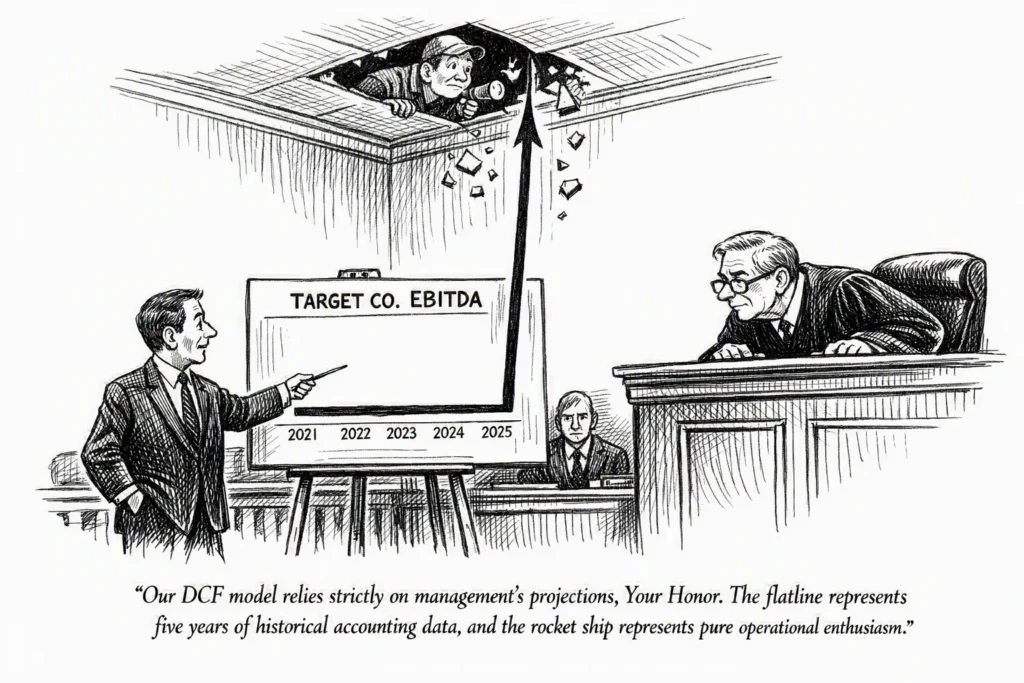
2. Expert Insights | Legal Update: LeVine v. Platzer – Valuation of Intangible Assets Under New York Partnership Law • Michael Molder, CPA/ABV/CFF, ASA, CVA • QuickRead (NACVA)
Article dissects case law LeVine v. Platzer with lessons about the need to value intangibles (even when it’s difficult) and about the “known or knowable” rule.
3. Expert Insights | Understanding the Delta: When 409A Valuations Differ from Funding Rounds • Trisch Garthoeffner, ABV, CVA, MAFF, EA, MAcc • QuickRead (NAVCA)
Article Clarifies When 409A Valuations Differ from Funding Rounds
4. From the Bookshelves | Business Valuation: Fundamentals, Techniques, and Theory (2026 Edition) • National Association of Certified Valuators and Analysts (NACVA)
NACVA Finally Publishes Reference Valuation Book
5. Expert Insights | Follow the Standards When Using AI and Similar Technologies
Using the Tool Does Not Change the Standards – Just Make Sure You Are Following Them
Also Worth Knowing
6. Case Law Watch | ZipBy USA LLC v. Parzych • United States Court of Appeals for the First Circuit
Reasonable Projections Are Defensible Even if Future Events (COVID-19) Completely Change Outcomes—and May Incorporate Credible Strategic Synergies
7. Case Law Watch | Hancock County Land Acquisitions, LLC v. Commissioner • United States Tax Court
Court Rejects a Sophisticated DCF Built on Speculative Assumptions
8. Case Law Watch | Duffield v. Legend Spine, LLC • Superior Court of Pennsylvania
When Internal Transactions Become the Best Indication of Value
9. Expert Insight | Applying the Modern New Business Rule in Real Life: Overview of an Expert’s Testimony in a Precedent-Setting Texas Court Case • Allyn Needham, PhD, CEA • QuickRead (NACVA)
When Startup Projections Become Legally Defensible. Article Dissecting a Precedent-Setting Texas Court Case
10. Case Law Watch | Rogers v. Protein Holdings • Maine Superior Court, Cumberland County
When a Shareholder Agreement Prevails Over a Business Valuation
11. Case Law Watch | In re Allonhill, LLC • United States Court of Appeals for the Third Circuit
Valuing Litigation Liabilities Without the Benefit of Hindsight
12. Case Law Watch | Harman Road Property, LLC v. Commissioner • United States Tax Court
Court Rejects Optimistic Projections
13. Regulatory Enforcement | In the Matter of Madison Capital Funding LLC • United States Securities and Exchange Commission
Fair Value Must Evolve When Markets Change
14. Case Law Watch | Heredia v. Lanco Brokerage Corp. • Supreme Court of the State of New York, New York County
When Corporate Misconduct Affects Value
15. Guidance Update | Global CBV Institute’s Updated Valuation Practice Standards Take Effect • CBV Institute, Valuation Practice Standards
Professional Standards – Canada’s CBV Institute Introduces Formal Quality Review and Stronger Engagement Requirements
18. From the Bookshelf | Yearbook: A Year in Review for Valuation Professionals • Business Valuation Resources (BVR)
Business Valuation Update Yearbook: A Year in Review for Valuation Professionals
19. Expert Insights | Direct Capitalization Methodology and Mid-Period Adjustment to the Capitalization Rate
Keeping Direct Capitalization and DCF Theoretically Consistent
5 Quarterly Highlights - Editor's Choice
1. Expert Insights | Vetting a Client’s Projection: A Process
Article Proposes Process to Determine Whether Client Projections Should Be Included in the Valuation
Edward Mendlowitz, CPA, ABV, CFF • QuickRead (NACVA) • February 25, 2026
Read the original article on NACVA.com
Financial projections are often among the most consequential inputs in a business valuation—and among the most uncertain. In a February 2026 QuickRead article, Edward Mendlowitz, CPA/ABV/CFF, presents a practical process for testing projections before relying on them in a valuation.
His central message is straightforward: if a valuator relies on projections to any extent, the projections must be vetted. The process does not need to become a separate forecasting or rebuttal engagement, but the valuator should perform and document enough work to be satisfied that the projections are reasonable for their intended use.
A Practical Projection-Vetting Process
Mendlowitz’s checklist can be condensed into ten principal tests:
- Purpose and Audience: Why were the projections prepared, for whom, and what are they intended to accomplish?
- Business and Economic Logic: Do the forecasts reflect an adequate understanding of the company’s products, services, competitive strengths, weaknesses, and important intangible assets?
- Organizational Readiness: Does the company have—or can it realistically build—the management structure, staffing, and organizational capabilities needed to execute the plan?
- Growth and Profitability: Are the projected growth, profitability, and ultimate size of the company reasonable in the context of the business?
- Cash Flow and Financing: Can the company finance the projected growth, meet cash needs and debt service, and remain within reasonable leverage and covenant constraints?
- Balance-Sheet Consistency: Are projected receivables, inventory, payables, debt, equity, and working-capital relationships consistent with the projected sales and growth?
- Revenue Mechanics: Where will the sales actually come from—what customers, volumes, prices, order frequency, marketing activity, and collection cycle support the revenue forecast?
- Capacity and Resources: Can the company’s people, facilities, suppliers, inventory, production or service capacity, and quality-control systems support the projected volume?
- Historical Performance: How do the projections compare with three to five years of historical results, financial trends, ratios, and tax returns?
- Related-Party Transactions: Are owner compensation, leases, loans, employment agreements, or other related-party arrangements affecting the projected financial results?
One Additional Test: Management’s Forecasting Track Record
Although not part of Mendlowitz’s checklist, another potentially useful test is to compare management’s previous forecasts with actual results.
A management team with a history of reasonably accurate forecasting provides different evidence from one that has repeatedly projected growth or margin improvements that did not materialize. Prior forecast-to-actual comparisons can help identify persistent optimism, conservatism, or other systematic forecasting biases.
This test should not determine the answer by itself—conditions change, and even reasonable projections can prove wrong—but it can provide useful evidence about the reliability of management’s forecasting process.
Who Is Responsible for the Projections?
Mendlowitz generally prefers not to participate in preparing or modifying management’s projections when serving as the valuator. He distinguishes between preparing a forecast and assessing whether a forecast is reasonable for use in a valuation. His own practice is to avoid participating in projection preparation unless specifically engaged for that purpose.
That distinction should not be interpreted to mean that valuators must always use management projections as presented. In valuation practice, a valuator may rely on management forecasts after appropriate assessment, adjust forecasts based on supportable evidence, develop an independent forecast, use probability-weighted scenarios, or conclude that the available projections are not sufficiently reliable for use in the valuation; which may lead to passing on the engagement.
The important distinction is between authorship and responsibility for reliance. Management may prepare the projections, but the valuator remains responsible for determining whether the projections used in the valuation are reasonable and appropriate for the engagement. As Mendlowitz states, if projections are relied upon “to any extent,” it is incumbent on the valuator to vet them.
Vet, but Do Not Necessarily Rebuild
Mendlowitz also cautions against allowing projection vetting to become an engagement within the engagement. He compares the appropriate level of work to reviewing a valuation report for general reasonableness rather than performing a full rebuttal.
The objective is to identify significant omissions, unsupported assumptions, internal inconsistencies, and disconnects between the forecast and the company’s operating and financial realities. The work should be proportionate to the engagement and documented in the valuator’s files.
Why It Matters
Projections do not become reasonable simply because management prepared them, nor do they become unreasonable simply because actual results later differ from the forecast.
The relevant question is whether the projections were reasonable and supportable based on the information available at the valuation date. A sound review should connect the forecast from beginning to end: market opportunity and customers → revenue → operating capacity → people and facilities → working capital and capital expenditures → financing → cash flow and balance-sheet consistency.
For valuation professionals, the lesson is clear: management may author a forecast, but the valuator is responsible for the decision to rely on it—and for ensuring that the projections used in the valuation have been appropriately tested and supported.
2. Expert Insights | Legal Update: LeVine v. Platzer
Valuation of Intangible Assets Under New York Partnership Law
Michael Molder, CPA/ABV/CFF, ASA, CVA • QuickRead (NACVA) • March 25, 2026
Read the original article on NACVA.com
Underlying case: LeVine v. Platzer, 2025 N.Y. Misc. LEXIS 8520 (N.Y. Sup. Ct., Oct. 17, 2025)
Read the court decision on NYCourts.com
The Case
LeVine v. Platzer involved the judicial valuation of a departing partner’s interest in a New York law firm following its dissolution. The parties’ experts largely agreed on the overall valuation approach but differed significantly in estimating the value of several key assets, particularly accounts receivable (AR), work in progress (WIP), contingent-fee matters, and the firm’s lease. The court ultimately rejected many of the extreme positions advanced by both experts and independently determined the value of the disputed assets.
Determining What Was Being Valued
Before determining value, the court first had to determine what ownership interest the plaintiff actually held.
Because the law firm operated without a comprehensive written partnership agreement governing ownership percentages, the defendants argued that the default provisions of New York Partnership Law §40(1) should apply, effectively limiting the plaintiff to a 25% ownership interest.
The court disagreed. It found that the firm’s long-standing course of conduct—including Schedule K-1 allocations, historical profit distributions, and prior partner separation agreements—demonstrated that the partners had consistently operated under an agreement different from the statutory default. Based on that evidence, the court concluded that the plaintiff owned a 40.362% partnership interest, rather than the 25% interest advocated by the defendants.
Application to Practice
Before valuing an ownership interest, valuators should ensure that the interest being valued has been properly identified. When ownership percentages are disputed, historical tax reporting, profit allocations, prior transactions, and other evidence of the parties’ actual economic relationship may become highly relevant. While the ultimate legal determination rests with the court or counsel, understanding the factual basis for that determination is essential to a well-supported valuation.
The Valuation Lessons
- Difficult-to-Value Assets Should Not Automatically Be Assigned No Value
Perhaps the most important lesson concerns work in progress (WIP) and contingent-fee matters.
One expert concluded that certain contingent-fee cases could not be valued and therefore assigned them no value. The court rejected that conclusion, finding that although precise measurement was difficult, the evidence demonstrated that those matters possessed meaningful economic value. Rather than treating them as worthless, the court estimated their value using information available as of the valuation date together with the firm’s historical experience.
Application to Practice
Valuation uncertainty generally calls for careful estimation—not elimination. When reliable evidence indicates an asset possesses economic value, the challenge is to develop a reasonable methodology rather than defaulting to zero simply because precise measurement is difficult.
- “Known or Knowable” Does Not Mean Ignoring Everything That Happens Later
The court reaffirmed the familiar valuation principle that value must be determined using information known or reasonably knowable as of the valuation date.
At the same time, the court looked to certain subsequent collections as a corroborative “sanity check” when evaluating the competing expert opinions, while emphasizing that later events could not be used to create value that was unknowable on the valuation date.
Application to Practice
Subsequent events generally should not determine value. However, in appropriate circumstances, they may provide corroborative evidence regarding whether assumptions made as of the valuation date were reasonable.
- Courts Are Not Limited to the Experts’ Conclusions
Neither valuation expert fully persuaded the court.
After identifying weaknesses in each methodology, the court independently determined the value of the principal disputed assets. In several instances—including accounts receivable and work in progress—the court arrived at values between the competing expert opinions after concluding that neither methodology fully reflected the evidence.
As the court observed:
“The truth, as is often the case with dueling hired-gun valuation experts, is somewhere in the middle.”
Application to Practice
Courts are not required to accept one expert’s opinion over another’s. Credibility often depends as much on balanced professional judgment as on technical methodology. Experts who acknowledge uncertainty, avoid unsupported extreme positions, and support their conclusions with objective evidence are often more persuasive than those advancing advocacy-driven opinions.
Why It Matters
Although LeVine arose in the context of a partnership dispute, the valuation principles extend well beyond law firms. Business valuators are frequently required to estimate the value of uncertain or difficult-to-measure assets, including work in progress, contingent receivables, customer relationships, intellectual property, earn-outs, and other intangible assets.
The decision reinforces four enduring principles of valuation practice:
- Before determining value, ensure the ownership interest being valued has been correctly identified.
- Uncertainty is not a justification for assigning zero value to an asset that possesses demonstrable economic value.
- Valuation should be based on information known or reasonably knowable as of the valuation date, with subsequent events used cautiously, if at all, only as corroborative evidence.
- Credibility depends as much on balanced, well-supported professional judgment as on sophisticated valuation models.
3. Expert Insights | Understanding the Delta: When 409A Valuations Differ from Funding Rounds
Article Clarifies When 409A Valuations Differ from Funding Rounds
Trisch Garthoeffner, ABV, CVA, MAFF, EA, MAcc • QuickRead (NACVA) • March 4, 2026
Read the original article on NACVA.com
The Structural Disconnect
Founders are often surprised when a recent financing round values preferred shares at $10.00 per share, while a subsequent IRC §409A valuation concludes that common stock is worth only a fraction of that amount.
The article explains that this apparent disconnect is often entirely appropriate because the two analyses are valuing different securities for different purposes. A financing round establishes the price investors are willing to pay for preferred stock, whereas a §409A valuation determines the Fair Market Value of common stock for equity compensation purposes.
Preferred shares typically include rights that common stock does not, including:
- Liquidation preferences;
- Conversion rights;
- Dividend rights;
- Anti-dilution protections; and
- Participation rights.
Because preferred investors generally recover value first in downside scenarios, common stock often warrants a lower value. Valuators therefore allocate enterprise value among the various classes of equity using methodologies such as the Option Pricing Method (OPM), Probability-Weighted Expected Return Method (PWERM), or Hybrid Methods, reflecting the rights and risks associated with each class of stock.
Why the Gap Can Be Significant
According to the author, several factors may widen the difference between preferred-share pricing and common-stock Fair Market Value:
- aggressive fundraising valuations driven by investor demand;
- early-stage business risk and uncertainty;
- structural preferences embedded in preferred stock;
- discounts for lack of marketability (DLOM); and
- changes in company performance or market conditions between the financing round and the valuation date.
When the Gap Becomes a Red Flag
While differences between a financing price and a §409A valuation are normal, the article notes that extreme discrepancies deserve closer scrutiny. Examples include:
- a §409A value higher than the recent preferred-stock price without a clear explanation;
- a valuation that ignores material financing terms;
- a significant deterioration in company performance after the financing round that is not reflected in the valuation; and
- mechanically adopting the financing-round price without allocating enterprise value among the various equity classes.
The author also reminds practitioners that secondary transactions, crowdfunding offerings, and similar market transactions should be treated as evidence—not proof—of Fair Market Value. Before relying on them, the valuator should evaluate the type of security traded, investor sophistication, transaction size, information asymmetry, and whether the transaction represents an orderly, arm’s-length market.
Why It Matters
A recent financing round does not automatically establish the Fair Market Value of every class of equity. The valuator’s responsibility is to understand the company’s capital structure, financing terms, rights associated with each security, and valuation date, then apply an appropriate allocation methodology to estimate the value of the specific security being appraised.
The article reinforces an important valuation principle: a difference between preferred-share pricing and common-stock Fair Market Value is often evidence that the valuation is properly reflecting the economic rights, risks, and priorities embedded in the capital structure—not evidence that one of the two values is necessarily incorrect.
4. From the Bookshelves | Business Valuation: Fundamentals, Techniques, and Theory (2026 Edition)
NACVA Finally Publishes Reference Valuation Book
National Association of Certified Valuators and Analysts (NACVA) • March 2026
For decades, NACVA’s Business Valuation Certification Training Center (BVTC) has relied on its Fundamentals, Techniques and Theory curriculum to train Certified Valuation Analysts (CVAs). In Q1 2026, NACVA and Wiley transformed and substantially expanded that curriculum into Business Valuation: Fundamentals, Techniques, and Theory, making it available for the first time as a comprehensive hardcover reference for the broader valuation profession.
One noteworthy emphasis in the new edition is the Valuation Process Pyramid, which NACVA now presents as the conceptual framework for the valuation engagement. Although the Pyramid has long appeared in NACVA training materials, the new text places greater emphasis on valuation as an iterative process rather than a simple sequence of independent steps. As assumptions regarding normalized earnings, projected cash flows, discount rates, comparable companies, or discounts evolve during an engagement, earlier conclusions may need to be revisited before arriving at a final opinion of value. This reflects the reality that developing a credible valuation often requires continual refinement rather than a single pass through a checklist.
Practical Takeaways
The book reinforces several themes that are increasingly evident in valuation practice:
- Professional judgment is as important as technical methodology.
- Every significant assumption should be supported and internally consistent.
- The various components of a valuation—normalization adjustments, projections, discount rates, valuation methods, and discounts—should be evaluated as an integrated whole rather than in isolation.
- Compliance with professional standards remains fundamental throughout the engagement.
Why It Matters
For NACVA members, the publication serves as the Association’s most current and comprehensive reference on business valuation methodology. Even for professionals credentialed through other organizations, it provides a valuable overview of NACVA’s current thinking on valuation development and reporting. The renewed emphasis on an iterative, process-oriented approach is a useful reminder that high-quality valuations are rarely produced by mechanically applying formulas; they result from disciplined analysis, continual reassessment, and sound professional judgment.
5. Expert Insights | Follow the Standards When Using AI and Similar Technologies
Using the Tool Does Not Change the Standards – Just Make sure You Are Following Them
James D. Ewart, CPA, ABV, CFF, CVA • NACVA Association News • March 11, 2026
Read the original article on NACVA.com
AI and Professional Standards
As artificial intelligence becomes increasingly integrated into business valuation practice, many professionals have wondered whether new valuation standards governing AI are needed.
In this article, James D. Ewart—writing as a member of NACVA’s Ethics Oversight Board—explains that new AI-specific valuation standards do not appear to be necessary. Instead, the use of AI should be governed by the same Professional Standards and ethical principles that already apply to every valuation engagement. The article reflects NACVA’s broader effort to help practitioners integrate AI into their practices while continuing to comply with existing professional obligations.
The message is not “don’t use AI.” Rather, it is “use AI—but continue to follow the standards.”
Where AI Can Assist Valuation Professionals
The article recognizes that AI can improve efficiency throughout the valuation process, including:
- legal and technical research;
- reviewing professional literature;
- summarizing financial information;
- identifying comparable companies or transactions;
- assisting with financial modeling and analysis;
- drafting portions of valuation reports; and
- improving administrative and analytical workflows.
Used appropriately, AI can significantly improve productivity without changing the valuator’s professional responsibilities.
Professional Responsibilities Do Not Change
The article emphasizes that the use of AI does not reduce the valuator’s responsibility to comply with existing Professional Standards. Among the key responsibilities that remain with the valuator are:
- Competency and Verification: Independently evaluate and verify AI-generated information, calculations, assumptions, and conclusions rather than accepting them at face value.
- Professional Judgment: Select appropriate valuation approaches, methods, assumptions, and conclusions based on the facts and circumstances of the engagement.
- Confidentiality: Protect confidential client information when using AI-enabled applications and understand how client data may be processed or stored.
- Documentation: Maintain sufficient workpaper documentation to support the valuation conclusions and the analyses performed, regardless of whether AI assisted in preparing portions of the work.
- Ultimate Responsibility: The valuator—not the software—remains fully responsible for the final valuation opinion.
To reinforce this point, the author presents an intentionally extreme example of an AI-generated valuation conclusion that is clearly unreasonable. The lesson is that technology itself is not the problem; failure to exercise independent professional judgment is.
Why It Matters
Artificial intelligence is rapidly becoming another tool available to valuation professionals. This article provides one of NACVA’s earliest discussions of how existing Professional Standards apply to AI-assisted valuation work.
The practical message is straightforward: AI can improve efficiency, but it cannot replace professional judgment. Valuators may appropriately use AI throughout much of the engagement process, provided they continue to exercise professional skepticism, verify important information, protect confidential client data, maintain adequate documentation, and accept full responsibility for the valuation conclusion.
Also Worth Knowing
6. Case Law Watch | ZipBy USA LLC v. Parzych
Reasonable Projections Are Defensible Even if Future Events (COVID-19) Completely Change Outcomes—and May Incorporate Credible Strategic Synergies
ZipBy USA LLC v. Parzych, 2026 U.S. App. LEXIS 8326 (1st Cir.) • March 19, 2026
Read the court decision on justia.com
Although ZipBy offers lessons relevant to valuation professionals, it was not a business valuation case. Rather, it was a lost-profits damages case arising from an alleged usurpation of a corporate opportunity. The dispute focused on whether ZipBy suffered economic damages after an acquisition opportunity involving another company (TCS) was allegedly diverted away from the business.
The Court’s Analysis
A central issue was a Daubert/Rule 702 challenge to the plaintiff’s damages expert. The defendant argued that the expert’s lost-profits analysis was unreliable because it relied on projections that later proved overly optimistic when compared to the target company’s actual performance, particularly following the disruptions caused by COVID-19. The First Circuit rejected that challenge and allowed the opinion to stand.
Valuation Lessons
- Reasonable Projections Do Not Become Invalid Simply Because Later Events Produce Different Results
The defendant emphasized that actual performance ultimately fell well short of the projections used in the damages analysis. The court nevertheless concluded that the relevant question was whether the projections were reasonably supported when they were prepared, not whether subsequent events later proved them inaccurate. The fact that later developments—including extraordinary events—produced materially different outcomes did not automatically render the projections unreliable or inadmissible.
Application to Practice: Forecasts used in valuations and damages analyses should be judged based on the information available when they were developed. Later events may prove a forecast wrong without proving it was unreasonable.
- “Known or Knowable” Information Remains the Proper Reference Point
The court’s reasoning was consistent with a familiar valuation principle: assumptions should be evaluated based on information known or reasonably knowable at the relevant time. The court declined to treat subsequent performance as conclusive evidence that the underlying forecasts were improper.
Application to Practice: Whether evaluating a DCF model, management forecast, or lost-profits calculation, practitioners should focus on what information was available at the valuation date rather than allowing hindsight to drive the analysis.
- Historical Standalone Performance Is Not Always the Appropriate Benchmark
The defendant also argued that the expert’s projections were unrealistic because they exceeded the target company’s historical standalone results. The First Circuit disagreed, stating:
“There is no logical reason why TCS’s financial contribution to ZipBy, if ZipBy had acquired it, would have equaled only TCS’s actual performance as a standalone company.”
The court further noted evidence that one purpose of the acquisition was to exploit synergies between the companies and thereby strengthen their market position. As a result, the expert was permitted to model a “but-for” world that reflected anticipated integration benefits rather than simply extrapolating historical standalone performance.
Application to Practice: In damages analyses involving acquisitions or strategic transactions, historical standalone performance may not always represent the upper limit of expected results where credible evidence supports operational synergies or integration benefits.
Why It Matters
While ZipBy is fundamentally an economic damages case, it offers useful guidance for valuation professionals who rely on management forecasts, discounted cash flow analyses, or other forward-looking models. The decision reinforces three practical principles: (1) reasonable projections should be evaluated based on the information available when they were prepared, (2) subsequent events do not automatically invalidate an otherwise supportable forecast, and (3) in appropriate circumstances, future performance may reflect expected strategic benefits rather than merely continuing historical standalone results. Together, these principles provide support for the careful use—and defense—of forecast-based analyses in both valuation and damages engagements.
7. Case Law Watch | Hancock County Land Acquisitions, LLC v. Commissioner • Court Here
Court Rejects a Sophisticated DCF Built on Speculative Assumptions
Hancock County Land Acquisitions, LLC v. Commissioner, T.C. Memo. 2026-28 (U.S. Tax Court) • March 26, 2026
Read the court decision on leagle.com
The Case
The case involved the appraisal of a 236-acre tract of vacant land contributed as a conservation easement for purposes of claiming a charitable contribution deduction. The taxpayer’s appraiser concluded that the property’s Highest and Best Use (HBU) was as a future frac sand mining operation and estimated its value using a multi-year Discounted Cash Flow (DCF) model under the Income Approach. The IRS disagreed, contending that both the proposed highest and best use and the projected income stream were highly speculative.
The Tax Court agreed with the IRS, concluding that the appraisal rested on assumptions that were not adequately supported as of the valuation date.
Four Practical Valuation Lessons
- Highest and Best Use Must Be Financially Feasible
The court emphasized that an alternative highest and best use must satisfy the traditional appraisal tests, including financial feasibility. Given the depressed market for frac sand at the valuation date, the court found that the proposed mining operation was not shown to be a reasonably probable or financially feasible use of the property.
- A Sophisticated DCF Cannot Rescue Weak Assumptions
The taxpayer presented an extensive discounted cash flow model projecting future mining royalties. The court looked beyond the mathematics of the model and focused instead on whether its underlying assumptions were supported by objective evidence. It concluded they were not.
- Not Every Transaction Establishes Fair Market Value
The taxpayer also argued that the price investors paid to acquire interests in the partnership supported the claimed value. The court rejected that argument, observing that investors were purchasing a syndicated conservation easement structure and its associated tax benefits—not simply the underlying real estate. Those transactions therefore did not establish the property’s fair market value.
- Comparable Sales Ultimately Carried Greater Weight
Having rejected the speculative income projections, the court relied primarily on comparable sales of similar properties to determine the property’s value, illustrating that observable market evidence may provide a more reliable indication of value when future income depends on uncertain development assumptions.
Why It Matters
Although this is a real estate appraisal case, its lessons extend directly to business valuation. Whether applying an Income Approach to a business, a new product line, a real estate development, or a mineral property, the quality of the valuation depends less on the sophistication of the financial model than on the credibility of its underlying assumptions. A well-constructed DCF cannot compensate for projections that are not reasonably probable and objectively supportable as of the valuation date.
P.S. – Highest and Best Use (HBU)
In real estate appraisal, Highest and Best Use is the reasonably probable use of a property that is legally permissible, physically possible, financially feasible, and maximally productive. Only after these four tests are satisfied should an appraiser determine the property’s value under that use. Although business valuation does not formally apply the HBU doctrine, the underlying principle is remarkably similar: projected cash flows should reflect opportunities that are reasonably achievable—not merely conceivable.
8. Case Law Watch | Duffield v. Legend Spine, LLC
When Internal Transactions Become the Best Indication of Value
Duffield v. Legend Spine, LLC, 3023 EDA 2024 (Pa. Super. Ct.) • March 11, 2026
Read the court decision on Justia.com
The Case
Duffield arose from a shareholder-oppression and fiduciary-duty dispute involving a closely held medical-device company. After the plaintiff was expelled from the company, litigation followed concerning the value of his ownership interest and the damages resulting from the alleged freeze-out. The court ultimately upheld a multimillion-dollar damages award supported by valuation testimony.
The Valuation Lessons
- Recent Transactions in the Company’s Own Equity May Provide Powerful Market Evidence
The plaintiff’s valuation expert considered all three traditional valuation approaches but concluded that the Market Approach was most appropriate under the circumstances. The court noted that multiple transactions involving the company’s own equity had occurred around the valuation date at approximately $15,000 per unit, and that a business plan prepared by the company’s CEO for prospective investors reflected a similar valuation metric.
Application to Practice: In closely held companies where guideline-company data may be limited or unreliable, recent arm’s-length transactions involving the subject company’s own equity can provide compelling evidence of value.
- Challenges to an Expert’s Conclusions Often Go to Weight Rather Than Admissibility
The defendants sought to undermine the plaintiff’s valuation expert by attacking his methodology and conclusions. The court upheld the testimony, emphasizing that the expert explained his valuation approach, considered accepted methodologies, referenced valuation literature, and supported his conclusions with market evidence. Significantly, the defendants did not present a competing valuation expert. The court concluded that criticisms of the expert’s methods and conclusions primarily affected the weight of the testimony rather than its admissibility.
Application to Practice: Courts generally expect valuation disagreements to be tested through cross-examination and competing expert evidence. When a valuation expert applies recognized methods and adequately supports the analysis, unsupported criticism may be less persuasive than a well-developed rebuttal opinion.
- Insider Conduct May Affect Valuation Conclusions
Much of the litigation focused on allegations that company insiders increased compensation, prioritized personal interests, and failed to pursue business opportunities after the minority owner was removed. The court viewed this conduct as relevant to the underlying fiduciary-duty and oppression claims.
Application to Practice: Although the valuation itself did not turn on normalization adjustments, the case reminds valuators to carefully evaluate whether excessive compensation, related-party transactions, or other insider conduct has distorted the company’s reported earnings or economic performance.
Why It Matters
Duffield is a useful reminder that valuation disputes often occur within broader shareholder and fiduciary-duty conflicts. For valuation professionals, the decision reinforces three practical points: reliable market evidence can come from a company’s own transactions, courts frequently distinguish between attacks on an expert’s conclusions and attacks on admissibility, and a thorough understanding of management conduct may be critical when valuing interests in closely held companies. Just as importantly, the case illustrates the practical value of presenting a supported valuation opinion: while the defendants criticized the plaintiff’s expert, they offered no competing valuation evidence of their own.
9. Expert Insight | Applying the Modern New Business Rule in Real Life: Overview of an Expert’s Testimony in a Precedent-Setting Texas Court Case
When Startup Projections Become Legally Defensible. Article Dissecting a Precedent-Setting Texas Court Case.
Allyn Needham, PhD, CEA • QuickRead (NACVA) • February 25, 2026
Read the original article on NACVA.com
The Modern New Business Rule: From Rule of Law to Rule of Evidence
Historically, under the traditional New Business Rule, startup or newly established businesses were generally barred from recovering lost profits because, without an operating history, projected earnings were considered inherently speculative.
The article explains how many courts have moved away from that rigid approach. Under the Modern New Business Rule, the absence of an operating history no longer automatically precludes recovery. Instead, the issue becomes one of evidence: can the expert demonstrate lost profits with reasonable certainty?
To recover lost profits, the plaintiff must generally establish:
- Proximate cause;
- Foreseeability; and
- Reasonable certainty of the claimed damages.
The article is therefore less about valuing startup companies than about demonstrating that a startup’s projections are sufficiently reliable to support an expert opinion.
A Practical Framework for Supporting Startup Projections
Because a startup lacks historical operating results, projections receive greater judicial scrutiny. In the Texas Business Court case discussed, the expert supported his conclusions using nine categories of objective evidence, which can be organized into three practical themes.
Pillar 1 – Industry Validation (The Macro Environment)
Before evaluating the company itself, the expert demonstrated that the underlying industries were healthy and expected to continue growing by relying on independent third-party research.
Evidence included:
- historical performance of the cold-storage industry;
- historical performance of the pet-food processing industry; and
- projected future growth for both industries.
Newsletter Insight: Startup projections become significantly more persuasive when they are anchored to independent industry research rather than management optimism alone.
Pillar 2 – Management Capability (The Human Element)
The expert then addressed whether the individuals behind the venture had the qualifications necessary to execute the business plan.
Evidence included:
- management’s education, technical expertise, and industry experience; and
- established industry relationships expected to facilitate customer acquisition and operational success.
Pillar 3 – Operational Readiness (Execution Capability)
Finally, the expert demonstrated that the business was positioned to begin operations rather than merely representing an undeveloped concept.
Evidence included:
- readiness of the planned facilities and equipment;
- strategic geographic advantages; and
- measurable unmet market demand supporting the proposed operation.
Together, these three pillars transformed the projections from a speculative business plan into an opinion supported by objective evidence.
Surviving the Robinson (Daubert) Challenge
An important aspect of the case is that it became one of the first expert-admissibility decisions issued by the newly created Texas Business Court.
The defendant challenged the expert’s testimony under the Robinson standard—Texas’ counterpart to the federal Daubert standard—arguing that projected profits for a business that never commenced operations were inherently speculative.
The court denied the motion to exclude. Rather than relying solely on management’s expectations, the expert supported the projections through independent market research, industry data, operational evidence, and accepted economic methodologies. The court concluded that disagreements with the assumptions affected the weight of the testimony—not its admissibility.
Why It Matters
Although written in the context of lost-profit litigation, the article provides valuable guidance for business valuation professionals.
Early-stage businesses often lack the historical operating results that normally support an income approach. This case demonstrates that the absence of operating history does not automatically invalidate projected cash flows. Instead, the focus shifts to whether the projections are supported by objective evidence, including industry conditions, management capability, operational readiness, and demonstrated market demand.
The article also complements Edward Mendlowitz’s recent discussion on vetting projections. Together, the two articles reinforce an important principle for valuation professionals:
The quality of a projection depends less on whether it ultimately proves correct than on whether it was reasonable, well-supported, and appropriately documented based on the information available at the valuation date.
P.S. – What Is the Modern New Business Rule?
The Modern New Business Rule is not a statute but a judge-made common-law doctrine that has evolved through judicial decisions across the United States. Historically, many courts followed the traditional New Business Rule, under which new or unestablished businesses were generally barred from recovering lost profits because their projections were considered inherently speculative. One of the landmark decisions marking the shift away from that rule was Fera v. Village Plaza, Inc., 396 Mich. 639 (1976), in which the Michigan Supreme Court held that a business’s lack of operating history does not automatically preclude recovery if lost profits can be established with reasonable certainty. Today, most jurisdictions—including Texas—follow this modern approach. The Texas Business Court case discussed in this article illustrates the doctrine rather than creating it, demonstrating how objective evidence—such as industry research, management qualifications, operational readiness, and market demand—can support otherwise untested startup projections.
10. Case Law Watch | Rogers v. Protein Holdings
When a Shareholder Agreement Prevails Over a Business Valuation
Rogers v. Protein Holdings, No. CUMCV-24-09 (Me. Bus. & Consumer Ct.) • February 24, 2026
Read the court decision on Maine.edu
Context of the Dispute
This litigation arose following the death of a shareholder in a closely held ice cream manufacturing corporation, sparking a dispute between the estate and the surviving owners over the contract’s buyout provision. Structurally, this was not a pure business valuation proceeding but rather a contract construction case centered on an ambiguous shareholder agreement.
The agreement explicitly mandated a buyout based on a contractually defined “Buyout Value,” instructing the board to calculate the “fair market value” of the company’s underlying assets and liabilities. The estate introduced a comprehensive appraisal by a credentialed forensic valuator who concluded that the open-market fair market value of the shares was $6.58 million—an analysis the court found no fault with. In contrast, the company calculated the buyout at $3.64 million using a rigid internal spreadsheet formula the board had relied upon for years.
The Core Valuation Lesson
The Business and Consumer Court of Maine entered judgment adopting the lower formulaic value over the professional appraisal, revealing a critical legal gate for practitioners:
- The Ambiguity Tie-Breaker: The court ruled that broad terms like “fair market value” within the context of the agreement’s asset formula were legally ambiguous. However, the court completely sidelined the expert’s standard-compliant appraisal because the shareholders had historically scrutinized and approved the exact internal spreadsheet formula year after year.
- The Weight of Shareholder Scrutiny: Because the sophisticated owners repeatedly reviewed, adjusted, and signed off on the board’s specific financial calculations at annual meetings, they established an unambiguous “course of performance.” The court ruled that this explicit history of joint operational intent legally bound the parties to the subjective definition, rendering an objective open-market appraisal irrelevant.
- The Unresolved Vacuum: Notably, the ruling suggests that if the shareholders had historically neglected the agreement and failed to regularly review or calculate the formula, the court could have lacked evidence of a specific, shared intent. It’s not clear from this case that, in such a scenario, the Shareholder Agreement formula would have prevailed.
Why It Matters
Rogers delivers a sharp warning: an expert’s technically perfect appraisal will be cast aside by the court if it conflicts with the historical course of conduct and formulaic metrics established by a board.
For business owners and corporate counsel, it highlights the immense risk of pasting generic boilerplate phrases like “fair market value” into buy-sell agreements without clearly defining the calculation framework. To prevent these expensive legal traps, a qualified business valuation professional should be engaged during the drafting or updating of shareholder agreements. A valuation expert can pressure-test the text, helping you construct an unambiguous formula that properly accounts for future events and economic changes before a triggering event forces the parties into court.
11. Case Law Watch | In re Allonhill, LLC
Valuing Litigation Liabilities Without the Benefit of Hindsight
In re Allonhill, LLC, No. 25-1810 (3d Cir.) • March 16, 2026
Context of the Dispute
This matter arose from a bankruptcy preference action under 11 U.S.C. § 547(b), requiring the court to determine whether the debtor was insolvent when approximately $6.6 million was transferred to a creditor. The principal valuation battle centered on how a large, pending lawsuit against the debtor should be measured for the Bankruptcy Code’s balance-sheet solvency test.
The bankruptcy estate argued that the liability should reflect a $25.9 million trial judgment entered shortly after the transfer date. Conversely, the defense relied primarily on a much smaller, ultimate settlement amount achieved years later after a series of successful appeals. The Third Circuit held that the liability must be fairly valued strictly as of the transfer date, based on information known or reasonably knowable at that time, rather than being retroactively calculated using the clarity of hindsight.
Practical Valuation Lessons
- Solvency Requires Contemporaneous Valuation: Assets and liabilities must be measured based entirely on the economic conditions and risk parameters existing at the precise valuation date—not based on how events ultimately unfolded.
- Disputed Claims Differ from Contingent Claims: The court drew a critical line distinguishing liabilities arising from events that had already occurred (disputed claims, where only the final amount or legal enforceability remains uncertain) from liabilities dependent on future triggering events that have not yet occurred (contingent claims). This distinction changes how an appraiser must structurally approach and probability-weight the exposure.
- Subsequent Events are Evidence, Not Edicts: Later judgments, appeals, or settlements should be approached with extreme caution. They can provide useful evidence of what knowledgeable market participants could reasonably have expected at the valuation date, but they cannot simply step in and replace a contemporaneous valuation model.
Why It Matters for Valuation Practice
Business valuators frequently encounter contingent or disputed liabilities when executing solvency opinions, litigation support, financial reporting, and transaction advisory engagements. Allonhill serves as a stark warning that legal claims must be valued based on their expected economic impact and probability matrix as of the valuation date, rather than simply dropping in the amount eventually recovered or paid after years of litigation.
When you find yourself dealing with uncertain legal exposures in an engagement, it is crucial to avoid the comfortable trap of hindsight. A credentialed business valuation professional can help you structure an expected-value framework that respects the known-and-knowable principle. By meticulously analyzing the contemporaneous data—and framing later events as corroborative evidence rather than absolute answers—a qualified appraiser will ensure your models survive intense judicial scrutiny.
P.S. – The Hindsight Coin: Allonhill vs. LeVine This decision pairs perfectly with LeVine v. Platzer to create a comprehensive understanding of subsequent-event jurisprudence. While LeVine asks when subsequent events can be legitimately used to corroborate a valuation, Allonhill defines where those events cross the line into improper hindsight. Together, they outline the precise boundaries of the known-or-knowable standard for modern valuation practice.
P.P.S. – Contingent vs. Disputed Liabilities
A contingent liability depends on a future event that has not yet occurred (for example, a guarantee that has not yet been triggered). A disputed liability arises from events that have already occurred, but whose amount or legal enforceability remains uncertain. Allonhill demonstrates that this distinction can significantly influence how liabilities are measured in bankruptcy solvency analyses and, more broadly, in business valuation engagements involving uncertain legal exposures.
12. Case Law Watch | Harman Road Property, LLC v. Commissioner
Court Rejects Optimistic Projections
Harman Road Property, LLC v. Commissioner, T.C. Memo. 2026-23 (U.S. Tax Court) •
March 2, 2026
Read the court decision on casemine.com
The Case
The case involved the appraisal of agricultural land contributed to charity. The taxpayers’ appraiser concluded that the property’s Highest and Best Use was as a future limestone quarry and estimated its value using an Income (Royalty) Approach based on projected quarrying income. The IRS’s appraiser instead concluded that the property’s highest and best use remained agricultural and relied principally on the Market (Sales Comparison) Approach.
The Tax Court agreed with the IRS, finding that the projected royalty income depended on a quarry operation that was not reasonably probable as of the valuation date. Among other things:
- no mining or quarry permits had been obtained;
- no permit applications had been filed;
- no geological testing had established commercially recoverable mineral reserves;
- no quarry operations existed; and
- there was no objective evidence that quarry development was reasonably likely.
Because the projected income stream depended on assumptions that had not yet become reasonably probable, the court rejected the Income Approach.
Application to Valuation Practice
Although this is a real estate appraisal case, the underlying principle applies equally to business valuation. The Income Approach should reflect realistic, supportable expectations—not hypothetical opportunities. Before projecting future cash flows from a new product, market, facility, business line, or expansion, valuators should ask whether there is objective evidence that the opportunity was reasonably probable as of the valuation date. Optimistic scenarios alone do not create value.
Business valuators also frequently rely on real estate appraisals when valuing companies that own investment or operating real estate. Understanding the appraisal principles underlying those reports can therefore be just as important as understanding the valuation of the business itself.
Why It Matters
The decision reinforces a principle that extends well beyond real estate: credible projections must be grounded in objective evidence—not merely in future possibilities. Whether valuing a parcel of land, a startup, or an established business pursuing a new opportunity, future income should be based on conditions that are reasonably probable as of the valuation date, not on assumptions that remain speculative.
P.S. – Highest and Best Use (HBU)
In real estate appraisal, Highest and Best Use is the reasonably probable use of a property that is legally permissible, physically possible, financially feasible, and maximally productive. These four tests must all be satisfied. In Harman Road, the proposed quarry operation failed that standard because there were no permits, no permit applications, no geological confirmation of commercially recoverable reserves, and no evidence that quarry development was reasonably probable. Under those circumstances, the court concluded that the Market (Sales Comparison) Approach, based on the property’s existing agricultural use, provided a more credible indication of value than an Income Approach built on speculative future quarry operations.
P.P.S. – Harman Road and Hancock County: Two Applications of the Same Principle
Harman Road and Hancock County Land Acquisitions reinforce the same fundamental valuation principle from different perspectives. In Harman Road, the court rejected an Income Approach because the projected quarry operation was not reasonably probable as of the valuation date. In Hancock County, the court went a step further, emphasizing that even a sophisticated discounted cash flow model cannot overcome unsupported assumptions and that an alternative Highest and Best Use must first satisfy the traditional tests of legal permissibility, physical possibility, financial feasibility, and maximum productivity. Together, the cases remind valuation professionals that the credibility of an Income Approach depends less on the complexity of the model than on the objective support for its underlying assumptions.
13. Regulatory Enforcement | In the Matter of Madison Capital Funding LLC
Fair Value Must Evolve When Markets Change
In the Matter of Madison Capital Funding LLC, Investment Advisers Act Release No. 6948 (SEC) • February 25, 2026
Read the SEC decision on sec.gov
The Matter
The SEC settled an enforcement action against Madison Capital Funding LLC after finding that the adviser transferred recently originated loans from its own balance sheet into affiliated private funds using a long-standing pricing policy of par value less unamortized loan fees. During the market disruption caused by the onset of the COVID-19 pandemic, however, the adviser continued applying that formula without adequately determining whether it still reflected fair value under prevailing market conditions.
Although the loans had been originated only weeks earlier, the SEC concluded that the adviser failed to perform a sufficient fair value analysis before certifying that the transfers occurred at fair value.
Practical Valuation Lessons
- Fair value is a dynamic measurement.
Pricing conventions that work during stable markets may become unreliable when interest rates, credit spreads, liquidity, or other market conditions change materially. - Third-party approval does not replace valuation responsibility.
Although an independent review agent approved the conflicted transactions, the SEC concluded that responsibility for determining fair value remained with the investment adviser. - Credit analysis is not the same as valuation.
Confirming that a loan’s credit quality has not deteriorated does not establish that its market value remains unchanged. Fair value requires an assessment of current market conditions, not simply borrower performance.
Why It Matters
While this enforcement action involved private credit funds, its lessons extend well beyond investment management. Business valuators frequently encounter recent transaction prices, historical acquisition costs, financing rounds, or prior appraisals that appear to provide strong evidence of value. Madison Capital serves as a reminder that fair value is measured as of the valuation date. When market conditions change materially, valuators should reassess whether prior pricing evidence continues to reflect what knowledgeable market participants would pay today.
P.S. – Fair Value Is Not a Formula
Valuation policies, pricing conventions, and recent transaction prices can provide useful evidence of value, but they should not be applied mechanically. Fair value is inherently market-based and date-specific. When economic conditions change significantly, professional judgment—not formulaic consistency—becomes the key determinant of a credible valuation.
14. Case Law Wach | Heredia v. Lanco Brokerage Corp
When Corporate Misconduct Affects Value
Heredia v. Lanco Brokerage Corp., 2026 NY Slip Op 50085(U) (N.Y. Sup. Ct., N.Y. County) • January 23, 2026
The Case
Following the death of a 50% shareholder of an insurance brokerage, her husband inherited the shares and petitioned the court for judicial dissolution, alleging shareholder oppression, corporate waste, self-dealing, and denial of access to the company’s books and records. Rather than dissolve the corporation, the remaining shareholders exercised their statutory right under New York Business Corporation Law §1118 to purchase the Estate’s shares through a statutory buyout, requiring the court to determine their Fair Value. The court ordered a Fair Value determination and held that the allegations of corporate waste and self-dealing were sufficiently intertwined with the valuation process to warrant discovery and consideration during the valuation proceeding.
Application to Valuation Practice
Although the decision does not address valuation methodology directly, it highlights an important practical point. Before determining Fair Value, the valuator should consider whether the company’s reported earnings reflect normal operations. If supported by the evidence, appropriate normalization adjustments may include excessive owner compensation, payments to related parties, personal expenses charged to the business, non-arm’s-length transactions, diversion of corporate opportunities or revenues, or other expenditures inconsistent with the company’s ordinary economic operations.
Why It Matters
The case reminds valuation professionals that, in statutory buyouts, determining Fair Value may require more than applying valuation techniques—it may first require determining whether the underlying financial statements fairly reflect the economics of the business. Allegations of corporate waste, self-dealing, or other oppressive conduct may therefore become integral to the valuation engagement itself.
P.S. – Fair Value vs. Fair Market Value
New York statutory buyouts are governed by the Fair Value standard rather than Fair Market Value. Unlike Fair Market Value, Fair Value has been developed primarily through case law, including Matter of Blake (1985), Matter of Seagroatt Floral Co. (1991), Matter of Friedman v. Beway Realty Corp. (1995), Matter of Murphy (1998), Zelouf International Corp. v. Zelouf (2014), and Rosenblum v. Treitler (2025). Although there is no single statutory definition, Fair Value can be described as the court’s determination of a shareholder’s proportionate interest in the value of a going concern, applying equitable principles rather than assuming a hypothetical open-market sale. Consequently, New York courts generally do not apply minority discounts (DLOCs), although marketability discounts (DLOMs) may be appropriate depending on the facts and applicable case law.
15. Guidance Update | Global CBV Institute’s Updated Valuation Practice Standards Take Effect
Professional Standards – Canada's CBV Institute Introduces Formal Quality Review and Stronger Engagement Requirements
CBV Institute, Valuation Practice Standards (Effective January 1, 2026)
Read the original article on BVWire
See the CBV Institute Practice Standards on cbvinstitute.com
A Different Direction Worth Watching
Effective January 1, 2026, Canada’s CBV Institute implemented a comprehensive revision of its Valuation Practice Standards. Although these standards apply only to Canadian Chartered Business Valuators (CBVs), they are noteworthy because several of the revisions go beyond what is currently required under NACVA, AICPA (SSVS), ASA, or USPAP.
Noteworthy Differences from Current U.S. Standards
Among the more interesting developments are:
- Formal Quality Review. The revised standards introduce a formal engagement quality review process before issuance of valuation reports. The review is intended to assess whether the engagement complies with the Practice Standards, whether significant judgments are adequately supported, and whether the report is appropriate for issuance. It is not a second valuation or an independent opinion of value, but a structured review of the engagement’s quality and professional compliance.
- Independent Corroboration. The new foundational Practice Standard No. 100 expressly requires independent corroboration of significant relevant information as part of the scope of work. While corroboration is certainly good valuation practice under U.S. standards, the Canadian standards articulate this expectation more explicitly.
- Greater Emphasis on Scope of Work. The standards place increased emphasis on tailoring the scope of work to the engagement’s purpose and intended users, reinforcing that the extent of review, inquiry, analysis, and corroboration should reflect the nature of the assignment.
- More Robust Calculation Engagements. Even Calculation-level conclusions are expected to include sufficient support for significant assumptions and appropriate consideration of company, industry, and economic factors.
Gato Consulting’s Perspective
One aspect of the revised standards deserves particular attention: the formalization of a quality review process. Although no comparable requirement currently exists under NACVA, AICPA, ASA, or USPAP, Gato Consulting adopted an independent Quality Control and Peer Review Policy in 2026. Under that policy, significant valuation judgments are reviewed independently before report issuance, with emphasis on professional judgment, technical support, consistency, and compliance with applicable valuation standards. While the Canadian standards require an engagement quality review, Gato Consulting’s peer review is designed as an independent technical review focused specifically on the reasonableness of significant valuation judgments.
Why It Matters
These revisions do not directly affect U.S. valuation engagements, but they provide insight into the direction one major valuation organization believes the profession is heading. Increased emphasis on quality review, independent corroboration, documented scope of work, and support for significant assumptions may influence future discussions among other valuation organizations, including NACVA, the AICPA, the ASA, and the broader international valuation community
16. Expert Insights | What Today's RIA M&A Headlines Tell Us About Valuation (and Succession)
RIA M&A and Valuation
Brooks K. Hamner, CFA, ASA • RIA Valuation Insights Blog (Mercer Capital) • March 12, 2026
Read the original article on mercercapital.com
Beyond the Headline Multiple
Recent RIA acquisitions often make headlines by announcing impressive Assets Under Management (AUM) figures and attractive valuation multiples. Brooks Hamner argues, however, that sophisticated buyers look well beyond these metrics. Today’s transactions increasingly allocate risk through earnouts, equity rollovers, seller notes, and retention incentives, meaning that a firm receiving a premium headline multiple may ultimately realize less value than another with a lower multiple but a cleaner transaction structure.
Five Trends Shaping RIA Valuations
The article identifies several trends that are increasingly influencing valuations in the wealth management industry:
- Growth quality matters more than growth alone. Buyers distinguish between firms growing through market appreciation and those consistently generating organic net new assets, recurring revenue, and diversified client relationships. The latter generally command stronger valuations.
- Succession is no longer a binary decision. Rather than choosing only between selling the entire firm or remaining independent, many founders are using minority recapitalizations with private equity investors to obtain liquidity, diversify personal wealth, and finance internal ownership transitions while retaining strategic control.
- Founder dependency remains a valuation discount. Firms heavily dependent on a single rainmaker or advisor often receive lower valuations or more contingent deal structures. Shared client relationships, leadership depth, and documented succession planning reduce key-person risk and improve value.
- Institutional maturity commands premium pricing. Buyers increasingly reward firms with strong governance, standardized operating procedures, transparent financial reporting, compliance infrastructure, and a clear long-term strategic plan.
- Transaction structure matters as much as valuation. Comparing headline multiples alone can be misleading. The ultimate economics of a transaction often depend on the allocation of risk through contingent payments, rollover equity, financing arrangements, and post-closing obligations.
What RIA Owners Can Do Today
Before considering a sale or succession, ask yourself:
- Is our growth primarily driven by new client acquisition or simply by rising markets?
- Could the firm continue to thrive if the founder retired next year?
- Are key client relationships shared across multiple advisors?
- Do we have a documented succession and leadership development plan?
- Are our governance, compliance, and financial reporting systems institutional enough to support due diligence?
The best time to improve value is before buyers begin asking these questions.
Application to (Valuation) Practice
Although written for Registered Investment Advisers (RIAs), many of the article’s observations apply equally to other privately held professional-service firms. Valuation professionals should look beyond reported transaction multiples and evaluate the factors that truly drive future cash flows and risk—including organic growth, recurring revenue, governance, leadership depth, succession readiness, and the actual economics of comparable transactions.
Why It Matters
For RIA owners considering succession or a future sale, the article reinforces an important message: business value is built long before a transaction begins. Operational maturity, recurring revenue, reduced founder dependence, and effective governance not only improve marketability—they may also increase valuation and provide greater flexibility in structuring a successful transaction.
More broadly, valuation should not be viewed as a one-time exercise immediately before going to market. It is a strategic management tool that can help owners identify opportunities to strengthen the business, reduce risk, and improve transaction readiness over time. This philosophy aligns closely with Gato Consulting’s Value Growth & Exit Readiness Assessment, which is designed to identify practical initiatives that enhance both business value and sale readiness before an ownership transition begins.
17. Expert Insights | How to Value an Automobile Dealership: Five Critical Factors for 2026
Business Valuation Resources (BVWire) • January 27, 2026
Read the original article on BVResources.com
Related report (available for purchase)
A Specialized Industry Requires Specialized Valuation
Automobile dealerships are among the most specialized businesses to value. In a January 2026 BVWire article, Business Valuation Resources highlights five industry-specific factors that can materially affect value and that distinguish dealerships from most other operating companies.
Among the most important valuation considerations are:
- Blue Sky (Goodwill). A dealership’s intangible value often represents a significant portion of total enterprise value and is influenced by franchise strength, profitability, market conditions, and buyer demand.
- Manufacturer (OEM) Relationships. Franchise agreements, facility requirements, image programs, and manufacturer approval rights can significantly influence value.
- Fixed Operations. Parts and service departments frequently provide the most stable and predictable earnings, often representing a major component of dealership value.
- Real Estate. Whether the real estate is owned, leased, or transferred separately can materially affect both transaction structure and valuation.
- Current Market Conditions. Interest rates, inventory availability, consolidation trends, consumer demand, and franchise-specific market dynamics continue to influence dealership pricing.
Application to Practice
Although most valuation professionals do not regularly value automobile dealerships, the article serves as a useful reminder that industry-specific value drivers matter. A dealership cannot be valued using generic multiples alone; understanding franchise economics, blue-sky value, fixed operations, and OEM requirements is essential to developing a credible conclusion of value.
Readers seeking a more comprehensive treatment—including valuation methodologies, industry benchmarks, and transaction considerations—may wish to consult BVR’s companion report, What It’s Worth: Automobile Dealership Value, available for purchase.
Why It Matters
This article is particularly relevant for business owners, attorneys, accountants, and advisors involved in dealership transactions, succession planning, shareholder disputes, or estate and gift tax matters. It also illustrates a broader valuation principle: specialized industries often require specialized valuation knowledge beyond the traditional income, market, and asset approaches.
Editor’s Note: This article is based on—and serves as an introduction to—BVR’s paid special report What It’s Worth: Automobile Dealership Value. The summary above reflects the free BVWire article and is not intended to replace the more detailed publication.
18. From the Bookshelf | Yearbook: A Year in Review for Valuation Professionals
Business Valuation Update Yearbook: A Year in Review for Valuation Professionals
Business Valuation Resources (BVR) • Published: January 2026
Get the Book on BVR.com (subscription required)
(This summary is based on the publisher’s description and publicly available information.)
Business Valuation Resources (BVR) has released the 2026 edition of its annual Business Valuation Update Yearbook, a 443-page reference that, according to the publisher, compiles notable developments in valuation methodology, professional standards, case law, regulatory updates, and practice management from the preceding year.
With an introduction by Executive Editor Andy Dzamba, this 443-page desktop reference synthesizes technical breakdowns from major valuation conferences and compiles proven, practice-building field strategies. The text places special technical emphasis on updating traditional valuation methodologies to properly handle modern macroeconomic disruptions, focusing closely on how to quantify and defend calculations affected by persistent inflation, market volatility, and changing risk-free rate baselines.
Why It Matters
While this compendium functions as a historical year-in-review, it serves a highly practical courtroom purpose. By presenting a concentrated look at evolving standard updates and practice benchmarks, the yearbook gives appraisers an operational baseline to audit their own models. It ensures that technical assumptions regarding discount rates, capitalization adjustments, or guideline transactional database parsing remain perfectly aligned with current, real-world consensus rather than outdated historical assumptions.
19. Expert Insights | Direct Capitalization Methodology and Mid-Period Adjustment to the Capitalization Rate
Keeping Direct Capitalization and DCF Theoretically Consistent
Dimitar Krastev, MBA, CFA • CBIZ • January 8, 2026
Read the original article on CBIZ.com
Summary
Dimitar Krastev examines a common inconsistency in applying the Income Approach: the mathematical disconnect between the Direct Capitalization (DC) and Discounted Cash Flow (DCF) methods when using identical assumptions. When stable, constant growth is projected, both methods should theoretically yield the same value conclusion. However, because DCF models routinely utilize a mid-period convention to reflect continuous cash generation, failing to adjust the single-period capitalization rate under the DC method will cause the two methods to diverge even when the underlying assumptions are identical.
Practical Notes
- Map Cash Flow Timing Consistently: If your DCF model assumes mid-period cash flows, you must adjust your capitalization rate when using the Direct Capitalization method so the two reconcile.
- Apply the Mid-Period Cap Rate Formula: To align the DC method with a mid-period DCF, adjust the capitalization rate using the discount rate () and long-term growth rate ():
 = ( d – g ) / [ (1 + d )^0.5 ]
- Omit Adjustments for Year-End Models: If your DCF is built on the assumption of end-of-period cash flows, the traditional formula of Capitalization Rate = d – g remains theoretically sound, and no mathematical adjustment is required.
Context and Contribution
The mathematical mechanics of discounting and capitalization are foundational tenets of corporate finance. Krastev’s contribution is demonstrating how a seemingly minor difference in cash-flow timing assumptions can lead to mismatched valuation conclusions. Rather than treating DC and DCF as competing theories, he provides a simple, practical adjustment to ensure internal consistency during the final reconciliation process.
Why It Matters
For valuation analysts, an unexplained gap between DC and DCF conclusions built on the same assumptions is hard to defend—whether in review, audit, or cross-examination. Applying Krastev’s adjustment removes that discrepancy at its source. Ensuring that cash flow timing is handled consistently across both methods eliminates artificial discrepancies, providing a more robust, mathematically cohesive valuation report.
Note: As Krastev explains, the DC method suits businesses with stable or constant-growth cash flows, while the DCF method is designed for cash flows that fluctuate before stabilizing.
Copyright Notice
All copyrights, trademarks, article titles, logos, journals, books, court decisions, charts, tables, and other source materials referenced in this publication remain the property of their respective owners.
Business Valuation Quarterly Brief contains independently prepared summaries, commentary, and educational discussion. It does not reproduce original articles and is not affiliated with, endorsed by, or sponsored by any referenced author, publisher, organization, or credentialing body unless expressly stated.
Any errors or omissions in the summaries or commentary are solely those of the editor.
No Professional Relationship
Receipt, viewing, or distribution of this publication does not create an appraiser-client, consultant-client, advisory, attorney-client, accountant-client, or any other professional relationship with the editor or Gato Consulting.
Third-Party References
References and links to third-party publications, organizations, and websites are provided solely for the reader’s convenience and informational purposes and do not imply affiliation, sponsorship, endorsement, or approval by the referenced parties.
Editorial Standards
Business Valuation Quarterly Brief is independently curated and edited by Luis V. Gato. Artificial intelligence and other modern research and editorial tools are used to assist in the preparation of the publication. All editorial judgments, article selections, summaries, commentary, and final content are independently reviewed, edited, and approved by Luis V. Gato.
© 2026 Gato Consulting. Business Valuation Quarterly Brief. All rights reserved.