

The Humor Approach

About the Publication
Business Valuation Quarterly Brief is an independent editorial publication that summarizes recent developments in business valuation. Each quarterly edition highlights significant court decisions, professional guidance, regulatory developments, books, and practitioner insights that may be relevant to attorneys, accountants, lenders, wealth advisors, business owners, business valuation professionals, and others who encounter valuation issues.
Whenever available, each entry includes a link to the original source. The summaries, commentary, practical applications, editorial observations, and opinions are independently prepared and reflect the views of the editor solely. They do not necessarily reflect the views of any author, publisher, court, professional organization, credentialing body, or other party referenced in the publication.
Disclaimer
The information in this publication is provided solely for educational and informational purposes and should not be construed as legal, tax, accounting, valuation, investment, or other professional advice.
Court decisions are discussed only insofar as they present issues relevant to business valuation. The discussions are not intended to provide complete summaries of the facts, procedural history, judicial reasoning, or legal conclusions contained in the underlying opinions.
Readers should review the original source materials and exercise their own professional judgment when evaluating the matters discussed or applying them to particular facts and circumstances. No person should act or refrain from acting based on this publication without obtaining advice from appropriately qualified professionals.
Personal Note
Beyond its educational purpose, this publication also serves two personal goals.
First, it encourages me to continually review current business valuation literature and deepen my own professional knowledge.
Second, as I build this open “living reference library,” I intend to use it as a technical resource whenever I encounter specialized valuation issues that arise only occasionally in practice.
I hope you will find it useful for those purposes as well.
– Luis Gato, Editor
Business Valuation Quarterly Brief - Q2 2026

5 Quarterly Highlights - Editor's Choice
1. Case Law Watch | Healthcare Foundation of Wilson v. DLP Healthcare, LLC • North Carolina Business Court
Can a Party Stop a Valuation Process After Seeing a Near-Final Draft It Doesn’t Like?
The Humor Approach

2. Expert Insights | Key Takeaways from Professor Aswath Damodaran’s 2026 Edition of Equity Risk Premiums: Determinants, Estimation, and Implications • QuickRead (NACVA) • Trisch Garthoeffner, ABV, CVA, MAFF, EA, MAcc
Damodaran says that Equity Risk Premiums can become stale, even from reputable sources, and that they should be updated when conditions change. How to do it.
3. Expert Insights | Vetting Management Projections: Best Practices and Insights • Perspectives (Willamette) • Nathan P. Novak, CFA, ASA
Past Forecast Accuracy May Be One of the Best Indicators of Whether Current Projections Should Be Relied Upon, and Other Reliability Indicators
4. Expert Insights | Firm Size and Financial Metrics Volatility • Business Valuation Review (BVR, ASA) • Vincent Covrig, PhD, CFA • Pavan Kumar Nadiminti, MS • Mary Ann K. Travers, ASA
Smaller Companies Exhibit Greater Revenue and Earnings Volatility, With Important Implications for Earnout Valuation and Opportunities for Deal Design
5. Case Law Watch | Bowers v. Russell • U.S. District Court (D. Mass.)
A Later Sale Does Not Prove an Earlier Valuation Was Wrong. Fair Market Value Governed ESOP Redemption
Also Worth Knowing
6. Expert Insights | Complex Capital Structures in Transfer Tax Planning: A Valuation Perspective • Value Matters® (Mercer Capital) • Lucas M. Parris, CFA, ASA-BV/IA • Sujan Rajbhandary, CFA, ABV
Complex Ownership Structures Are Moving from Private Equity into Mainstream Estate Planning
7. Case Law Watch | Estate of Anne Milner Fields v. Commissioner • U.S. Court of Appeals for the Fifth Circuit
Court Applies IRC §2036, Eliminating the Tax Benefits of a Family Limited Partnership. A Discovered Email Seeking a “Deeper Discount” Was Considered Evidence That the FLP Was Created Primarily for Tax-Reduction Purposes
8. Case Law Watch | Matthew Dundon, Trustee of the Endo GUC Trust v. TPG Capital, L.P., et al. • U.S. Bankruptcy Court (S.D.N.Y.)
NY Bankruptcy Court Keeps $8 Billion Alive. A Negotiated Purchase Price Challenged on the Basis of a Constructive Fraudulent Transfer, Offering Important M&A and Solvency Lessons.
9. Expert Insights | Goodwill Impairment in Volatile Markets: A Three-Part KPMG Series • KPMG • Marina Arias, ABV • Frederik Bort, ABV, CFA
A Practical Workflow for Building More Defensible Goodwill Conclusions During Market Volatility. And considerations on MPAP applications.
10. Expert Insights | The Bankability Method: Ensuring SBA 7(a) Financing Success to Close a Small Business Sale • QuickRead (NACVA) • Terry Lammers, CVA
A Framework to Help Determine the Borrower’s Ability to Service the Loan
11. Expert Insights | Options for Business Owners Exploring Exit Opportunities: Looking to Reduce Risk, and Increase Liquidity • QuickRead (NACVA) • James A. Janos, CFA, ABV, FMVA
ESOPs, Leveraged Recaps, and Other Strategies Can Unlock Liquidity Without a Full Sale
12. Expert Insights | What Courts Actually Expect From Business Valuation Expert Witnesses • BVWire (BVR) • Author not mentioned
Lessons Learned from Veteran Testifiers—What Makes a Valuation Expert Credible to Judges and Juries—Beyond the Numbers
13. Expert Insights | Valuation of Partial Interests in Real Estate Holding Companies: A Factor-Based Income Approach • The Value Examiner (NACVA) • Donald Sonneman, ASA
A More Transparent Way to Support DLOC and DLOM When Market Evidence Is Limited
14. Expert Insights | The Impact of Payment-in-Kind Instruments on Discounted Cash Flow Models • The Value Examiner (NACVA) • Michael D. Pakter, CPA, CFF, CGMA, CFE, CVA, MAFF, CA, CIRA, CDBV • Miranda Kishel, MBA, CVA, CBEC, MAFF, MSCTA
When Leverage Evolves, the Entire Valuation Model May Need to Change with It—A Detailed Look at Several Parts of a Valuation Model that May Need to Change
15. Expert Insights | Discount for Lack of Absolute Control • Business Valuation Review (BVR, ASA) • Tyrone (Ty) T. Taylor, CFA, CVA, CBA, ASA, ABAR, MAFF
A Comprehensive Database Study Quantifies the Discount for Lack of Absolute Control for Controlling Ownership Interests
The Humor Approach

16. Case Law Watch | Mickey Dollens v. Goosehead Insurance, Inc. • Delaware Court of Chancery
Court Recognizes Measurable Value for Control Premium Based on Control Rights
17. Expert Insights | Leverage Impacts on Equity Volatility Excluding the Impact of Size • Business Valuation Review (BVR, ASA) • James K. Herr, ASA, CFA, CPA, ABV, CFF
Empirical Evidence Suggests That When Capital Structures Fall Within a 20% to 60% Range, Merton-Based Volatility Adjustments May Be Unnecessary—or Should Be Reduced.
18. Expert Insights | Leveraging AI in Business Valuations: Practical Applications, Ethical Boundaries, and Defensible Practice • QuickRead (NACVA) • Gregory M. Clark, CPA, CVA, MAFF
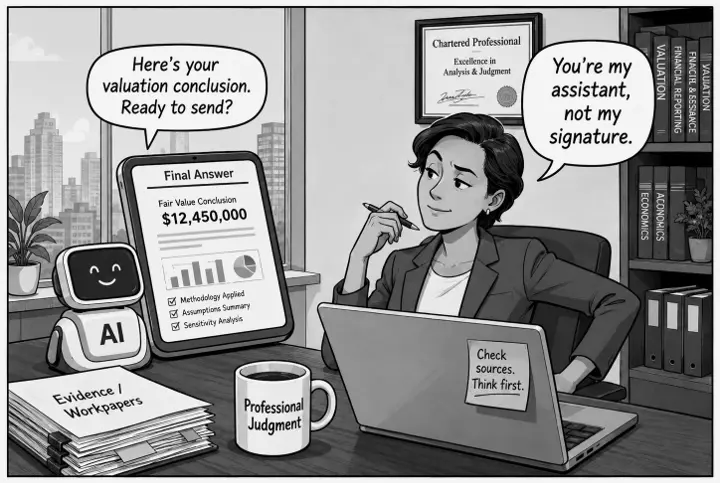
AI Can Improve Your Workflow, But It Cannot Replace Your Judgment – Practical Advice.
19. Expert Insights | IPEV Guideline Updates – Where Do We See the Biggest Impact? • Blick Rothenberg (UK) • Andrew Snook • Simon Lewis, CTA, ACA
The Revised Guidance Clarifies How Existing Valuation Principles Apply to Today’s Venture Capital Environment
20. Expert Insights | Legal Update: Randall v. Widen: Admissibility of Rebuttal Witness Testimony • QuickRead (NACVA) • Michael J. Molder, JD, CPA, CFE, CVA, MAFF
Also Includes Interesting Notes on a Regression Analysis Using the Guideline Public Company Method and a Reconciliation of Methods.
21. Case Law Watch | Glenmede Trust Co. v. Infinity Q Capital Management • New York Appellate Division, First Department
Manipulating the Inputs Used to Value Illiquid Financial Instruments Can Send an Executive to Prison
The Humor Approach

22. Case Law Watch | Spectrum Dynamics Medical Ltd. v. General Electric Co. • U.S. District Court (S.D.N.Y.)
Lessons on Valuing Damages, Lost Profits, Applying the Royalty Method, and How Not to Calculate a Technological Head Start
23. Expert Insights | Can You Have Negative Equity as a Valuation Conclusion? • Business Valuation Law News (BVR) • Jim Alerding, CPA, ABV
When Negative Equity Is the Correct Answer
24. Case Law Watch | Quantalytix, Inc. v. Vien Bui • U.S. District Court (N.D. Ala.)
Appraisals Outweigh Speculative Valuation Assertions in Court
25. Case Law Watch | SJI Renewable Energy Ventures, LLC v. REV LNG Holdings, LLC • New York Appellate Division, First Department
When Buyout Formulas Work but Valuation Provisions Don’t. Cautions to take in a Buy-Sell Agreement
26. Expert Insights | Are We Taking Our Net Working Capital Calculations Seriously Enough? • QuickRead (NACVA) • Sarah Von Helfenstein, MBA, CVA
Practical Notes on Net Working Capital Calculations and Projections
27. Expert Insights | The Effect of Macroeconomic Uncertainty on Business Valuation • Perspectives (Willamette) • Zoe A. Zurn
Inflation, Tariffs, Data Gaps, and Tight Credit Affect Cash Flows and Required Returns, But Not Always in the Same Place
28. Case Law Watch | Jay S. Turner v. J & J Slavik, Inc. • Michigan Court of Appeals
When a Contract Requires Fair Market Value but Corporate Misconduct Makes Valuation Practically Impossible
29. Expert Insights | Public Prices, Private Marks: What BDC Discounts Are Signaling • Jeff K. Davis, CFA, and Jack Carter, CPA • Portfolio Valuation Insights (Mercer Capital)
Persistent Discounts Between Public Market Prices and Private NAV Marks Raise Important Questions for Valuation Professionals
30. Case Law Watch | Steelray Consulting, LLC v. Overstock.com, Inc. • U.S. District Court (D. Utah)
Court Rejects Technology Value Based on Development Cost; Allows CPM-Based Valuation of Marketing Rights
31. Case Law Watch | Guild Ventures, LLC v. Kenwood Commons, LLC • New York Appellate Division, Third Department
NY Court Battle of Highest and Best Use Appraisals. Court Sides with an HBU Appraisal Grounded in What Is Reasonably Achievable as of the Foreclosure Date
32. Case Law Watch | Golden Rule Financial Corp. v. Shareholder Representative Services LLC • Delaware Court of Chancery
In M&A, Inaccurate Financial Statements Can Become Expensive
The Humor Approach
“Fair Malue Value is the price at which neither party gets exactly what they want.”
“I told a client her restaurant was worth between 3 and 4 million. She asked, ‘Can you be more precise?’ I said, ‘Sure. It’s definitely not the 6 million you think.'”
33. Expert Insights | Tales from the Trenches: Inventory Can Make or Break a Valuation • Business Valuation Law News (BVR) • Jim Alerding, CPA, ABV
A Reminder of Balance Sheet Items That Deserve Scrutiny
34. Expert Insights | SEC Enforcement: Valuation Process Matters, Not Just Valuation Error • BDO • Dale Thompson, CPA
Changing Market Conditions Can Affect the Value of Performing Financial Assets—Even When No Default Has Occurred
35. Case Law Watch | OptimisCorp v. Atkins • Delaware Court of Chancery
Court Rejects Damages Theory Built on a Partial View of Causation Despite Proven Fiduciary Breach
36. Case Law Watch | CellMark, Inc. v. Webster • U.S. District Court (E.D. Ky.)
Rebuttal Experts May Challenge Assumptions and Industry Trends—But Not Dictate Facts or Apply Legal Labels
37. Case Law Watch | Rayo Int’l Trading Co. v. V. Jwo Corp. • U.S. District Court (C.D. Cal.)
Measuring Brand Value Without Perfect Data
38. Expert Insights | When Credentials Aren’t Enough: Lessons from the Exclusion of a Highly Qualified Damages Expert • QuickRead (NACVA) • Sohini Chakraborty
Factual Alignment and Reliability Lessons from a Federal Daubert Challenge
39. Case Law Watch | Rising Rock Partners, LLC v. Commissioner • U.S. Tax Court
Highest and Best Use Must Be Reasonably Probable—Not Merely Possible
40. Expert Insights | AI, Work Product, and Rule 26 in Three Cases: Beware of Your AI Queries; They May Not Be Protected • QuickRead (NACVA) • Dorothy Haraminac, MBA, MAFF, CFE, PI
AI Use in Litigation Creates New Questions About Discoverability and Confidentiality
41. Case Law Watch | Kimberly Road Fulton 25, LLC v. Commissioner • U.S. Tax Court
How Speculative HBU “Costume Design” Led to a 96% Cut in Charitable Contribution Deduction
The Humor Approach
42. Expert Insights | Displacement Versus Augmentation: The Effects of AI on Employment Dynamics and Firm Value • The Value Examiner (NACVA) • Mark A. Chen • Joanna (Xiaoyu) Wang • Reviewed by: Min Cao, PhD
AI Creates Value in Two Very Different Ways. Sometimes it Replaces Employees, Sometimes it Enhances What They Can Do. Valuators Need to Understand Which One They Are Looking At
43. Expert Insights | Four Specific Indicia of Breach of Fiduciary Duty • QuickRead (NACVA) • Miranda Kishel, MBA, CVA, CBEC, MAFF
Four Red Flags Courts Repeatedly Associate with Disloyal Conduct
44. Valuation Guidance Update | NACVA Advisory Brief: Retainer Agreements
Retainer Terms Should Clarify Payment and Preserve Objectivity—This NACVA Brief Contains Conflicting Contingent-Fee Language
45. Valuation Guidance Update | NACVA Advisory Brief: Cryptocurrency
A Blockchain Transaction Is Not a Complete Holding: NACVA’s New Brief Explains How to Verify Cryptocurrency Records, Attribution, and Transfer Risk Before Valuing It
5 Quarterly Highlights - Editor's Choice
1. Case Law Watch | Healthcare Foundation of Wilson v. DLP Healthcare, LLC
Can a Party Stop a Valuation Process After Seeing a Near-Final Draft It Doesn't Like?
Healthcare Foundation of Wilson v. DLP Healthcare, LLC, et al., 2026 NCBC 57
North Carolina Business Court • June 23, 2026
Read the court decision on nycourts.gov
The Case
Healthcare Foundation of Wilson exercised a contractual put option requiring DLP Healthcare to purchase its 20% interest in Wilson Holding, the owner and operator of Wilson Medical Center. Under the put and operating agreements, the purchase price was to be based on an appraisal of a 100% interest in Wilson Holding performed by a qualified appraiser selected by the governing board. The governing board retained BDO to perform that appraisal.
According to the complaint, the parties jointly proceeded using December 31, 2024 as the valuation date. BDO spent approximately six months gathering information, conducting analyses, and issuing multiple drafts. During that period, both sides reviewed the drafts and provided comments without objecting to the valuation date.
The process allegedly changed in June 2025 when BDO delivered a third, nearly final draft that valued Wilson Holding at a figure approaching $300 million, implying a purchase price of approximately $55 million for Healthcare Foundation’s minority interest. According to the complaint, DLP Healthcare then challenged the valuation date for the first time, and DLP Partner—acting as Wilson Holding’s manager—instructed BDO not to issue its final appraisal. Healthcare Foundation thereafter filed suit.
What the Court Decided
This was not a final decision on the merits.
The North Carolina Business Court merely considered whether the claims were sufficiently pleaded to survive a motion to dismiss. Taking Healthcare Foundation’s allegations as true, the court concluded that the direct and derivative claims for:
- breach of contract,
- breach of fiduciary duty,
- aiding and abetting breach of fiduciary duty, and
- breach of the implied covenant of good faith and fair dealing
were sufficiently pleaded and could proceed.
It granted the motion only as to the derivative tortious‑interference claim against DLP Partner, dismissing that claim with prejudice.
could proceed.
The court held that the complaint plausibly alleged:
- the existence of an agreement to use December 31, 2024 as the valuation date;
- months of conduct consistent with that agreement;
- a valuation-date objection arising only after a near-final draft was issued; and
- managerial actions that may have benefited one owner at the expense of another.
The court did not determine:
- whether Wilson Holding was actually worth $300 million;
- whether Healthcare Foundation was entitled to $55 million;
- whether DLP Healthcare breached any contract; or
- whether any fiduciary duties were actually violated.
Those questions remain for later stages of the litigation.
Why It Matters
This is not a valuation-methodology case, but it contains important lessons about the valuation process.
The dispute was not about capitalization rates, valuation multiples, discounts, or valuation theory. Rather, it concerned what happens when an agreed valuation process appears to break down after a near-final conclusion emerges that one party does not like.
The opinion suggests that allegations of this type of conduct—renouncing an agreed valuation date and halting an ongoing appraisal process after a near‑final draft—are sufficient at the pleading stage to support contract and fiduciary‑duty claims, particularly where the valuation process was established by agreement and followed for months without objection.
For business owners, attorneys, and valuation professionals, the case serves as a reminder that disagreements about process can become just as important as disagreements about value.
P.S. – Editorial Commentary – Room for Further Thought: Protecting the Valuation Process
One aspect of Healthcare Foundation of Wilson may resonate with valuation professionals. According to the allegations, the parties agreed on a valuation date, participated in the appraisal process for months, reviewed multiple drafts, and only later disputed a core engagement assumption after a near-final conclusion emerged.
Many professional valuation standards contemplate that key engagement terms—such as the valuation date, standard of value, intended use, and scope of work—should be established before substantive valuation work begins in well-crafted Engagement Letters. Once an appraisal is underway, changing those fundamental assumptions may raise questions about the consistency and integrity of the process.
Draft reports are an important quality-control tool. They help identify missing facts, misunderstandings, and analytical errors. They are not generally intended to provide an opportunity to renegotiate engagement terms or revisit professional conclusions simply because the indicated value proves disappointing.
This case also invites a broader discussion of how appraisers can protect the integrity of the process. Possible safeguards may include:
- documenting the valuation date, standard of value, and scope of work at engagement;
- defining the purpose and limits of draft-review comments;
- limiting draft comments to factual corrections, missing information, or analytical errors;
- maintaining written records of requested revisions and the reasons they are accepted or rejected; and
- making clear that professional judgments and final conclusions remain the responsibility of the appraiser, not the parties.
Ultimately, valuation professionals are engaged to provide an independent opinion—not a negotiated result. The facts alleged in Healthcare Foundation of Wilson illustrate why a well-defined valuation process can be just as important as the valuation itself.
2. Expert Insights | Key Takeaways from Professor Aswath Damodaran's 2026 Edition of Equity Risk Premiums: Determinants, Estimation, and Implications
Damodaran says that Equity Risk Premiums can become stale, even from reputable sources, and that they should be updated when conditions change. How to do it.
Trisch Garthoeffner, ABV, CVA, MAFF, EA, MAcc • QuickRead (NACVA) • April 29, 2026
Read the original article on NACVA.com
Underlying Paper:
Aswath Damodaran, Equity Risk Premiums (ERP): Determinants, Estimation, and Implications – 2026 Edition (March 2026)
Summary
In this article, Trisch Garthoeffner summarizes Professor Aswath Damodaran’s 2026 update on Equity Risk Premiums (ERP), one of the most influential inputs in business valuation. Damodaran’s annual paper reviews the theory behind ERP, discusses the principal estimation methods, updates country risk premiums and implied ERPs, and explains why he continues to favor forward-looking implied ERP over traditional historical averages.
For business valuators, the importance of ERP is obvious. It is a core input into the Capital Asset Pricing Model (CAPM) and therefore directly affects the cost of equity, weighted average cost of capital (WACC), and ultimately value.
The article does much more than report Damodaran’s estimated 4.23% U.S. implied ERP at the beginning of 2026. Its principal contribution is explaining why, in Damodaran’s view, an implied, forward‑looking ERP is generally a better estimate of investors’ required return than a historical average ERP.
Practical Notes
- Don’t Treat ERP as Just Another CAPM Input
Many practitioners devote significant attention to beta selection, size premiums, and company-specific risk premiums while simply inserting an ERP obtained from a database.
Damodaran argues that ERP deserves the same analytical attention as every other component of the discount rate because it represents the market’s required compensation for bearing equity risk. A seemingly modest change in ERP can materially change the cost of equity and the concluded value.
- Understand What the Three ERP Methods Actually Measure
Both Garthoeffner’s article and Damodaran’s paper review three common methods of estimating ERP.
Historical ERP measures the excess return investors earned over long historical periods.
Survey ERP measures what investors, analysts, or academics say they expect.
Implied ERP estimates the return investors are currently requiring by solving for the discount rate embedded in today’s market prices.
Damodaran’s conclusion is clear: for most valuation purposes, the current implied ERP is generally the best estimate of the market’s required return because it reflects today’s prices, today’s expectations, and today’s interest rates—not yesterday’s realized returns.
- Historical ERP Is Not a Neutral Alternative
One of the article’s most valuable observations is that choosing a historical ERP is not simply selecting another accepted valuation input.
If today’s market implies one ERP but the analyst deliberately substitutes a materially different historical premium, the analyst is implicitly expressing a view that current market prices do not accurately reflect investors’ required returns.
That may ultimately be the correct conclusion in a particular engagement.
Damodaran’s point is simply that practitioners should recognize this as an affirmative market judgment, not merely a computational preference.
- ERP Changes Because Markets Change
Damodaran explains that ERP is influenced by numerous factors, including:
- investor risk aversion;
- inflation expectations;
- macroeconomic uncertainty;
- liquidity;
- government and monetary policy;
- information quality;
- catastrophic risk; and
- behavioral influences.
Consequently, ERP should not be viewed as a permanent long-term constant. As market conditions evolve, the implied ERP evolves with them.
- What Should Business Valuators Actually Do?
This is where Damodaran’s work becomes especially practical.
Business valuators typically need ERP as an input into CAPM; they do not estimate the market’s required return independently.
Damodaran’s framework suggests that, if you choose to use an implied ERP methodology, the ERP should be consistent with market conditions existing at the valuation date, rather than relying on a historical premium simply because it has long been used.
In practice, valuators have two reasonable options:
Option 1 — Use the most recent reputable published source.
This is the approach followed by most practitioners. Professor Damodaran publishes an annual ERP study and makes his implied ERP estimates, underlying datasets, and methodology publicly available.
Option 2 — Calculate the implied ERP yourself.
Although relatively uncommon outside academia, the methodology is conceptually straightforward and follows the same principles Damodaran applies in his own work.
Beginning with the current value of a broad equity index (typically the S&P 500), estimate the cash flows expected to be distributed to shareholders (dividends, buybacks, or free cash flows), together with long-term growth expectations. Solve for the required market return (r) that satisfies:

The implied ERP is then simply:

where r represents the market’s implied required return.
The important lesson is not that every valuator should calculate ERP from scratch. Rather, it is that the implied ERP reflects current market conditions at the valuation date, making it conceptually different from a historical average based on realized returns.
Context and Contribution
Damodaran has advocated market-implied ERP for many years. Neither the methodology nor the underlying finance theory is new.
The 2026 edition updates the implied ERP estimates, country-risk premiums, supporting market data, and discussion of the economic and behavioral determinants of ERP.
Garthoeffner’s contribution is to distill this extensive body of work into a concise, practitioner‑oriented article that explains why ERP selection is fundamentally an economic judgment—not simply a lookup exercise.
Editorial Perspective
One point that deserves emphasis is that ERP is an input for business valuators but an output of Damodaran’s model.
When we value a private company, ERP enters CAPM as one component of the discount rate. Damodaran, however, begins with today’s equity market, expected cash flows, growth assumptions, and the current risk-free rate, then solves for the ERP implied by those market conditions.
Viewed this way, ERP is not an arbitrary percentage to be carried forward from one engagement to the next. It is the market’s current price for bearing equity risk.
Practitioners need not perform these calculations themselves, but understanding where an implied ERP comes from—and why it changes over time—provides a stronger conceptual foundation for selecting and defending one of the most influential inputs in the valuation process.
Why It Matters
Many valuation reports carefully justify beta, size premium, and company-specific risk premium while giving comparatively little attention to ERP. Damodaran’s work reminds us that ERP deserves the same scrutiny. Whether practitioners ultimately adopt his implied methodology or another accepted approach, the important lesson is to understand what the selected ERP represents, why it was chosen, and how it fits the market conditions existing at the valuation date.
3. Expert Insights | Vetting Management Projections: Best Practices and Insights
Past Forecast Accuracy May Be One of the Best Indicators of Whether Current Projections Should Be Relied Upon, and Other Reliability Indicators
Nathan P. Novak, CFA, ASA • Perspectives (Willamette) • April 2026
Read the original article on Willamette.com
Summary
Financial projections often have a significant impact on business valuation conclusions, particularly when applying the Income Approach. In this article, Nathan Novak presents a structured framework for evaluating whether management-prepared projections are sufficiently reliable for use in a valuation analysis. Drawing on recent judicial decisions—including Pierce v. Commissioner, Hyde Park Venture Partners Fund III v. FairXchange, LLC, and In re PetSmart, Inc.—the article emphasizes that valuation analysts should perform meaningful due diligence before relying on management forecasts. Rather than focusing solely on the projected numbers, Novak encourages practitioners to evaluate the process used to develop the projections, management’s historical forecasting accuracy, and the appropriate response when concerns arise.
Practical Notes for Business Valuators
The article offers several practical ideas that can be incorporated into virtually any valuation engagement.
- Evaluate the forecasting process—not just the forecast. Before relying on projections, understand when they were prepared, why they were prepared, who participated, how frequently they are updated, and how management uses them internally. Projections prepared in the ordinary course of business through a robust process generally deserve greater confidence than those created solely for litigation or a specific transaction.
- Compare prior forecasts with actual results. Perhaps the article’s most useful recommendation is to compare several years of historical projections against actual operating performance. Novak’s example illustrates that while revenue forecasts may be reasonably accurate, EBITDA projections can exhibit a consistent optimistic bias. Historical forecast accuracy can provide objective evidence regarding management’s forecasting process and may identify recurring optimism or conservatism that warrants additional scrutiny.
- Expand the analysis beyond revenue. Similar comparisons may be performed for EBITDA, capital expenditures, working capital requirements, debt-free net income, margins, ratios, and other cash flow sensitive metrics. The article also suggests comparing the forecasting performance of guideline public companies to determine whether forecasting errors are company-specific or reflect broader industry trends.
- Adjust only after appropriate due diligence. Novak cautions that, even when management has a history of somewhat inaccurate projections, it may be difficult and sometimes inadvisable for an analyst to create an entirely new set of projections. Depending on the circumstances, concerns may be addressed through additional due diligence with management or by making either direct adjustments to projected cash flows or adjustments to valuation assumptions such as discount rates or selected market multiples.
One Practical Lesson: Past Forecast Accuracy Matters (Editorial Commentary)
One of the article’s most valuable contributions is its emphasis on historical forecast accuracy. Rather than viewing each projection as an isolated exercise, practitioners can evaluate management’s forecasting credibility by comparing prior projections with actual results.
A management team that has historically projected revenue and profitability with reasonable accuracy presents different evidence from one that has consistently overestimated growth or margins. While past forecasting performance should not determine whether current projections are accepted or rejected, it can provide valuable evidence regarding the reliability of management’s forecasting process and whether additional due diligence or valuation adjustments may be appropriate.
Why It Matters
Management projections frequently drive valuation conclusions, yet their reliability often receives less attention than discount rates or valuation multiples. Novak’s framework reminds practitioners that evaluating how projections were prepared—and how well management has forecasted in the past—can materially strengthen both the supportability and defensibility of a valuation conclusion.
P.S. Readers may recall Edward Mendlowitz’s February 2026 QuickRead article, Vetting a Client’s Projection: A Process. While both authors address the same subject, they begin from different perspectives. Together, the two articles provide complementary frameworks: Mendlowitz emphasizes whether the forecast itself is operationally and financially reasonable, while Novak adds a deeper examination of the forecasting process, management’s historical forecasting accuracy, and how the valuator might respond when concerns arise.
4. Expert Insights | Firm Size and Financial Metrics Volatility
Smaller Companies Exhibit Greater Revenue and Earnings Volatility, With Important Implications for Earnout Valuation and Opportunities for Deal Design
Vincent Covrig, PhD, CFA • Pavan Kumar Nadiminti, MS • Mary Ann K. Travers, ASA • Business Valuation Review (BVR, ASA) • Spring 2026
Read the original article on bvr.kglmeridian.com (subscription required)
Summary
Earnouts and other contingent consideration arrangements are commonly valued using option-based models, making volatility one of the key valuation inputs. Because operating metrics such as revenue and EBITDA are not publicly traded, estimating their volatility requires judgment and appropriate benchmarks.
Using twenty years of public-company data, the authors found that smaller companies generally experience greater volatility in revenue, EBITDA, net income, assets, and market capitalization than larger companies. The relationship remained significant after considering profitability, leverage, and industry effects, and was strongest among the smallest firms.
For perspective, the study’s smallest‑company group has an average MVIC below roughly $360 million, while the largest group averages more than $6.5 billion. Across multiple financial metrics, the smaller companies typically exhibit volatility on the order of 1.5 to 2.0 times that of the largest firms, depending on the metric and method used.
Why Volatility Matters
Suppose an acquisition agreement provides the seller with an additional $2 million if Year 2 EBITDA exceeds $10 million.
Now consider two otherwise identical companies:
Company A
- Expected Year 2 EBITDA: $8.5 million
- EBITDA volatility: 15%
Company B
- Expected Year 2 EBITDA: $8.5 million
- EBITDA volatility: 35%
Neither company is expected to reach the $10 million target. However, Company B has a much wider range of possible outcomes, making it more likely to exceed the threshold and trigger the earnout payment.
The expected EBITDA is identical in both cases; what changes is the probability of achieving the required result. From an option‑style valuation perspective, higher volatility increases the value of this contingent payoff because it raises the chance of reaching favorable outcomes. This illustration is editorial commentary and is not taken from the original article.
Context and Contribution
Earlier research documented the relationship between company size and equity volatility. This study extends that concept to the operating metrics commonly used in earnout and contingent‑consideration valuations and provides additional empirical support for considering company size—alongside profitability and industry—when selecting volatility assumptions.
Editorial Perspective
Although the article focuses on valuation, its findings may also have implications for transaction structuring. If smaller businesses are more volatile than the parties assume, earnout thresholds, caps, and measurement periods may produce payout outcomes very different from what either side expected when the agreement was negotiated.
Modeling an earnout under different volatility assumptions before finalizing the acquisition agreement may help determine whether its expected value—and the range of possible payout outcomes—align with the parties’ commercial objectives. This observation is editorial commentary and is not a conclusion expressly stated by the authors.
Why It Matters
This article reminds practitioners that volatility is not merely a technical modeling input. For many private‑company transactions, it can materially affect both the value of contingent consideration and the transaction’s overall economics. For practitioners who value earnouts—or negotiate them—it reinforces the importance of evaluating whether volatility assumptions appropriately reflect the size and characteristics of the subject company. Thoughtful consideration of this issue may reduce the likelihood of unintended economic outcomes after closing. (Editorial commentary.)
5. Case Law Watch | Bowers v. Russell
A Later Sale Does Not Prove an Earlier Valuation Was Wrong. Fair Market Value Governed ESOP Redemption.
Bowers v. Russell, 2026 U.S. Dist. LEXIS 118935 (D. Mass.) • May 29, 2026
Read the court decision on findlaw.com
The Case
This ERISA dispute arose from the termination of an Employee Stock Ownership Plan (ESOP) at Russelectric, an electrical equipment manufacturer. In November 2016, the company redeemed the ESOP’s 30% ownership interest for $134 per share. In October 2018, Russelectric was sold to Siemens for approximately $345 million, a price that on a per‑share basis far exceeded the amount paid for the ESOP’s shares in November 2016.
Following a twelve-day bench trial, the court rejected that argument. It concluded that the November 2016 redemption transaction was for “adequate consideration” because the $134 per‑share price reflected fair market value as determined in good faith and through a prudent process.
The court did, however, find fiduciary breaches relating to certain transaction bonuses paid in connection with the later Siemens sale.
Valuation Lessons
- A Subsequent Sale Does Not Automatically Invalidate an Earlier Valuation
The plaintiffs’ central argument was straightforward: if Siemens was willing to purchase Russelectric for a much higher value less than two years later, the 2016 redemption price must have been too low.
The court disagreed. It evaluated the redemption as of November 2016 and focused on what was reasonably known and knowable at that valuation date. It found that many of the operational improvements that ultimately transformed the company were still developing at the time: a new management team had only recently been installed, major operational reforms were still being implemented, and many of the resulting increases in backlog, bookings, revenues, and profitability did not materialize until 2017.
Application to Practice
This may be the most important valuation lesson in the opinion.
Valuation disputes are often fueled by hindsight. When a company subsequently succeeds, sells at a premium, or outperforms expectations, parties naturally question whether an earlier valuation was too low. Bowers illustrates that a valuation is judged based on the information reasonably available at the valuation date, not on subsequent developments, even when a later sale occurs at a much higher price.
- Courts Often Evaluate the Valuation Process as Much as the Valuation Conclusion
The court repeatedly emphasized the process supporting the redemption price.
Prairie Capital performed an independent valuation, using financial information and projections provided by Russelectric’s management. The ESOP trustee (Argent) retained Prairie Capital, reviewed its work, negotiated with the company, and obtained a fairness opinion concluding that $134 per share was not less than fair market value and constituted adequate consideration. The final negotiated price of $134 per share fell within Prairie Capital’s valuation range of approximately $120 to $141 per share and exceeded the midpoint of that range.
The court found no evidence that management withheld material information from Prairie Capital; rather, the record showed that management supplied Prairie Capital with the same forecasts and operating information it provided to the Board.
Application to Practice
The opinion serves as a reminder that a well-documented valuation process can become as important as the valuation itself.
Independent appraisals, contemporaneous projections, informed negotiations, fairness opinions, and thorough documentation often become critical evidence years later when a valuation is challenged.
- Fair Market Value Was Determined Using a Hypothetical Buyer-and-Seller Framework
One of the plaintiffs’ experts concluded that the ESOP shares were worth approximately $436 per share, more than three times the redemption price. The court ultimately rejected that conclusion.
A significant disagreement concerned how the ESOP’s 30% ownership interest should be analyzed. Prairie Capital and the defendants’ valuation expert evaluated the ESOP’s 30% interest using a traditional fair‑market‑value framework based on a hypothetical willing buyer and willing seller, and treated the block as a noncontrolling interest. The plaintiffs’ expert argued that this approach was inappropriate because the actual transaction involved the company redeeming the shares itself.
The court sided with Prairie Capital’s framework, holding that the ESOP’s 30% interest should be valued from the perspective of a hypothetical market participant and that it was appropriate to analyze it as a minority, noncontrolling interest.
Application to Practice
Importantly, the court applied a Fair Market Value standard rather than a statutory Fair Value standard, and grounded its analysis in the statutory definition tying adequate consideration to fair market value as determined in good faith.
The court accepted a hypothetical willing-buyer-willing-seller framework and was unwilling to abandon it simply because the actual transaction involved the company redeeming the shares. For valuation professionals, the decision is a useful reminder that the applicable standard of value—and the assumptions embedded within that standard—can materially affect the final conclusion.
Why It Matters
Although Bowers arose in the ESOP context, its lessons extend well beyond ERISA valuations.
The company ultimately sold to Siemens for far more than the value implied by the 2016 redemption price, but the court still held that the earlier redemption was for adequate consideration. It emphasized that the $134 per‑share price was grounded in contemporaneous information, supported by an independent valuation and fairness opinion, and produced through a process the court viewed as prudent and loyal to ESOP participants.
The broader lesson is one that appears frequently in valuation litigation:
A valuation should be judged by what was reasonably known at the valuation date, not by what happened afterward.
P.S. In a July 2026 QuickRead follow-up, Michael J. Molder highlights two useful qualifications. First, the court accepted Prairie Capital’s minority-interest treatment as reasonable under the circumstances, but did not establish a blanket rule requiring a minority discount whenever a company redeems ESOP shares. Second, hiring an outside expert does not fix a weak fiduciary process. The compensation consultant spent only about 10 hours on the assignment, did not know about the ESOP clawback, and misunderstood the Board Chairman’s operating role. The practical lesson is simple: expert advice provides little protection when the expert lacks critical facts and decision-makers do not critically evaluate the work.
Also Worth Knowing
6. Expert Insights | Complex Capital Structures in Transfer Tax Planning: A Valuation Perspective
Complex Ownership Structures Are Moving from Private Equity into Mainstream Estate Planning
Lucas M. Parris, CFA, ASA-BV/IA, and Sujan Rajbhandary, CFA, ABV • Value Matters® (Mercer Capital) • June 18, 2026
Summary
Parris and Rajbhandary discuss the growing use of complex capital structures in privately held companies. Preferred equity, rollover equity, profits interests, earnouts, convertible securities, and other structured ownership interests—once seen primarily in venture capital and private equity transactions—are increasingly appearing in family-owned businesses and closely held companies. As these structures become more common, allocating value among ownership interests becomes increasingly important, particularly for transfer-tax planning.
Practical Notes for Business Valuators
The authors remind practitioners that, after determining enterprise value, the next challenge may be allocating that value among ownership classes with different economic rights.
Some practical considerations include:
- Focus on economics, not labels. Preferred and common equity may differ substantially depending on liquidation preferences, participation rights, conversion features, preferred returns, and incentive compensation provisions contained in the governing agreements.
- Avoid pro rata allocations. Where ownership classes have different contractual rights, value generally cannot be allocated simply according to ownership percentages. The analysis should reflect how future cash flows and exit proceeds are expected to flow through the capital structure.
- Choose the allocation methodology that fits the facts. The article briefly reviews three commonly used approaches: the Scenario-Based Method (SBM), the Option Pricing Method (OPM), and Monte Carlo Simulation, each appropriate under different circumstances.
Context and Contribution
The valuation concepts discussed in this article are well established. Experienced practitioners are already familiar with the Scenario-Based Method, Option Pricing Method, Monte Carlo Simulation, and the importance of analyzing the economic rights attached to different ownership classes.
The article’s contribution lies elsewhere. It highlights how these capital structures are becoming increasingly common outside traditional venture capital and private equity transactions. As family businesses, founder-owned companies, and closely held entities adopt more sophisticated ownership arrangements, valuation analyses that were once relatively specialized are becoming part of mainstream valuation practice.
The article also provides a useful illustration showing that junior equity may possess meaningful value—even when it appears to have little or no current intrinsic value—because of the option-like characteristics embedded in its future participation rights.
Why It Matters
Complex capital structures are no longer confined to institutional transactions. As structured ownership arrangements become more common in privately held companies, valuators increasingly need to analyze the contractual economics of each ownership class—not simply its ownership percentage. This article serves as a timely reminder that enterprise valuation and value allocation are distinct steps, both requiring careful professional judgment.
P.S. Readers may recall our discussion of the AICPA’s December 2025 Working Draft, Valuation of Privately-Held-Company Equity Securities Issued as Compensation. While Mercer’s article focuses on transfer-tax planning and the AICPA draft addresses ASC 718 valuations, both reflect the same broader trend: private-company capital structures are becoming increasingly sophisticated. As preferred equity, profits interests, rollover equity, and other structured ownership arrangements become more common, valuation professionals should expect continued refinement of the analytical frameworks used to allocate value among multiple classes of equity.
7. Case Law Watch | Estate of Anne Milner Fields v. Commissioner
Court Applies IRC §2036, Eliminating the Tax Benefits of a Family Limited Partnership. A Discovered Email Seeking a "Deeper Discount" Was Considered Evidence That the FLP Was Created Primarily for Tax-Reduction Purposes.
Estate of Anne Milner Fields v. Commissioner, No. 25-60403 (5th Cir.) • May 8, 2026
The Case
During the final weeks of Anne Milner Fields’ life, approximately $17 million of assets were transferred into a newly formed Family Limited Partnership (AM Fields, LP). Unlike many Family Limited Partnership cases, the partnership did not own an operating business. Instead, it held primarily passive investment assets, including a brokerage account of nearly $10 million, approximately $5.3 million of community-bank stock, interests in two LLCs, a Texas tree farm, notes receivable, and other investment assets.
Following Ms. Fields’ death, the Estate filed Form 706 reporting the value of her limited‑partnership interest at approximately $10.9 million, rather than the roughly $17 million value of the underlying assets transferred into the partnership. A valuation appraiser applied a 15% Discount for Lack of Control (DLOC), reflecting the limited partner’s inability to control partnership decisions, and a 25% Discount for Lack of Marketability (DLOM), recognizing the absence of a ready market for the partnership interest.
The earlier Tax Court opinion (T.C. Memo. 2024-90) also revealed that, during the planning process, the estate-planning attorney emailed the appraiser asking whether revisions to the partnership agreement might produce “a deeper discount.” The Tax Court cited this email not as proof that the appraisal itself was technically improper, but as evidence that maximizing valuation discounts had become a principal objective of the planning.
What the Court Decided
The Fifth Circuit did not resolve whether the appraisal was correct or whether the 15% DLOC and 25% DLOM were appropriate.
Instead, it affirmed the Tax Court’s threshold legal conclusion: under IRC §2036, the underlying assets had to be included in the taxable estate because the transfer to the partnership was not a bona fide sale for a substantial non‑tax purpose.
Under IRC §2036, assets transferred during life are nevertheless included in a decedent’s taxable estate if the decedent retained enjoyment of those assets and the transfer was not a bona fide sale motivated by a substantial non-tax purpose.
Both the Tax Court and the Fifth Circuit concluded that the Estate failed to establish that the Family Limited Partnership served a sufficiently substantial non-tax purpose. Among the facts supporting that conclusion were:
- the partnership was created only weeks before Ms. Fields entered hospice care and died;
- the transferred assets consisted primarily of passive investments rather than an operating business;
- there was little objective evidence that the partnership meaningfully changed how the assets were managed;
- the asserted non-tax purposes appeared to be post hoc justifications rather than actual motivations; and
- contemporaneous emails discussing how to obtain “a deeper discount” reinforced the conclusion that estate-tax reduction had become a principal objective of the transaction.
Accordingly, both the Tax Court and the Fifth Circuit held that the underlying assets—not the discounted partnership interest—had to be included in Ms. Fields’s taxable estate. As a result, the claimed valuation discounts produced no estate‑tax benefit.
Why It Matters
Fields is not really a valuation-discount case—it is an estate-planning case with important valuation consequences.
The appraisal itself was never the central issue. Neither court rejected the valuation methodology or suggested that the 15% DLOC or 25% DLOM were excessive; they simply held that §2036 prevented the Estate from relying on the partnership discounts at all. Rather, they concluded that the Estate could not rely on the discounted partnership value because the Family Limited Partnership failed to qualify for the bona fide sale exception under IRC §2036.
The broader lesson is that valuation discounts are a consequence of a legally sustainable planning structure—not a substitute for one. Even a well-supported appraisal cannot preserve tax benefits if the underlying entity fails to satisfy the legal requirements necessary for those discounts to be recognized.
P.S. – Estate Planning as an Interdisciplinary Exercise
One subtle lesson from Fields is that successful Family Limited Partnership planning requires more than a technically sound appraisal. Attorneys, accountants, and valuation professionals each have distinct roles, but the planning must collectively demonstrate legitimate non-tax objectives that are supported by both documentation and actual operation. When contemporaneous evidence suggests that maximizing valuation discounts has become the dominant objective, those communications may later become powerful evidence that the structure was designed principally for tax avoidance. Had the partnership been created and operated pursuant to well‑documented business, succession, or asset‑management purposes long before Ms. Fields’s final illness, it is plausible that future litigation would have focused more on the appropriate level of valuation discounts rather than on whether the Estate was entitled to claim any at all.
8. Case Law Watch | Matthew Dundon, Trustee of the Endo GUC Trust v. TPG Capital, L.P., et al.
NY Bankruptcy Court Keeps $8 Billion Alive. A Negotiated Purchase Price Challenged on the Basis of a Constructive Fraudulent Transfer, Offering Important M&A and Solvency Lessons.
Matthew Dundon, Trustee of the Endo GUC Trust v. TPG Capital, L.P., et al., Adv. Pro. No. 24-7030 (DSJ) (Bankr. S.D.N.Y.) • Decided: May 29, 2026
Read the court decision on uscourts.gov
Practitioners’ Note: While this is a bankruptcy and fraudulent transfer lawsuit rather than a traditional business valuation (BV) dispute, it is a great read for transaction advisors. It highlights the legal and financial fallout that occurs when aggressive management projections, inadequate due diligence, and hidden contingent liabilities collide to destroy a multi-billion-dollar corporate acquisition.
The Case & The Transaction Structure
In 2015, major pharmaceutical manufacturer Endo International plc executed a highly aggressive, $8.05 billion acquisition of generic drug manufacturer Par Pharmaceutical from the private equity firm TPG. To fund the transaction, Endo provided the following consideration:
- $4.1 billion in cash.
- 18.1 million shares of Endo stock (then valued at $1.3 billion).
- The assumption of $2.2 billion of Par’s existing debt.
- Approximately $450 million in transaction costs and related fees.
Following the acquisition, both companies faced a cascade of opioid-related lawsuits, eventually forcing Endo into Chapter 11 bankruptcy in August 2022. The Trustee of the Endo General Unsecured Creditors’ Trust, Matthew Dundon, subsequently sued the TPG selling entities.
The Trustee alleged that the transaction constituted a constructive fraudulent transfer. He argued that Endo grossly overpaid for Par, so it did not receive “reasonably equivalent value,” and that the transaction left Endo insolvent or with unreasonably small capital because both Endo and Par had massive, accrued but unacknowledged opioid liabilities at the time.
The Bankruptcy Court’s Ruling
U.S. Bankruptcy Judge David S. Jones denied the motion to dismiss the constructive fraudulent transfer claim against the TPG Transfer Defendants. He dismissed the constructive fraudulent transfer claim against Par’s former officers and directors, holding they were subsequent transferees who took “for value” by surrendering their options and RSUs, and dismissed the contribution claim against all defendants for lack of factual support. The court concluded that the Trustee’s allegations against the TPG Transfer Defendants were plausible and must proceed to discovery and further proceedings. The court held that the Trustee had sufficiently alleged that Par’s true enterprise value was far below the $8 billion purchase price, and that Endo was rendered insolvent by the transaction due to its massive, unacknowledged contingent opioid liabilities.
Three Critical Lessons for M&A and Solvency Professionals
- A Negotiated Purchase Price is Not Automatic Proof of Fair Value
- The Trustee pointed to Par’s own pre‑sale internal valuation and S‑1 filing, which placed its enterprise value in the $3–4 billion range—roughly half of the value implied by Endo’s transaction.
- Furthermore, between the deal’s announcement in May 2015 and its close in September 2015, Endo’s market capitalization declined by roughly $3 billion and its share price fell nearly 20%, which the Trustee cited as contemporaneous market evidence that Endo had overpaid.
- The Lesson: In constructive fraudulent transfer litigation, courts may give significant deference to an arm’s‑length purchase price between sophisticated parties, but they will not treat it as automatic proof of fair value when contemporaneous internal valuations and market data plausibly suggest the price was far out of line with actual enterprise value.
- M&A Due Diligence Must Scope and Measure Contingent Liabilities
- The Trustee alleged that Par’s suspicious order monitoring (SOM) system for opioids was legally noncompliant, creating large, inevitable, and unacknowledged legal liabilities that were not reflected in the transaction economics or balance‑sheet solvency analysis.
- The Lesson: Valuation and financial due diligence are inextricably linked. A transaction model is only as reliable as its underlying liability assumptions. If M&A advisors fail to aggressively investigate and mathematically model contingent regulatory, legal, and environmental liabilities, the subsequent exposure can completely overwhelm the transaction’s projected EBITDA and multiple synergies.
- The Solvency “Hindsight” Rule Has a Critical Exception
- TPG argued that the Trustee was improperly using hindsight by pointing to opioid settlements and bankruptcies that occurred years after the 2015 transaction.
- The court reaffirmed that solvency must be judged based on information known or reasonably knowable at the time of the transfer. But it also explained that subsequent events—such as later litigation and settlements—may be considered when they shed light on liabilities that already existed or were highly probable as of the transaction date.
- The Lesson: Underreporting or failing to acknowledge a severe, pre-existing problem (such as reckless product sales practices) cannot be shielded by the hindsight rule if the underlying risk was already actively generating massive, knowable liability at the appraisal date.
Why it matters
A multi-billion-dollar deal negotiated by sophisticated parties can still be deemed a constructive fraudulent transfer if the buyer’s due diligence fails to account for catastrophic, pre-existing liabilities. M&A advisors and valuators must independently test management’s optimistic narratives and assumptions, especially when a company’s risk profile suggests that significant contingent liabilities may already be accruing in the background.
Lorem ipsum dolor sit amet, consectetur adipiscing elit. Ut elit tellus, luctus nec ullamcorper mattis, pulvinar dapibus leo.
9. Expert Insights | Goodwill Impairment in Volatile Markets: A Three-Part KPMG Series
A Practical Reporting Workflow for Building More Defensible Fair Value Goodwill Conclusions During Market Volatility. And considerations on MPAP application.
Marina Arias, ABV • Frederik Bort, ABV, CFA • KPMG • June 2026
Summary
KPMG’s three-part series addresses goodwill impairment testing during periods of significant market volatility and economic uncertainty. It uses three periods of disruption—the 2008–2009 financial crisis, the COVID-19 pandemic, and the policy- and trade-related uncertainty that emerged in 2025—to illustrate how rapidly changing market conditions can affect the evidence and assumptions underlying a fair value analysis.
The fundamental valuation principles do not change. What changes is the reliability and interpretation of the inputs. During volatile periods, market evidence may become less comparable, market multiples and discount rates may require recalibration, valuation ranges may widen, and greater analysis may be necessary to distinguish temporary market volatility from a fundamental repricing of risk. KPMG emphasizes contemporaneous documentation, sensitivity analysis, and support for significant judgments.
The series is particularly useful because it combines this valuation guidance with two practical tools: a checklist of potential goodwill impairment triggering events and an eight-step workflow that takes the practitioner from confirming the reporting-unit structure and documenting the triggering-event assessment, through selecting the valuation approach and updating projections, discount rates, multiples, and MPAP assumptions, to performing the quantitative test, sensitivity analysis, market-capitalization reconciliation, and final documentation.
Practical Applications in Goodwill Impairment Testing
- Start with the triggering event—not the valuation model.
KPMG provides a useful checklist covering macroeconomic conditions, industry and market developments, cost factors, financial performance, entity-specific events, changes affecting the reporting unit, and sustained declines in share price. Importantly, the analysis is company-specific; no single factor is necessarily determinative.
KPMG also addresses an important procedural question: once a triggering event has been identified, can the company still use the optional qualitative assessment—“Step 0”—to avoid quantitative testing? Generally, no. The factors that establish the trigger are also considered in Step 0, so the qualitative assessment would likely point toward proceeding to a quantitative impairment test.
The article then presents an eight-step workflow for conducting and documenting the process. Rather than reproduce it here, practitioners dealing with goodwill impairment should review KPMG’s original workflow.
- Volatility should be reflected somewhere in the valuation.
One of KPMG’s most useful valuation observations extends beyond goodwill impairment. When uncertainty materially affects the subject company, simply ignoring it is generally not appropriate.
Depending on the circumstances, KPMG suggests:
- widening valuation ranges and using sensitivity analysis;
- recalibrating discount rates and market multiples;
- using scenario-based or probability-weighted cash flows when uncertainty can reasonably be incorporated into projections; or
- when incorporating the uncertainty into cash flows is not feasible, considering a well-supported adjustment to the discount rate.
The important point is not that every period of volatility automatically requires a higher discount rate. Rather, the analyst should determine where the uncertainty belongs in the valuation and document that judgment. As a practical matter, the valuator should also be careful not to double-count the same risk in both cash flows and the discount rate.
- Reconsider the relevance of market evidence.
Historical market evidence does not become useless merely because markets have changed—but its relevance and comparability may deteriorate. KPMG notes that recalibration may be necessary when market multiples, discount rates, or acquisition premiums change rapidly or transaction volume declines.
Similarly, a single day’s market capitalization may not always provide the best indication of fair value during unusual volatility. KPMG notes that an average market price over a reasonable period preceding the measurement date may sometimes be appropriate.
The governing principle remains the measurement date: the analyst needs to determine what information market participants would have considered at that date, rather than allowing subsequent developments to influence the conclusion.
Market Participant Acquisition Premiums: An Important Empirical Observation
Perhaps the most interesting empirical contribution for valuation practitioners is KPMG’s analysis of Market Participant Acquisition Premiums (MPAPs) during periods of market stress.
KPMG’s analysis of S&P Capital IQ data found meaningfully higher MPAPs during the financial crisis and COVID periods compared with preceding periods:
- Median MPAPs increased by approximately 6 to 10 percentage points; and
- 75th-percentile MPAPs increased by approximately 6 to 23 percentage points.
These data do not mean that an analyst can simply increase the MPAP because markets are volatile. KPMG stresses that historical observations are not a substitute for current, company-specific evidence. As an MPAP moves toward the upper end of an observed range, additional quantitative support—including identification and, where possible, quantification of market-participant synergies—becomes increasingly important.
Editorial Note: A Potential Lesson for DLOC Analysis
KPMG’s analysis concerns MPAPs in goodwill impairment testing, not Discounts for Lack of Control (DLOC). Nevertheless, I believe it has an important application when MPAP evidence is used to derive a DLOC.
If a crisis or significant market disruption has recently emerged, a lookback period consisting primarily of transactions completed during the preceding, more stable environment may not provide the most relevant evidence. The valuator should consider how acquisition premiums behaved during comparable periods of market uncertainty and use professional judgment in selecting the reference period and transactions used to support the Selected Control Premium.
In short: when using MPAP evidence to derive a DLOC, analyze recent transactions, but also consider what happened to acquisition premiums during comparable periods of uncertainty.
Context and Contribution
The individual concepts in the series—triggering events, scenario analysis, discount-rate adjustments, MPAP support, market-capitalization reconciliation, and measurement-date evidence—are not new. KPMG’s contribution is bringing them together into a practical framework specifically for periods when markets are moving rapidly, and historical evidence becomes less reliable.
The eight-step workflow is particularly useful as a process-control tool, while the empirical comparison of MPAPs across preceding and stressed market periods provides practitioners with concrete evidence that acquisition premiums themselves can be sensitive to economic conditions. KPMG’s workflow explicitly incorporates updating projections, terminal assumptions, discount rates and multiples; supporting MPAP assumptions; performing sensitivities; reconciling to market capitalization; and documenting significant judgments.
KPMG’s empirical comparison of MPAPs across stable and stressed market periods is particularly noteworthy. I have not previously encountered this type of empirical analysis of how MPAPs behave during periods of significant market disruption.
Why It Matters
Volatile markets do not require a different definition of fair value, but they may require different evidence, assumptions, ranges, and levels of support. The next time a goodwill impairment test coincides with significant market disruption, don’t simply update last year’s model. Reassess the triggering-event analysis, the measurement-date evidence, uncertainty in cash flows or discount rates, and the relevance of market data. KPMG’s workflow provides a useful roadmap—and its MPAP analysis is a reminder to carefully consider whether the historical reference period remains appropriate.
10. Expert Insights | The Bankability Method: Ensuring SBA 7(a) Financing Success to Close a Small Business Sale
A Framework to Help Determine the Borrower's Ability to Service the Loan
Terry Lammers, CVA • QuickRead (NACVA) • April 22, 2026
Summary
Terry Lammers proposes the Bankability Method, an income-based valuation framework intended primarily for businesses valued below approximately $5 million, where buyers frequently depend on SBA 7(a) financing. The method focuses not simply on what a business may be worth in theory, but on whether a typical SBA‑financed buyer can realistically acquire and service the debt used to purchase it.
Under the Bankability Method, a transaction should generally provide:
- a reasonable salary for the buyer;
- repayment of acquisition debt in roughly five years; and
- a debt service coverage ratio (DSCR) of approximately 1.5x–1.75x.
Lammers argues that many transactions fail because the business is priced above what available cash flow can reasonably support under common SBA lending structures.
Practical Notes
- The Method Is Really a Cash Flow Test
The article’s most important contribution is not a new valuation formula but its focus on the cash flow available after debt service, owner compensation, and required coverage—essentially, whether the business can “pay for itself” under typical SBA terms.
Lammers argues that EBITDA alone may not adequately reflect what a buyer can actually afford because principal debt payments consume cash without appearing as an expense on the income statement.
- “True Cash” May Differ from Reported Earnings
The article introduces the concept of “true cash” — the cash remaining after considering obligations such as principal debt repayment that are not captured as expenses on the income statement.
As a result, a business that appears profitable on paper may generate significantly less cash available to support acquisition financing. For buyers, lenders, and transaction advisors, that distinction can materially affect what is financeable.
- Buyer Type Matters
Lammers distinguishes between:
- financial buyers, who are constrained by lender requirements and cash flow coverage; and
- strategic buyers, who may be willing to pay more because of expected synergies, market-share gains, or other strategic benefits.
This serves as a useful reminder that transaction value depends partly on who the likely buyer is.
Editorial Perspective
The article is best viewed as a supplemental transaction‑feasibility analysis rather than a replacement for traditional valuation methodologies. It remains the lender’s responsibility—not the valuator’s—to decide whether to approve a loan.
Banks already perform their own lending analyses, and business valuation does not ordinarily seek to determine what a lender will finance. However, the framework highlights a useful issue for valuators: projected cash flows, debt service capacity, owner compensation, and DSCR may provide insight into whether a transaction is realistically executable.
Used in that way, a bankability analysis may help bridge the gap between a valuation conclusion and real‑world transaction feasibility.
Why It Matters
The article reminds practitioners that value and financeability are not always the same thing. While the Bankability Method is directed toward small-business transactions, its broader lesson is that cash flow available to a buyer may be more important than EBITDA alone. For valuators involved in exit planning, transaction consulting, or buyer-side analyses, understanding debt service capacity and financing constraints can provide useful context alongside a traditional valuation conclusion.
11. Expert Insights | Options for Business Owners Exploring Exit Opportunities: Looking to Reduce Risk, and Increase Liquidity
ESOPs, Leveraged Recaps, and Other Strategies Can Unlock Liquidity Without a Full Sale
James A. Janos, CFA, ABV, FMVA • QuickRead (NACVA) • April 8, 2026
Read the original article on NACVA.com
Summary
James Janos observes that many business owners approaching retirement default to the idea of a full sale as their primary exit option. He suggests that this mindset may overlook the owner’s real objectives, which often include increasing liquidity, reducing wealth concentration, preserving a legacy, retaining some control, or transitioning ownership gradually.
The article reminds readers that, for many privately held business owners, the business represents a highly concentrated and illiquid portion of their net worth. Rather than focusing immediately on finding a buyer, Janos encourages owners and their advisors to first identify the underlying objective and then evaluate the range of available strategies.
Practical Notes
- Start With the Objective
The article’s central message is that the question should not be:
“How do I sell my business?”
but rather:
“What am I trying to accomplish?”
The answer may be liquidity, diversification, succession, reduced management responsibility, preservation of company culture, or a combination of these goals. The appropriate transaction structure may differ depending on that objective.
- Consider Alternatives to a Full Sale
Janos discusses several strategies that may better align with an owner’s objectives, including:
- a personal line of credit secured by company shares;
- a leveraged recapitalization;
- an Employee Stock Ownership Plan (ESOP);
- a sale to an insider or key employee;
- a sale or gift to family members; and
- divestiture of non-core assets, such as sale-leaseback transactions or the sale of non-core business lines.
The article does not advocate one approach over another; instead, it presents these as alternatives that may provide liquidity while preserving varying degrees of ownership, control, or legacy, depending on the owner’s priorities.
- Valuation Plays a Central Role
Although the article focuses on exit planning rather than valuation methodology, virtually every strategy he discusses—ESOPs, leveraged recaps, insider sales, family transfers, and partial divestitures—would in practice require or rely heavily on valuation analysis. Whether evaluating an ESOP, leveraged recapitalization, insider transaction, family transfer, or partial divestiture, a well-supported valuation helps owners and their advisors compare alternatives and understand the economic trade-offs involved.
Context and Contribution
The exit-planning alternatives discussed in the article—including ESOPs, leveraged recapitalizations, insider sales, and family transfers—are well-established tools. Janos’s contribution is not the introduction of a new exit strategy, but the reframing of the exit-planning discussion from a wealth-management perspective. Rather than assuming a full sale is the default outcome, the article encourages owners and their advisors to first identify the underlying objective—liquidity, diversification, succession, legacy, or control—and then select the transaction structure that best supports those objectives.
Why It Matters
For business valuators, this article is a useful reminder that a valuation is often the beginning—not the end—of the exit-planning conversation. Helping clients understand how value fits into different liquidity and succession strategies may ultimately be as important as determining the value itself. That broader perspective can also strengthen collaboration with attorneys, CPAs, lenders, wealth managers, and other advisors involved in the owner’s transition.
12. Expert Insights | What Courts Actually Expect From Business Valuation Expert Witnesses
Lessons Learned from Veteran Testifiers—What Makes a Valuation Expert Credible to Judges and Juries—Beyond the Numbers
Author not mentioned • BVWire (BVR) • April 21, 2026
Read the original article on BVResources.com
Summary
Drawing on insights from a BVR webinar featuring experienced valuation professionals, this article explains what judges and juries expect from business valuation expert testimony. It highlights that effective testimony relies less on technical complexity and far more on the expert’s clarity, candor, and judgment. Courts want experts who help them understand the facts and analysis, not advocates or “hired guns,” and they expect valuation professionals to treat testimony as an exercise in explanation rather than winning a debate.
Practical Notes
- Educate the Bench: Approach testimony as teaching—explain how you reached your conclusions and what your analysis does and does not say, advocating for your opinion rather than for a particular legal outcome or client preference.
- Practice Intellectual Honesty: Acknowledge data limitations and uncertainties, and be willing to correct mistakes promptly—courts tend to reward transparency and measured concessions more than attempts to defend an error.
- Maintain Measured Composure: Under cross‑examination, remain calm, respectful, and noncombative, since courts closely watch demeanor and often view argumentative or defensive behavior as undermining credibility.
- Master Underlying Frameworks: Know the source of each key assumption, adjustment, and data point so you can explain your analysis naturally, without scripts, and answer only the question asked.
Context and Contribution
The professional expectations around expert testimony—objectivity, clarity, and assistance to the court—are not new, but this article distills them into practical lessons drawn from veteran testifiers. Its core contribution is organizing those experiences into a clear, practitioner‑oriented set of habits for preparation, testimony, and demeanor. The emphasis shifts away from aggressive rebuttal tactics toward building trust with the court through plain‑language explanation and consistent, credible conduct. (Editorial commentary.)
Why It Matters
Courts assess business valuation experts on more than technical accuracy; they pay close attention to clarity, demeanor, and credibility throughout testimony. Experts who treat testimony as an exercise in explaining their analysis—acknowledging uncertainty where it exists, correcting mistakes, and remaining respectful under cross‑examination—are more likely to be seen as trustworthy and helpful to the trier of fact. The article underscores that preparation, intellectual honesty, and noncombative communication can significantly influence how valuation opinions are received in litigation.
Editorial Note
For valuation professionals building an expert‑witness practice, this perspective is a practical checklist for where to invest effort: not only in models and reports, but in preparation, communication, and courtroom judgment. Focusing on explanation over argument and credibility over performance positions your work to withstand scrutiny across multiple cases, not just “win” a single engagement.
13. Expert Insights | Valuation of Partial Interests in Real Estate Holding Companies: A Factor-Based Income Approach
A More Transparent Way to Support DLOC and DLOM When Market Evidence Is Limited
Donald Sonneman, ASA • The Value Examiner (NACVA) • May/June 2026
Read the original article on NACVA.com
Summary
For many years, business valuators estimating discounts for partial interests in real estate holding companies relied heavily on empirical market evidence such as the Partnership Profiles studies. As those studies have become increasingly limited—and in some years virtually unavailable—supporting DLOC and DLOM conclusions using market data alone has become more difficult. Donald Sonneman addresses this challenge by proposing a factor-based income approach that supplements whatever empirical market evidence is available with a transparent discounted cash flow (DCF) model built from the economic benefits expected by a minority investor.
The underlying concept is not entirely new. Income approaches based on the expected cash flows to a partial-interest owner have been discussed for years in the valuation of tenancy-in-common (TIC) interests and other fractional ownership interests. Sonneman’s contribution is to integrate these concepts into a structured framework specifically designed for private real estate holding companies, with particular emphasis on transparency, separately analyzing DLOC and DLOM, and providing an alternative analytical framework as empirical market studies become less robust.
Practical Notes
- Focus on Distribution Capacity Rather Than Historical Distributions
A key contribution of the article is its emphasis on distribution capacity. Actual distributions may significantly understate economic benefits when controlling owners elect to retain available cash. Consistent with concepts found in Revenue Ruling 59-60, Sonneman recommends estimating the property’s distribution capacity from stabilized operating results and then using the discount rate to reflect additional uncertainty or constraints, rather than assuming that past distributions necessarily represent the full economic benefit to a minority owner.
- Build the Valuation Around Investor Economics
The proposed methodology models the investment from the perspective of a hypothetical minority owner. Expected distributions are projected over an assumed holding period, followed by an estimated reversion upon eventual disposition of the underlying real estate. This shifts the analysis from selecting an empirical discount toward measuring the actual economic benefits available to the investor.
To maintain consistency between the underlying real estate appraisal and the entity-level DCF model, Sonneman proposes estimating the reversion discount rate using the following relationship:
Reversion Discount Rate = (Terminal Capitalization Rate ÷ Going-In Capitalization Rate) × Cash Flow Discount Rate
- Separate DLOC and DLOM
Rather than treating DLOC and DLOM as a single combined adjustment, the article evaluates them independently by considering the specific characteristics affecting each. Transfer restrictions, voting rights, distribution control, leverage, concentration risk, and other ownership characteristics are analyzed individually, making the resulting conclusions more transparent and easier to explain to clients, courts, and taxing authorities.
- Use the Income Approach as a Complement
Importantly, Sonneman is not advocating abandoning empirical market evidence. Instead, he presents the factor-based income approach as a complementary analytical framework and reasonableness check when comparable transaction data are sparse or imperfect.
Context and Contribution
The article does not introduce the general idea of valuing partial interests through expected cash flows; similar concepts have long existed in the valuation of tenancy‑in‑common (TIC) and other fractional ownership interests. Its contribution lies in adapting those established principles into a practical framework for private real estate holding companies at a time when traditional empirical databases have become increasingly limited. By explicitly linking DLOC and DLOM to identifiable ownership characteristics and investor economics, the methodology offers practitioners a more transparent and potentially more defensible way to support their conclusions.
Why It Matters
As empirical support for DLOC and DLOM continues to diminish, practitioners need valuation methodologies that are both economically sound and readily explainable. Sonneman’s article offers a structured framework that links valuation discounts directly to identifiable economic rights, restrictions, and expected investor returns rather than relying exclusively on increasingly limited market studies. Whether or not practitioners adopt the author’s specific modeling choices, the broader lesson is valuable: discounts should be supported by transparent analysis grounded in investor economics and identifiable rights and restrictions—not simply by selecting percentages from published studies.
14. Expert Insights | The Impact of Payment-in-Kind Instruments on Discounted Cash Flow Models
When Leverage Evolves, the Entire Valuation Model May Need to Change with It—A Detailed Look at Several Parts of a Valuation Model that May Need to Change
Michael D. Pakter, CPA, CFF, CGMA, CFE, CVA, MAFF, CA, CIRA, CDBV, and Miranda Kishel, MBA, CVA, CBEC, MAFF, MSCTA • The Value Examiner (NACVA) • May/June 2026
Read the original article on NACVA.com
Summary
Michael Pakter and Miranda Kishel examine how Payment-in-Kind (PIK) financing can complicate Discounted Cash Flow (DCF) valuations. Unlike conventional debt, PIK instruments allow interest to be capitalized into the outstanding principal rather than paid currently in cash. This preserves near-term liquidity but creates a compounding obligation, increasing future leverage, refinancing needs, and financial risk.
The authors illustrate the compounding effect with a simple example. A $100 million PIK note bearing 10% annual interest grows to $110 million after one year, $121 million after two years, and approximately $161 million after five years if interest continues to be capitalized. Although the company preserves cash during that period, the economic obligation continues to grow.
The article’s broader message extends beyond PIK financing itself. Whenever financing materially changes a company’s leverage during the forecast period, practitioners should ensure that projected cash flows, discount rates, capital structure assumptions, and terminal value remain internally consistent.
Practical Notes
- Build a Separate PIK Debt Schedule
One of the article’s strongest recommendations is to explicitly model the PIK obligation rather than treating it like conventional debt.
A practical schedule should track:
- opening principal;
- annual capitalized interest;
- interest-on-interest compounding;
- PIK-toggle provisions;
- maturity balances;
- refinancing assumptions;
- conversion features; and
- expected repayment, refinancing, restructuring, or debt-for-equity conversion.
Deferred interest has not disappeared—it has accumulated into a larger future obligation.
- Match the Valuation Model to the Financing Structure
The authors discuss both an unlevered DCF model using Net Cash Flow to Invested Capital (NCFIC), discounted at WACC to arrive at Enterprise Value, and a direct-to-equity DCF model discounted at an equity rate of return (cost of equity).
Editorial clarification: Readers familiar with the more common valuation terminology may recognize these as broadly corresponding to FCFF/WACC and FCFE/Cost of Equity, respectively. We use those terms below simply as convenient shorthand.
For practitioners, the important point is that PIK financing affects the two frameworks differently.
Under an FCFF (Enterprise Value) model, operating cash flows are measured before financing costs. Accordingly, capitalized PIK interest does not directly change projected operating cash flows. However, the growing debt balance can materially affect:
- leverage;
- capital structure;
- refinancing needs;
- financial-distress risk;
- the appropriate discount rate; and
- the debt ultimately deducted from Enterprise Value to arrive at Equity Value.
Under an FCFE (Equity Value) model, debt service is reflected directly in projected cash flows. Deferring interest payments through a PIK instrument may therefore increase near-term equity cash flows, but the accumulated obligation must ultimately be reflected through repayment, refinancing, restructuring, dilution, or reduced terminal equity value.
- Question Whether a Constant Discount Rate Remains Appropriate
Traditional DCF models often assume a reasonably stable capital structure.
PIK financing may invalidate that assumption because leverage can increase significantly over the projection period.
For Enterprise Value models, practitioners should evaluate whether a constant WACC continues to reflect the company’s changing leverage and financial risk.
For Equity Value models, the same question applies to the Cost of Equity, since increasing leverage generally increases equity risk.
The authors suggest that practitioners consider whether changing leverage warrants updating debt-to-equity ratios, component costs of capital, or even the overall discount rate during the projection period.
- Consider the Adjusted Present Value (APV) Method
When leverage changes materially over time, Pakter and Kishel discuss the Adjusted Present Value (APV) method as an alternative.
APV is not a different valuation approach; it is another way of implementing the Income Approach.
Rather than embedding financing effects within WACC, APV first values the business as though it were entirely unlevered and then separately values the effects of financing.
Conceptually:
APV = Unlevered Business Value + Present Value of Financing Benefits − Present Value of Financing Costs
For companies with rapidly changing leverage, APV may provide a more transparent way of capturing changing tax shields, financing costs, and financial-distress risk than relying on a single constant WACC.
- Revisit Terminal Value
The article appropriately emphasizes that terminal value deserves particular attention.
If significant PIK balances remain outstanding at the end of the discrete projection period, practitioners should ask:
- Will the debt be repaid?
- Refinanced?
- Converted into equity?
- Restructured?
A conventional perpetuity-growth or exit-multiple calculation may overstate value if it assumes normalized operations while ignoring an unusually large accumulated financing obligation.
- Use Scenario Analysis
Because the ultimate resolution of PIK financing is often uncertain, the authors recommend evaluating multiple scenarios, including:
- repayment at maturity;
- refinancing;
- debt restructuring;
- debt-for-equity conversion; and
- varying operating performance and interest-rate assumptions.
Small changes in financing assumptions may produce materially different valuation conclusions.
Context and Contribution
Payment-in-Kind financing, DCF valuation, WACC, and APV are all well-established concepts. The contribution of this article is not the introduction of a new valuation methodology, but the integration of these concepts into a practical framework for valuing businesses with deferred-interest financing.
Rather than viewing PIK debt simply as another financing instrument, Pakter and Kishel demonstrate how it can simultaneously affect leverage, capital structure, discount rates, refinancing assumptions, terminal value, and ultimately equity value. The result is a practical roadmap for maintaining internal consistency throughout a DCF analysis whenever financing materially changes the company’s risk profile.
Editorial Perspective
The practical lessons extend well beyond Payment-in-Kind instruments.
Many middle-market companies employ financing arrangements that can significantly change leverage during a projection period, including seller notes with deferred payments, mezzanine debt, earn-out financing, or other forms of subordinated capital.
Regardless of the instrument, practitioners may find it useful to ask three questions:
- Have I explicitly modeled the evolving debt obligation?
- Does the discount rate still reflect the company’s changing financial risk?
- Does the terminal value appropriately recognize the financing obligations that remain at the end of the projection period?
These questions help ensure that projected cash flows, discount rates, and terminal assumptions all reflect the same underlying economic reality.
Why It Matters
Payment-in-Kind financing is most commonly encountered in leveraged buyouts, sponsor-backed companies, private credit transactions, mezzanine financings, and financially stressed businesses. Even practitioners who rarely encounter formal PIK instruments may face similar valuation issues whenever financing causes leverage to evolve materially over time.
The article’s central lesson is broadly applicable: financing assumptions should not be treated as an afterthought. When capital structure changes significantly during the forecast period, the valuation model should be updated accordingly so that cash flows, discount rates, leverage assumptions, and terminal value remain internally consistent. That discipline produces valuations that are more robust, more defensible, and more reflective of economic reality.
15. Expert Insights | Discount for Lack of Absolute Control
A Comprehensive Database Study Quantifies the Discount for Lack of Absolute Control for Controlling Ownership Interests.
Tyrone (Ty) T. Taylor, CFA, CVA, CBA, ASA, ABAR, MAFF • Business Valuation Review (BVR, ASA) • Spring 2026
Read the original article on bvr.kglmeridian.com (subscription required)
Summary
Does obtaining voting control automatically eliminate all control‑related valuation discounts? Taylor argues that it does not. He distinguishes absolute control (100% of the voting interests) from majority control (more than 50% but less than 100%), noting that majority owners may still face opposition from minority shareholders, delays in executing transactions, litigation risk, or contractual restrictions that reduce the practical benefits of control. As a result, a controlling interest may not always be worth its simple pro rata share of a 100% value.
To test that proposition, Taylor analyzes more than 2,500 financial acquisition transactions from the FactSet/BVR Control Premium Study. In his sample, implied discounts generally decline as ownership approaches 100%—with controlling interests just above 50% showing average discounts on the order of 18%, compared with discounts of roughly 4% for interests in the 80%–90% range. For ownership interests of 90% or more, the study does not find a statistically significant difference from complete ownership, suggesting that—based on this dataset—interests at or above that level may be treated as effectively equivalent to absolute control for purposes of this specific discount analysis.
Editorial Illustration
Assume a business is worth $10 million on a 100% basis.
A 75% ownership interest has a simple pro rata value of $7.5 million. Taylor’s theory asks whether that amount fully reflects the realities of owning 75% rather than 100%. If minority owners can delay a sale, initiate litigation, or exercise rights that reduce the majority owner’s flexibility, the economic value of the controlling interest may reasonably be less than its proportional share.
This illustration is editorial commentary and is not taken from the original article.
Context and Contribution
For decades, many valuation practitioners have tended in practice to treat control as a binary concept: either an interest controls the company or it does not. Taylor proposes a more graduated framework by introducing empirical benchmarks for ownership interests between 50% and 100%. Whether or not those benchmarks ultimately gain widespread acceptance, the article provides data to support a discussion that previously relied largely on professional judgment. (Editorial commentary)
Editorial Note: Practical Application and Judicial Reality
In current practice, discounts for majority interests that fall short of 100% ownership still appear relatively uncommon, and there is limited evidence that the IRS or courts routinely recognize such adjustments solely because an interest is less than 100%. Taylor notes from his own experience that IRS reviewers have challenged these discounts in the past and have asked practitioners for empirical support that was difficult to provide before this type of study.
Courts have occasionally recognized a distinction between ordinary majority control and more complete control. In Estate of Dunn, the Fifth Circuit directed that a combined 22.5% discount be applied for lack of marketability and lack of super‑majority control to a majority block of stock, implicitly recognizing additional risk short of absolute control. In Estate of Warne, the Tax Court applied a modest DLOC to majority interests below 90%, although both parties had already agreed that some discount applied. These decisions provide narrow support for Taylor’s premise, but not for automatically applying his indicated discounts based solely on ownership percentage.
Why It Matters
This article challenges the long-standing assumption that obtaining more than 50% ownership automatically conveys the full economic benefits of complete control. Although the legal acceptance of a Discount for Lack of Absolute Control remains uncertain, Taylor provides empirical evidence that may assist practitioners when evaluating controlling interests that fall short of 100% ownership. As with many valuation adjustments, governing documents, voting rights, and the specific facts of each engagement remain critical.
16. Case Law Watch | Mickey Dollens v. Goosehead Insurance, Inc.
Court Recognizes Measurable Value for Control Premium Based on Control Rights
Mickey Dollens v. Goosehead Insurance, Inc., C.A. No. 2022-1018-JTL, Delaware Court of Chancery • June 30, 2026
Read the court decision on Justia
The Case
Goosehead Insurance went public in 2018 using a dual-class share structure — but not a traditional high-vote/low-vote structure. Both Class A and Class B shares carry one vote per share on all matters. The founders’ control derived entirely from contractual governance rights in a stockholders agreement, not from differential voting power. At the same time, the founders and a small group of other pre-IPO equity holders (collectively, the ‘Holders’) entered into a stockholders agreement with Pubco granting the Holders extensive governance rights, including the ability to designate a majority of board nominees, appoint the board chair, and exercise approval rights over a broad range of significant corporate actions.
Importantly, those rights could remain in place even after substantial reductions in ownership, provided the Holders continued to satisfy a ‘Substantial Ownership Requirement,’ defined as beneficial ownership of at least 10% of the issued and outstanding shares of Common Stock. The practical effect was that the founders could obtain liquidity while retaining significant influence over the company’s governance.
A minority stockholder challenged the arrangement, alleging that the agreement improperly restricted the board’s statutory authority under Delaware law. The litigation ultimately resulted in a settlement that partially modified certain governance provisions. The settlement (i) narrowed several categories of pre-approval requirements and added a fiduciary-out clause, and (ii) clarified that the Holders’ board-nomination right was not exclusive. However, the Holders retained a meaningful subset of pre-approval rights, the Chair-Designation Right was left entirely unchanged, and the fiduciary-out was constrained by an objective reasonableness standard resembling enhanced scrutiny — meaning the settlement did not fully restore the independent authority a board would otherwise have under Section 141(a) of the DGCL. In evaluating that settlement, the Court was required to determine whether the changes conferred a meaningful benefit on public stockholders.
Control Has Value Because of the Rights It Creates
Although Goosehead is not a traditional valuation case, it contains observations that should interest valuation professionals.
The court recognized that governance rights have economic value because they affect who controls important corporate decisions. In discussing the benefits created by the settlement, Vice Chancellor Laster reviewed prior Delaware decisions that have attempted to quantify the value associated with shifts in corporate control.
Specifically, the court cited prior Delaware decisions — including In re Expedia Group Shareholders Litigation (2022) and In re The Mosaic Co. (2011) — which used 1% to 5% of market capitalization as a rough proxy for the ‘ambient value of control‘ in the context of calculating attorneys’ fee awards in non-monetary governance settlements. Applying a midpoint of approximately 3.5% (consistent with Mosaic), the court noted that this proxy implied a benefit range of roughly $28.3M to $141.5M on Goosehead’s approximate $2.83 billion market capitalization, supporting approval of the $950,000 fee award. Applying a midpoint concept, the court noted that a control-value benefit could be substantial in a public company of Goosehead’s size.
Importantly, the opinion did not establish a judicial control premium, nor did it endorse a specific percentage applicable in valuation engagements. Rather, the discussion illustrates a broader principle:
Delaware courts recognize that control rights possess measurable economic value.
For valuation professionals, that observation is noteworthy because courts rarely discuss the economic value of corporate control this directly.
Governance Documents Matter
Perhaps the most practical takeaway is the importance of carefully reviewing governance documents.
The rights at issue in Goosehead did not arise solely from share ownership. They arose from contractual provisions governing:
- board composition;
- appointment rights;
- approval rights;
- veto rights;
- management authority; and
- major corporate decisions.
As a result, two ownership interests with identical percentage ownership could possess materially different values if the accompanying governance rights differ.
For business valuators, shareholder agreements, operating agreements, voting agreements, and similar documents are often as important as financial statements because they determine what rights a hypothetical buyer is actually acquiring.
The economic significance of those control rights was demonstrated sharply in September 2022, when the Holders — exercising their governance authority — caused Pubco to appoint Mark Jones, Jr. (the founders’ 30-year-old son) as Chief Financial Officer. In a single trading day, Class A shares fell more than 21%, eliminating over $243 million in market capitalization. That real-time market response provides perhaps the most concrete illustration in the opinion that governance rights carry quantifiable economic value — and that the market prices control accordingly.
The Delaware Governance Angle
The opinion is also significant because it reflects Delaware’s evolving treatment of stockholder agreements.
Historically, governance agreements restricting core board powers were treated as potentially void under Section 141(a) of the DGCL. In W. Palm Beach Firefighters Pension Fund v. Moelis & Co. (Del. Jan. 2026), the Delaware Supreme Court established a new doctrine of ‘hypothetical legal significance’: if a provision in a governance agreement could have been validly implemented through a charter provision under Section 102(b)(1), it is voidable — not void — and therefore subject to affirmative defenses such as laches. This significantly reduced the legal vulnerability of founder-control governance agreements in Delaware and was the pivotal development that cleared the way for settlement approval in Dollens.
While this development is primarily a corporate-law issue, it has practical implications for investors, founders, and transaction advisors because governance rights that are legally enforceable often carry greater economic value than rights that are vulnerable to challenge.
Why It Matters
Goosehead reminds us that value does not arise solely from cash flow, earnings, or assets. It also derives from the legal rights attached to an ownership interest.
For valuation professionals, governance documents are not merely legal exhibits. They are often fundamental valuation documents because they define:
- who controls the company;
- who appoints management;
- who directs strategy;
- who approves major transactions; and
- who ultimately receives the benefits of control.
Understanding those rights is often a prerequisite to understanding value.
P.S. – Control Premiums Begin with Control Rights
Valuation professionals frequently debate the appropriate magnitude of a control premium or the applicability of a discount for lack of control.
Goosehead suggests a more fundamental question should come first:
What does “control” actually permit the owner to do?
Can the owner appoint directors? Replace management? Control distributions? Approve acquisitions? Block major transactions? Amend governance documents?
Only after identifying those rights can an appraiser reasonably assess whether a control premium—or a discount for lack of control—is economically justified.
One of the most interesting aspects of the opinion is not that it endorses any particular control premium. It does not. Rather, it openly acknowledges a concept that valuation professionals have long recognized:
Corporate control has economic value, and that value ultimately stems from the governance rights attached to ownership.
In that respect, Goosehead is less a corporate-law case than a reminder that control is not an abstract valuation adjustment. It is a bundle of rights, and those rights are what create value.
17. Expert Insights | Leverage Impacts on Equity Volatility Excluding the Impact of Size
Empirical Evidence Suggests That When Capital Structures Fall Within a 20% to 60% Range, Merton-Based Volatility Adjustments May Be Unnecessary—or Should Be Reduced
James K. Herr, ASA, CFA, CPA, ABV, CFF • Business Valuation Review (BVR, ASA) • Spring 2026
Read the original article on bvr.kglmeridian.com (subscription required)
Summary
Equity volatility is a critical input in numerous valuation applications, including option‑based DLOM models, Option Pricing Method (OPM) analyses, stock‑based compensation, profits interests, and contingent consideration. When a guideline public company and a subject company have different capital structures, practitioners often turn to the Merton model to adjust observed equity volatility for differences in leverage.
Herr evaluates more than 20,000 historical observation pairs in which companies experienced meaningful changes in leverage while remaining in the same size decile. The study confirms that leverage changes are associated with changes in equity volatility, but finds that Merton‑based adjustments generally predict larger volatility moves than those observed in the market data. The gap is most notable when leverage ratios move within a broad middle range—roughly 20% to 60% debt to total capital—rather than from very low to very high leverage or vice versa.
Editorial Illustration
Suppose a guideline public company has an observed equity volatility of 40%.
- If the Merton model indicates that leverage differences justify increasing volatility from 40% to 50%, Herr’s findings suggest scaling that 10‑percentage‑point adjustment down to roughly one‑half to one‑fourth of its size. In this example, instead of moving the volatility a full 10 points from 40% to 50%, a tempered adjustment might place it in a range closer to 42.5% to 45%.
- Likewise, if the model indicates reducing volatility from 40% to 30%, the empirical evidence would support a more moderate adjustment, perhaps 35% to 37.5%.
The point is not that leverage adjustments should never be made, but that historical market behavior may support applying only a portion of the theoretical Merton adjustment when both companies have moderate leverage. This illustration is editorial commentary and is not taken from the original article.
Context and Contribution
Financial theory has long recognized that increasing leverage raises equity risk. Herr does not challenge that principle. Rather, his contribution is empirical: using a large set of historical observations, he shows that the change in equity volatility associated with leverage movements is often materially smaller than the change implied by the Merton model, especially for movements within a mid‑range of leverage ratios instead of from very low to very high leverage levels.
Editorial Perspective
Although the article focuses on equity volatility, its broader message concerns how financial theory should be tempered by empirical evidence. When selecting guideline public companies, matching capital structures as closely as practical may reduce the need for large leverage adjustments. When differences remain, practitioners may wish to treat Merton‑derived adjustments as a starting point for professional judgment rather than a purely mechanical calculation. This observation is editorial commentary and is not a conclusion expressly stated by the author.
Why It Matters
This article reminds practitioners that sophisticated valuation models should be informed by observed market behavior. For many private-company valuations, careful selection of comparable companies—and thoughtful application of leverage adjustments—may produce conclusions that better reflect market evidence than relying solely on theoretical model outputs.
18. Expert Insights | Leveraging AI in Business Valuations: Practical Applications, Ethical Boundaries, and Defensible Practice
AI Can Improve Your Workflow, But It Cannot Replace Your Judgment - Practical Advice
Gregory M. Clark, CPA, CVA, MAFF • QuickRead (NACVA) • May 20, 2026
Read the original article on NACVA.com
Summary
Gregory Clark examines one of the most important questions facing valuation professionals today: not whether artificial intelligence should be used, but how it can be used responsibly. Rather than viewing AI as a replacement for the valuator, Clark argues that it is best understood as a productivity tool that can accelerate research, drafting, data organization, visualization, and administrative tasks while leaving professional judgment squarely with the analyst.
The article focuses less on specific AI platforms and more on the professional responsibilities that remain unchanged regardless of technology. AI can summarize reports, organize documents, identify patterns, generate visualizations, and support communication. However, it cannot exercise professional skepticism, determine whether assumptions are reasonable, select an appropriate valuation methodology, or defend a conclusion under scrutiny.
Practical Notes
- Use AI to Improve Efficiency—Not Professional Judgment
Clark identifies numerous valuation-related tasks where AI can be valuable, including:
- summarizing industry and economic reports;
- organizing large document collections;
- drafting correspondence and meeting notes;
- preparing interview, deposition, or cross-examination questions;
- generating charts and visual presentations; and
- identifying patterns across large datasets.
These uses improve efficiency without displacing the valuator’s analytical responsibilities.
- Treat AI Output as a First Draft
One of the article’s strongest themes is that AI-generated work should be treated as a draft, not as completed analysis.
AI summaries may omit facts, overstate conclusions, misinterpret context, or generate unsupported assertions. Practitioners remain responsible for reviewing source materials, verifying factual accuracy, and ensuring that AI-assisted work reasonably reflects the underlying evidence.
- AI Cannot Defend an Expert Opinion
Clark repeatedly emphasizes that professional skepticism, judgment, independence, and accountability remain non-delegable responsibilities.
AI may assist with research, explanation, formatting, and visualization, but it cannot determine whether:
- a normalization adjustment is appropriate;
- assumptions are economically reasonable;
- a valuation method fits the facts;
- a discount rate is supportable; or
- a conclusion is defensible.
The valuation opinion remains the professional’s responsibility regardless of how much AI assistance was used.
- Be Careful With Confidential Information
The article highlights confidentiality as a significant area of risk because valuation engagements routinely involve tax returns, financial statements, customer information, banking records, litigation materials, and other sensitive data.
Clark appropriately advises practitioners to understand the provider’s data policies, firm governance requirements, engagement restrictions, and applicable professional standards before uploading information into an AI tool.
The article does not attempt to establish a detailed, bright‑line framework for when confidential information may or may not be uploaded. Instead, it emphasizes that the responsibility remains with the practitioner to assess whether use of a particular AI platform is consistent with confidentiality obligations and firm policies.
- Establish Firm-Wide AI Policies
Clark recommends that firms formally address:
- approved AI tools;
- staff training;
- human-review requirements;
- documentation standards;
- quality-control procedures; and
- data-security safeguards.
As AI becomes more common within valuation practice, governance may become more important than the technology itself.
Context & Contribution
The individual AI applications discussed are already familiar to many practitioners. What distinguishes Clark’s article is its emphasis on governance and defensibility, rather than software features.
Instead of asking which AI platform to use, Clark focuses on how AI can be incorporated into a valuation process without compromising professional standards, expert credibility, or client confidentiality.
Why It Matters
Artificial intelligence is rapidly becoming part of everyday valuation work. Clark’s article provides a practical framework for using AI as a productivity tool while preserving the core responsibilities that define the profession.
Perhaps the article’s most important lesson is that AI can assist with research, drafting, and organization, but it cannot own the analysis. Valuation conclusions must still be understood, verified, and defended by the practitioner. As AI capabilities continue to evolve, that principle is unlikely to change.
19. Expert Insights | IPEV Guideline Updates – Where Do We See the Biggest Impact?
The Revised Guidance Clarifies How Existing Valuation Principles Apply to Today's Venture Capital Environment
Andrew Snook and Simon Lewis, CTA, ACA • Blick Rothenberg (UK) • June 30, 2026
Read the original article on BlickRothenberg.com
Summary
The updated International Private Equity and Venture Capital (IPEV) Valuation Guidelines became effective for reporting periods beginning on or after April 1, 2026. According to the authors, the revisions make only limited changes to the Guidelines themselves. Instead, the most significant updates appear in the expanded explanatory text, which provides additional guidance for applying established valuation principles to issues increasingly encountered in venture capital investing.
The article discusses five areas receiving additional attention: calibration, liquidation preferences, venture debt and convertible instruments (SAFEs and CLNs), limited information rights, and artificial intelligence.
Practical Notes for Business Valuators
Rather than introducing new valuation methodologies, the revised guidance provides greater clarity in several areas:
- Calibration remains fundamental—but the guidance expands how it should be applied. In addition to confirming calibration’s importance near a transaction date, the revised commentary explains that it can also serve as a reasonableness check between reporting dates. For early-stage companies, valuators should consider not only milestone achievement, but also cash burn, company-specific developments, and broader market conditions.
- Liquidation preferences receive more explicit treatment. The revisions acknowledge that an as-converted (single share price) approach may be appropriate when liquidation preferences are unlikely to affect economic outcomes. At the same time, the guidance emphasizes that this is a practical simplification—not a default—and that preference stacks should be modeled when they materially affect value allocation.
- SAFEs and Convertible Loan Notes receive dedicated guidance. Although these instruments are now common in venture investing, prior IPEV guidance offered relatively little discussion. The revisions explain that valuation caps should be viewed as useful valuation evidence—not automatic indicators of fair value—and should be evaluated alongside dilution, market changes, and expected exit scenarios.
- Information risk is addressed more directly. The updated guidance recognizes that limited information rights may justify an additional return requirement, while reaffirming that the obligation to determine fair value remains unchanged.
- Artificial Intelligence appears for the first time. The revisions recognize AI as a tool that can improve research and analytical efficiency while reaffirming that professional judgment and skepticism remain essential.
Context and Contribution
The article’s contribution is not that valuation theory has changed. It has not. Rather, the revised IPEV guidance reflects how venture capital investing has evolved over the past decade. Capital structures have become more complex, SAFEs and convertible instruments have become commonplace, information rights vary more widely, and AI has become part of everyday practice. The updated explanatory guidance acknowledges these developments and provides additional direction for applying long-established valuation principles in today’s private capital markets.
Why It Matters
For most business valuators, the practical lessons are more important than the technical revisions themselves. The updated IPEV Guidelines reinforce that sound valuation principles remain unchanged, while recognizing that today’s private-market transactions increasingly require more sophisticated application of those principles.
P.S. For readers who occasionally value venture-backed or private-equity-backed businesses, the IPEV Guidelines are among the most influential sources of application guidance worldwide. While they do not establish valuation standards like SSVS No. 1 or NACVA Professional Standards, they provide widely recognized best practices for applying fair value concepts to private capital investments. Interestingly, the themes discussed here closely parallel those in the AICPA’s recent Working Draft on privately held equity securities and Mercer’s article on complex capital structures, suggesting a broader trend toward refining—not replacing—established valuation methodologies as private markets continue to evolve.
20. Expert Insights | Legal Update: Randall v. Widen: Admissibility of Rebuttal Witness Testimony
Also Includes Interesting Notes on a Regression Analysis Using the Guideline Public Company Method and a Reconciliation of Methods
Michael J. Molder, JD, CPA, CFE, CVA, MAFF • QuickRead (NACVA) • May 27, 2026
Read the original article on NACVA.com
Read the underlying court decision on Justia.com
Summary
Michael Molder reviews a federal district court’s pretrial ruling on the admissibility of expert testimony in Randall v. Widen. The plaintiff sold her 20% interest in a closely held family technology company for approximately $1.3 million in 2020 while facing financial pressure during a divorce. Approximately fifteen months later, the company was sold to a third party for approximately $162 million. The plaintiff alleged that the defendants had failed to disclose material financial information—including favorable projections, significant cash reserves, and other information relevant to the redemption—constituting securities fraud, common law fraud, shareholder oppression, and related claims.
Before trial, both parties asked the court to exclude portions of the opposing experts’ testimony. The resulting opinion provides useful guidance on what courts expect from valuation experts and, in particular, from rebuttal experts.
Practical Notes
- Materiality and Reliance Are Different Questions
The defendants argued that the plaintiff’s valuation expert should not be permitted to testify about what financial information would have been material to a reasonable investor because the plaintiff was desperate for cash and likely would have accepted the offer regardless.
The court rejected that argument.
It explained that materiality is an objective question—what information would matter to a reasonable investor—while reliance is subjective and concerns whether this particular plaintiff actually relied on the alleged omissions. The plaintiff’s financial circumstances may be relevant to reliance, but they do not determine whether undisclosed information was objectively material. The court therefore permitted the valuation expert to testify regarding information a reasonable investor would consider important in evaluating the transaction.
- A Rebuttal Expert Does Not Necessarily Need an Independent Valuation
The plaintiff argued that the defendants’ rebuttal valuation expert should be excluded because he had not prepared his own independent valuation of the company.
The court disagreed.
It noted that the expert had been retained solely to contradict, impeach, or defuse the impact of the plaintiff’s valuation testimony—not to develop an independent conclusion of value. His assignment was to identify weaknesses in the plaintiff’s assumptions and methodology. Because his opinions were grounded in valuation experience and generally accepted valuation methods, they were admissible.
For practitioners, this is an important distinction. A rebuttal expert’s role is often to test the reliability of another expert’s analysis rather than to perform a complete valuation from scratch.
- Quantify Adjustments Whenever Possible
The plaintiff’s expert valued the company at approximately $113 million using the Guideline Public Company Method based on six publicly traded software-as-a-service companies.
The rebuttal expert argued that those guideline companies were substantially larger than the subject company. Rather than relying solely on qualitative judgment, he performed a regression analysis to estimate the relationship between company size and valuation multiples. Applying that analysis reduced the valuation indication by roughly $10 million.
The court did not determine whether the regression analysis was superior. Instead, it concluded that the disagreement concerned the persuasiveness—or weight—of the testimony rather than its admissibility. In other words, both experts were permitted to testify, and it would be up to the jury to decide which analysis was more convincing.
Although the opinion provides few details regarding the regression methodology, it illustrates a broader point for practitioners: quantitative support for valuation adjustments may be more persuasive than relying solely on professional judgment.
- Investigate an Outlier Before Discarding It
The plaintiff’s expert also performed a Discounted Cash Flow analysis using management projections prepared by the company’s accounting firm. The DCF produced a value of approximately $8 million, compared with approximately $113 million under the Guideline Public Company Method and $79 million under the Guideline Transaction Method.
Because the DCF result differed dramatically from the market approaches, the expert discarded it as an outlier.
The rebuttal expert criticized that decision. Citing Valuing a Business by Shannon Pratt and colleagues, he argued that the DCF should instead have prompted a closer examination of the underlying assumptions. He also prepared a sensitivity analysis demonstrating how different growth assumptions affected the DCF conclusion. The court allowed that testimony, finding it could help the jury assess the credibility of the plaintiff’s valuation.
For valuation professionals, the lesson extends beyond DCF analysis. When accepted valuation methods produce materially different conclusions, the discrepancy itself deserves investigation and explanation. Simply labeling one method an “outlier” may invite criticism if the reasons for the divergence are not fully explored and documented.
Context and Contribution
The decision does not establish new valuation methodology or alter Rule 702 standards. Instead, it offers a practical look at how courts distinguish between disagreements that justify excluding an expert and those that should be tested through cross-examination. Once a valuation opinion is grounded in accepted methods and reliable reasoning, disputes over assumptions, adjustments, and reconciliation will often affect how persuasive the testimony is, not whether the jury is allowed to hear it.
Editorial Observation
One aspect of the decision stands out.
Reconciliation is often viewed as the process of assigning weights to different valuation methods. Randall suggests an earlier step may be even more important: understanding why the methods disagree. A significant divergence between accepted approaches may reveal assumptions that warrant further investigation before deciding which methods deserve greater or lesser weight.
Why It Matters
Randall v. Widen reminds valuation professionals that courts evaluate not only the conclusion of value but also the reasoning behind it. Experts should be prepared to explain adjustments, assumptions, reconciliation decisions, and the treatment of conflicting indications of value. Interestingly, although the court admitted both valuation experts and the case proceeded to trial, the parties reached a confidential settlement after six days of testimony. As a result, no court ever determined the company’s value or decided which expert’s valuation was ultimately more persuasive.
21. Case Law Watch | Glenmede Trust Co. v. Infinity Q Capital Management
Manipulating the Inputs Used to Value Illiquid Financial Instruments Can Send an Executive to Prison
The Glenmede Trust Company, N.A., et al. v. Infinity Q Capital Management LLC, et al., New York Appellate Division, First Department • April 16, 2026
Read the court decision on nycourts.gov
The Case
The Infinity Q Diversified Alpha Fund held esoteric derivatives and volatility-tied swaps that lacked established market prices. To estimate the value of these illiquid positions and calculate the fund’s daily Net Asset Value (NAV), the fund used Bloomberg’s BVAL pricing service.
According to the complaints, the fund’s Chief Investment Officer, James Velissaris, systematically manipulated the inputs and parameters provided to Bloomberg’s BVAL pricing service. This rigged data artificially inflated the swaps’ values, masking an asset overstatement of approximately $500 million — the amount by which reported assets exceeded actual assets when the fund collapsed in February 2021, until the scheme was uncovered by the SEC, triggering a fund collapse and criminal prosecution. Velissaris ultimately pleaded guilty and was sentenced to 15 years in prison. The appellate ruling addressed the separate civil liability of Potter, the CEO, and IQCM under the Securities Act.
The appellate decision reviewed a lower court order that had granted dismissal of the Section 11 and 15 claims. The First Department modified that dismissal, holding that Potter — as a signatory to the registration statement — could not contractually limit his strict liability under Section 11 through a disclaimer placed above his signature, and that IQCM could face vicarious liability as his principal. The First Department modified the lower court’s dismissal, holding that a signatory has no statutory power to contractually disclaim or limit strict liability under Section 11.
Key Valuation Takeaways
- The “Independent Tool” Claim Creates Heightened Responsibility, Not a Safe Harbor:
The fund represented that BVAL was a third-party tool “that the Mutual Fund does not control.” Courts and regulators will look past that representation if the inputs feeding the tool are internally managed. For appraisers: any time you characterize a valuation method as relying on an “independent” database, platform, or service, you take on an obligation to verify that your use of it is actually independent — meaning the inputs, parameters, and comparable selections were not simply provided unchallenged by management. - Signatory Status Under Section 11 Has a Direct Appraisal Analogue:
Under Section 11(a)(4), appraisers named in a registration statement as having prepared a valuation bear strict liability for material misstatements in that valuation. The First Department’s reasoning — that Congress created limited-scope certifications only where it explicitly did so, and that disclaimer language cannot override statutory liability — applies with equal force to expert certifications. If your report is incorporated into a public filing, your limiting conditions must appear in the substance of the report, not just on a signature page. - Models Are Not Self-Validating: The valuation failure did not arise from a defective Bloomberg pricing engine; it happened because the inputs fed into the model were compromised. Sophisticated valuation software cannot correct or compensate for manipulated baseline parameters. The less observable the market, the more important independent valuation governance becomes. When market quotations disappear, professional judgment—and the controls surrounding that judgment—become the primary safeguard against material misstatement.
- Precision Does Not Equal Reliability: The asset values generated were granular enough to support a daily operational NAV calculation, yet — as the complaints allege — they bore no relationship to the actual economic value of the underlying positions. Valuators must remember that a highly specific number is not inherently a highly accurate one.
- Enhanced Level 3 Verification is Essential: Illiquid Level 3 instruments—whether volatility swaps, structured debt, private equities, or warrants—depend entirely on internal management modeling rather than active market transactions. Professional skepticism and the independent verification of baseline assumptions are critical.
Why It Matters to Business Valuators
While the opinion does not address business appraisal methodology directly, it is worth noting for practitioners that a mutual fund’s daily operational NAV is a strict accounting metric, which must not be confused with the Adjusted Net Asset Method under the Asset Approach.
However, both rely on the exact same structural truth: the baseline asset values must be authenticated. When valuing a private business or holding company that owns significant illiquid financial instruments, appraisers should not automatically rely on management’s carrying values or even third-party pricing services. Instead, they should understand how those values were developed, evaluate whether the underlying assumptions are reasonable, and determine whether additional verification is warranted.
22. Case Law Watch | Spectrum Dynamics Medical Ltd. v. General Electric Co.
Lessons on Valuing Damages, Lost Profits, Applying the Royalty Method, and How Not to Calculate a Technological Head Start
Spectrum Dynamics Medical Ltd. v. General Electric Co., No. 1:18-cv-11386 (S.D.N.Y.) • March 20, 2026
Read the court decision on justia.com
The Case
Spectrum Dynamics alleged that GE misappropriated confidential technology used to accelerate development of its competing StarGuide medical imaging system. Spectrum retained a technical expert to establish that GE obtained a three-to-five-year technological head start and a damages expert (Eric J. Phillips, CVA, MAFF) to quantify lost profits, unjust enrichment, avoided research-and-development costs, price erosion, and a reasonable royalty. Notably, although Spectrum’s technical expert suffered the opinion’s most significant exclusion, several of Phillips’s damages components—including his reasonable‑royalty analysis, avoided R&D‑cost estimate, and price‑erosion calculations—were found sufficiently reliable to be admitted, while other parts of his models were excluded.
Before trial, GE challenged the admissibility of the expert opinions under Daubert. Under the Daubert standard, the court does not determine whether an expert’s conclusions are correct. Rather, it evaluates whether the opinions are based on sufficiently reliable principles, methods, and facts to be presented to the jury.
The result was mixed. Some opinions were excluded, while others survived. The opinion provides a useful roadmap for valuation and damages professionals asked to quantify difficult-to-measure intangible economic losses.
Valuation & Damages Lessons
- Measuring Unjust Enrichment
What the court allowed—and what it suggests
The opinion highlights an important conceptual distinction: in unjust‑enrichment claims, the focus is on GE’s economic gain (head start, avoided costs, etc.), not on treating that gain as automatically identical to Spectrum’s loss.
Depending on the facts, that benefit may consist of:
- accelerated profits;
- avoided development costs;
- earlier service revenues;
- reduced development risk; or
- other incremental economic advantages.
Editorial Perspective
Although the court did not prescribe a preferred methodology, the opinion reinforces a fundamental principle: unjust enrichment should measure the defendant’s economic gain—not simply mirror the plaintiff’s loss. Analysts should first identify the specific benefit allegedly obtained and then measure that benefit without double-counting overlapping elements of value. A properly constructed “but-for” analysis remains the foundation of a credible unjust-enrichment model.
- Calculating Lost Profits
What the court rejected
Phillips’ lost-profits model—and portions of his unjust-enrichment analysis—relied heavily on GE’s internal sales projections.
The court found that he had not sufficiently investigated who prepared GE’s sales projections, how they were developed, or whether they remained reliable once actual StarGuide sales came in 16–20 percent below the forecasts in the first eighteen months.
Editorial Perspective
The court did not hold that management projections are inherently unreliable.
Rather, it emphasized that a damages expert remains professionally responsible for determining whether those projections are appropriate inputs. Management forecasts should be understood, tested, and, when appropriate, reconciled with subsequent operating results. Blind reliance—even on the opposing party’s own projections—can create an “analytical gap” between the data and the opinion large enough to jeopardize admissibility.
- Applying the Reasonable Royalty Method
What the court allowed
Unlike portions of the lost-profits model, Phillips’ reasonable-royalty opinion survived Daubert.
Applying the Georgia-Pacific and LinkCo frameworks, he tied the proposed royalty to the economics of a hypothetical negotiation—costs, expected profits, and licensing factors—rather than simply extrapolating from GE’s sales projections.
Editorial Perspective
A reasonable royalty attempts to reconstruct what willing parties would reasonably have negotiated at the time of the alleged misconduct. Accordingly, contemporaneous expectations and projections may legitimately play a larger role than they do in a lost-profits analysis—provided the expert explains how those expectations affect the negotiated royalty and supports the conclusion through an accepted valuation framework.
- Measuring a Technological Head Start
What the court rejected
The technical expert concluded that GE obtained a three-to-five-year technological head start.
The court excluded that opinion—not because a technological head start is inherently unmeasurable, but because Metzler did not apply his technical expertise to explain how the three‑to‑five‑year period was derived from the evidence. Rather than connecting specific trade secrets to identifiable engineering tasks and estimating the time each allegedly saved, the opinion relied principally on project timelines, internal documents, and assumptions regarding GE’s development process.
Editorial Perspective
Courts have long recognized that a technological head start may constitute a compensable economic advantage. Cases such as Jet Spray, Sabre GLBL, Epic Systems, and more recently ams-OSRAM recognize that damages may be measured by the period of accelerated development or the economic benefits flowing from it.
Spectrum Dynamics does not reject those head‑start damages principles. Instead, it illustrates that before a damages expert can estimate the value of a technological head start, the duration of that head start must first be established through a reliable technical analysis, not just project timelines and internal emails.
A stronger analysis might have:
- identified each alleged trade secret;
- explained which development activities it shortened;
- estimated the time saved for each activity;
- considered GE’s own engineering capabilities and alternative development paths; and
- supported the conclusion with a structured engineering analysis rather than a chronology of events.
Only after that work is completed can the appraiser credibly estimate the resulting economic benefit.
Why It Matters
Although Spectrum Dynamics arose from trade-secret litigation rather than a traditional business valuation engagement, it offers practical guidance for professionals who quantify economic damages involving intangible assets.
The opinion reminds us that sophisticated financial models cannot compensate for weak or speculative foundational assumptions; under Rule 702, reliability has to exist “at every step” of the analysis. Before measuring economic harm, experts must first establish the underlying technical or commercial advantage with a reliable methodology. Likewise, forecasts, management estimates, and other business information should be critically evaluated rather than accepted at face value.
For valuation professionals, the broader message is straightforward:
The credibility of a damages model depends at least as much on the quality of its assumptions as on the sophistication of its financial calculations.
P.S. – A Team Sport
One subtle lesson in Spectrum Dynamics is that complex intellectual-property damages assignments often require multiple disciplines. Engineers, scientists, industry specialists, economists, and valuation professionals each have distinct roles. The court expected the technical expert to establish whether a technological head start existed and, if so, how long it reasonably lasted. The damages expert’s role was then to translate that supported technical conclusion into economic value. Neither discipline could substitute for the other.
23. Expert Insights | Can You Have Negative Equity as a Valuation Conclusion?
When Negative Equity Is the Correct Answer
Jim Alerding, CPA, ABV • Business Valuation Law News (BVR) • April 7, 2026
Read the original article on BVResources.com
Summary
Jim Alerding addresses a recurring question in practice:
Can an equity interest have a negative value?
His answer is that a negative conclusion of value is possible, but it depends on the facts and the engagement context.
While negative equity is familiar on a GAAP balance sheet, a valuation conclusion is not itself a GAAP balance sheet and is based on economic value rather than book amounts. In settings where the fair value of a company’s liabilities exceeds the fair value of its assets, a negative equity conclusion may be appropriate, subject to adjustments for guarantees and other obligations.
Alerding discusses these issues in divorce, bankruptcy, and fraudulent-transfer matters, where debt levels, personal guarantees, and insolvency tests can materially affect the outcome.
Practical Notes
- Insolvency Is a Valuation Question
In bankruptcy and fraudulent-transfer matters, the key issue is often whether the fair value of liabilities exceeded the fair value of assets at a specific date. Although the “balance sheet test” sounds like an accounting exercise, in practice it typically requires a valuation analysis rather than reliance on book values alone. (Editorial commentary.)
- Debt Guarantees Matter
The article highlights the importance of understanding personal guarantees and other contingent obligations in both divorce and bankruptcy settings. In marital dissolution matters, Alerding notes that if guaranteed business debt is effectively backed by the divorcing parties, the guarantee can eliminate a negative business value—but then the liability must be reflected appropriately in the marital estate without double counting.
- Clients Often Resist Negative Conclusions
Alerding’s discussion underscores that a negative value conclusion is not inherently a valuation error when fair value liabilities exceed fair value assets, once guarantees and other offsets are properly analyzed. In practice, many clients and attorneys are uncomfortable with negative numbers, but if the facts support it, a negative equity value may be the most economically realistic conclusion. (Editorial commentary.)
What’s Worth Noting – Editorial Commentary
Although Alerding focuses on equity value, it is worth distinguishing negative equity value from negative enterprise value.
When liabilities exceed the value available to owners, equity value may become negative — even when the underlying operating business still has value. By contrast, enterprise value represents the value of the operating business before considering its financing structure.
While equity value can clearly fall below zero, many practitioners view a going-concern enterprise value as having a practical floor at or near zero, since owners would generally pursue liquidation, restructuring, or other alternatives before continuing to operate a business that destroys value indefinitely.
Why It Matters
Negative equity conclusions are uncommon but far from rare in bankruptcy, insolvency, fraudulent-transfer, and certain family-law matters. Alerding’s article is a useful reminder that valuation professionals should follow the economics and legal context of the engagement, rather than assume that ownership interests must always have positive value. Sometimes the correct conclusion is not just a lower number—it is a negative one. (Editorial commentary.)
24. Case Law Watch | Quantalytix, Inc. v. Vien Bui
Appraisals Outweigh Speculative Valuation Assertions in Court
Quantalytix, Inc. v. Vien Bui, 2026 U.S. Dist. LEXIS 101369 (N.D. Ala.) • May 7, 2026
Read the court decision on justia.com
The Case
Quantalytix, Inc., a financial technology software company, sought specific performance of a Stockholders Agreement requiring its former Chief Technology Officer, Vien Bui, to offer his restricted shares back to the company upon his resignation. The agreement dictated that the parties attempt to agree on Fair Market Value, and failing that, submit the dispute to a qualified appraiser whose conclusion would be “binding and conclusive.”
The parties failed to agree. Quantalytix retained Applied Economics, LLC, which concluded the common stock was worth $3.80 per share on a nonmarketable, noncontrolling basis as of May 2025. Bui disputed this figure, pointing to an earlier internal stock repurchase at $13.84 per share, a legacy valuation, and ongoing revenue growth to argue his shares were worth over $200,000. Quantalytix moved for specific performance to enforce the buyback at the appraised price.
Practitioner Note: Strictly speaking, this litigation primarily turned on federal jurisdiction and the specific performance of a contract rather than a formal judicial appraisal trial. However, the court’s discussion of the record provides a useful illustration of how judges weigh different types of valuation evidence when deciding threshold issues in shareholder disputes.
Valuation & Damages Lessons
- An Independent Appraisal Carries Greater Weight Than an Owner’s Personal Belief
Bui argued that his shares were worth substantially more than the appraiser’s conclusion, citing capital raises, key customer wins, and increased recurring revenue.
The court was unpersuaded by these assertions. It observed that the Applied Economics appraisal was the only non‑speculative valuation evidence in the record addressing the fair market value of the stock as of mid‑2025. While Bui disagreed with the methodology and conclusion, he offered no competing valuation from a qualified professional and instead relied on his personal belief that the shares were worth more than $7.78 per share. The court noted that his lay opinion carried little weight because he had no technical valuation training and that such testimony would likely be inadmissible at trial.
Application to Practice
In buy-sell or shareholder separation disputes governed by a contract, disagreement with a valuation is not itself evidence. Owners, founders, and executives frequently confuse corporate milestones with finalized equity value. When a shareholder agreement mandates an appraisal mechanism, disagreement alone is not evidence. As Quantalytix illustrates, a shareholder who wants to challenge an institutional appraisal generally needs another independent, qualified valuation, not just personal conviction or raw growth anecdotes.
- Historical Transaction Prices Alone Do Not Establish Fair Market Value
To discredit the $3.80 per-share appraisal, Bui pointed heavily to a December 2022 transaction where Quantalytix repurchased another employee’s stock at $13.84 per share.
The court declined to assign significant weight to this historical data point. It noted that the record did not explain how the $13.84 price was determined, the circumstances of the sale, or whether it reflected a fair‑market‑value calculation. The documentation in the record showed only a $20,000 purchase price, not a per‑share valuation analysis or supporting valuation methodology.
Application to Practice
Historical stock sales and internal buybacks can provide valuable market evidence, but their probative value depends entirely on the transparency of their foundations. Before an analyst relies on a prior transaction, they must investigate whether it was truly negotiated at arm’s length, what rights attached to those specific shares, and whether a formal appraisal supported it. A standalone transaction number, stripped of context and methodology, does not establish fair market value in a court of law.
The Unresolved Vacuum: The Dangerous Divergence of Valuation Purpose
A highly sophisticated nuance in Quantalytix involves the structural mismatch between different valuation engagements. The company’s CEO explained in a declaration that an earlier $7.78 per-share value had been developed strictly to satisfy IRC Section 409A for equity issuance purposes, whereas the subsequent $3.80 per-share appraisal was prepared with a broader scope of analysis specifically for the stock repurchase event.
While the court was not required to decide which methodology was superior, the record underscores a common operational reality: the purpose of a valuation engagement (409A compliance versus a stock repurchase) strongly influences its scope, assumptions, and ultimate conclusion.
For corporate advisors, this highlights a structural risk: if a shareholder agreement simply references “fair market value” without distinguishing between tax‑driven valuations (such as 409A models) and transaction‑specific repurchase appraisals, minority shareholders may later point to older tax valuations as evidence that newer, lower repurchase appraisals understate value. In practice, Section 409A valuations often rely on regulatory safe harbors designed to minimize employee tax exposure, which may not translate cleanly into an arm’s‑length corporate redemption framework.
Why It Matters
Quantalytix illustrates that when valuation‑related questions reach a courtroom, judges focus on the quality and admissibility of supporting evidence rather than the size of the asserted number. The court distinguished between a qualified appraisal, an unexplained historical transaction price, and a shareholder’s optimistic personal belief, giving real evidentiary weight only to the appraisal in assessing the amount in controversy. For valuation professionals, the takeaway is straightforward: whether executing a buy-sell trigger or defending a client in a corporate split, a credentialed, standard-compliant report is your primary line of defense. Raw indicators like revenue growth, customer wins, and financing rounds carry limited weight by themselves; they become persuasive only when they are formally analyzed and integrated into a credible appraisal framework.
25. Case Law Watch | SJI Renewable Energy Ventures, LLC v. REV LNG Holdings, LLC
When Buyout Formulas Work but Valuation Provisions Don't. Cautions to take in a Buy-Sell Agreement.
SJI Renewable Energy Ventures, LLC v. REV LNG Holdings, LLC, No. 652453/25 (N.Y. App. Div., 1st Dep’t) • June 4, 2026
Read the court decision on nycourts.gov
The Case
Under an amended LLC Agreement, SJI Renewable Energy Ventures agreed to purchase REV LNG Holdings’ remaining ownership interest if specified financial milestones were achieved. The purchase price was based on a formula that combined Company EBITDA with an FMV Multiple derived from comparable companies and comparable transactions.
The agreement also established a private appraisal process to resolve valuation disputes. When disagreements arose, however, the parties discovered that the appraisal provision was narrower than the purchase-price formula itself. Although the agreement allowed an appraiser to determine the FMV Multiple, it did not expressly authorize the appraiser to resolve disputes regarding Company EBITDA.
Applying Pennsylvania law, the New York Appellate Division held that courts must enforce LLC agreements as written, not as the parties later wish they had drafted them. Because the agreement’s definition of “FMV Calculation” referred only to the FMV Multiple, disputes over Company EBITDA fell outside the appraisal clause and remained for the court rather than the appraiser.
Why It Matters
This is not a valuation‑methodology case. The court did not analyze EBITDA multiples, valuation approaches, or competing appraisal conclusions; it focused strictly on what the LLC Agreement’s appraisal clause covered and did not cover.
Instead, the decision highlights a practical issue frequently encountered in shareholder agreements, LLC agreements, buy-sell agreements, earn-outs, and other transaction documents: an appraisal provision is only as broad as the authority it grants the appraiser.
Here, the purchase-price formula depended on two principal components, yet the appraisal clause expressly covered only one of them. The result was that part of the pricing dispute belonged before an appraiser while another part remained subject to litigation—a far less efficient outcome than the parties likely intended.
P.S. – A Drafting Reminder for Owners
Business owners often involve experienced legal counsel when negotiating buy-sell and shareholder agreements but give comparatively little attention to the valuation provisions until a dispute arises. SJI Renewable illustrates why those provisions deserve equal care.
Whenever a future buyout will depend on a valuation formula, consider involving a qualified business valuation professional during the drafting process—not to replace legal counsel, but to work alongside it. An appraiser can help identify whether the agreement clearly defines the valuation standard, financial metrics, assumptions, and, equally important, which issues the appraiser is actually authorized to decide. A well-drafted valuation provision may not prevent future disagreements, but it can greatly reduce the likelihood that a single pricing dispute will become two separate proceedings.
26. Expert Insights | Are We Taking Our Net Working Capital Calculations Seriously Enough?
Practical Notes on Net Working Capital Calculations and Projections
Sarah Von Helfenstein, MBA, CVA • QuickRead (NACVA) • April 15, 2026
Read the original article on NACVA.com
Summary
Sarah Von Helfenstein encourages valuation practitioners to devote more attention to forecasting changes in Net Working Capital (ΔNWC). Although ΔNWC directly affects Free Cash Flow and therefore value, it is often forecast using simplified historical percentages or mechanical spreadsheet assumptions while considerably more effort is devoted to revenue, margins, capital expenditures, taxes, and discount rates.
Drawing extensively on Professor Aswath Damodaran’s work on working capital in valuation, the article reviews several accepted forecasting techniques and emphasizes that the choice of method should depend on the company’s operating circumstances rather than habit. The central message is simple: before deciding how to forecast NWC, practitioners should first understand why it has changed historically and whether those changes are likely to continue.
Practical Notes
- Understand the Business Before Forecasting NWC
The article’s principal contribution is not a new forecasting technique but a reminder that changes in NWC often reflect management decisions and operating conditions.
For example:
- higher receivables may indicate either poor collections or strong revenue growth;
- higher inventory may reflect slowing demand or a deliberate strategy to protect against supply disruptions;
- extended payables may improve liquidity but may also strain supplier relationships.
The same balance-sheet movement can therefore imply very different operating realities. Understanding those drivers should precede selecting a forecasting method.
- Negative NWC Is Not Automatically a Weakness
The article also reminds practitioners that negative operating working capital is not necessarily a sign of financial distress. Drawing on Damodaran’s examples, it notes that companies such as Walmart and Dell have historically financed growth through supplier credit and efficient inventory turnover. However, that strategy may also increase liquidity risk, financing costs, or supplier dependence. The implication is that negative NWC deserves investigation rather than automatic adjustment.
- Match the Forecasting Method to the Facts
Building on Damodaran’s framework, the article discusses several accepted approaches for forecasting ΔNWC, including:
- most recent year’s change;
- NWC as a percentage of revenue;
- marginal NWC relative to revenue growth;
- historical average NWC ratios; and
- industry-average ratios.
Rather than recommending one universal method, the article explains that each is appropriate under different circumstances. For example, marginal NWC may better capture companies undergoing meaningful operational change, while historical averages may be preferable for mature businesses with relatively stable operations.
- Don’t Forget What Belongs in Operating NWC
The article also reviews an important valuation principle: operating NWC (or non‑cash working capital) should generally exclude cash, cash equivalents, marketable securities, and interest‑bearing debt, because those items relate to financing or non‑operating assets rather than core operations and are reflected elsewhere in the valuation model.
Context and Contribution
The underlying forecasting techniques are not new. Most are adapted directly from Professor Damodaran’s long-standing work on working capital and valuation, which the author acknowledges throughout the article.
What is valuable is the reminder that ΔNWC should not become an afterthought simply because it occupies one line in a discounted cash flow model. The article encourages practitioners to give working-capital assumptions the same thoughtful analysis routinely devoted to revenue growth, capital expenditures, and discount rates.
Why It Matters
Experienced business valuators will likely find few new technical concepts here. Nevertheless, the article serves as a useful reminder that relatively small changes in working-capital assumptions can materially affect free cash flow and value. More importantly, the process of understanding why working capital is changing often provides valuable insight into management strategy, operating efficiency, liquidity, and business risk—insights that may improve the valuation well beyond the NWC forecast itself.
27. Expert Insights | The Effect of Macroeconomic Uncertainty on Business Valuation
Inflation, Tariffs, Data Gaps, and Tight Credit Affect Cash Flows and Required Returns, But Not Always in the Same Place
Zoe A. Zurn • Perspectives (Willamette) • April 2026
Read the original article on Willamette.com
Summary
Macroeconomic uncertainty continues to complicate business valuation assignments. Inflation, interest-rate volatility, trade-policy uncertainty, tariff pressures, government-data disruptions, and tighter credit conditions have all increased the difficulty of forecasting future performance and selecting valuation assumptions.
The article discusses six uncertainty indicators monitored by the Federal Reserve: real economic uncertainty, inflation uncertainty, economic policy uncertainty, trade policy uncertainty, geopolitical risk, and the VIX. Elevated levels of these measures are commonly associated with delayed investment, more cautious consumer behavior, and tighter credit conditions.
For valuation professionals, the challenge is not simply recognizing uncertainty. The challenge is determining how that uncertainty affects a specific company and then incorporating those effects appropriately into cash flows, discount rates, market multiples, or other valuation inputs.
Practical Applications
The article offers several practical reminders for business valuators.
- Start with company-specific exposure. Inflation, tariffs, and changing credit conditions do not affect all companies equally. A manufacturer dependent on imported inputs may face very different risks than a local professional-services firm. Valuators should identify how uncertainty affects the subject company rather than applying broad economic concerns uniformly.
- Reevaluate projections. Management forecasts can become outdated quickly during periods of rapid economic change. The article notes that rolling forecasts and scenario analyses may provide more useful support than static annual budgets.
- Update both WACC and market evidence. Inflation, credit spreads, borrowing costs, and investor risk appetites may affect discount rates while also influencing market pricing multiples and transaction activity. Older market evidence may deserve less weight when economic conditions have changed materially.
- Expand sensitivity analysis. Probability-weighted scenarios and broader sensitivity ranges can help illustrate the valuation impact of alternative outcomes without artificially biasing the conclusion toward any single forecast.
Context and Contribution
The article does not propose a new valuation methodology. Its primary contribution is providing a framework for translating broad economic uncertainty into specific valuation inputs.
One particularly useful concept is the implicit warning against double‑counting risk. If tariff uncertainty has already been reflected through lower projected revenue or reduced margins, the same tariff effect generally should not also be added again through an increased discount rate. Conversely, if the effect cannot reasonably be modeled in projected cash flows, a discount‑rate adjustment may be appropriate.
The lesson extends beyond tariffs. The same principle applies to inflation concerns, recession risks, customer‑demand uncertainty, supply‑chain disruptions, and other valuation risks: practitioners should be able to identify where a risk enters the analysis and explain why it appears there only once. This is editorial commentary that reflects, but does not quote, the article’s discussion of trade‑policy uncertainty and macro‑factor channels.
Why It Matters
Economic uncertainty does not automatically justify a lower valuation conclusion. A defensible valuation identifies the subject company’s specific exposures, incorporates them into the appropriate valuation inputs, and clearly documents the rationale. The article’s most valuable lesson is methodological: uncertainty should be translated into specific assumptions and treated consistently, rather than cited broadly as a reason for adjusting value.
28. Case Law Watch | Jay S. Turner v. J & J Slavik, Inc.
When a Contract Requires Fair Market Value but Corporate Misconduct Makes Valuation Practically Impossible
Jay S. Turner v. J & J Slavik, Inc., No. 370564 (Mich. Ct. App.) • June 12, 2026
Read the court decision on justia.com
The Case
A 1989 stock restriction and redemption agreement required J & J Slavik, Inc. to purchase former CEO Jay Turner’s common stock at fair market value (FMV) as of December 31, 1991, following his termination. However, the company completely blocked this contractually mandated process. For decades, the defendants refused to provide financial information, denied Turner’s ongoing status as a shareholder, failed to execute the required appraisal, and ultimately permitted the destruction of the key historical records needed to calculate value. The trial court found that defendants had engaged in a massive and entirely successful campaign of minority‑shareholder oppression and spoliation of evidence, which made it nearly impossible to establish the fair market value of J & J or Turner’s stock as of December 31, 1991.
The Remedy
Because defendants’ misconduct left the record devoid of the financial data needed for a contractual FMV appraisal, the court bypassed the agreement’s valuation mechanism. Instead, it turned to Michigan’s shareholder‑oppression statute (MCL 450.1489), which gives courts broad equitable authority to craft whatever remedy is “appropriate” under the circumstances.
Rather than attempting to guess a speculative asset value from a decimated record, the court relied on the only uncontroverted stock‑value evidence: the $25,000 cash price Turner actually paid for his shares. Exercising its authority under MCL 450.1489(1)(e) to order a buyout at “fair value,” it directed defendants to purchase Turner’s 250 shares for $25,000 plus 7% simple, non‑compounded interest running from May 1992—the month Slavik formally refused to honor the redemption agreement. The Michigan Court of Appeals affirmed.
Why It Matters
Turner outlines what happens when a standard business valuation is made entirely impossible by corporate misconduct. While the underlying agreement explicitly required a fair-market-value determination, the defendants’ spoliation of evidence completely obliterated the financial data trail necessary to execute that determination. Faced with an absolute valuation vacuum, the court will abandon traditional, formulaic appraisal metrics entirely. Instead, it will step in with its statutory equitable authority to craft a baseline buyout rooted strictly in whatever undisputed evidence remains in the record.
P.S. – Structural Disconnect
One notable feature of Turner is the contrast between the agreement and the remedy. The shareholder agreement contractually mandated a buyout at fair market value, but the final relief arose under Michigan’s shareholder-oppression statute, which authorizes courts to compel a buyout at fair value or another value deemed appropriate under the totality of the circumstances. Because defendants’ bad‑faith conduct made a reliable FMV calculation virtually impossible, the court ultimately relied on its equitable powers under MCL 450.1489 to fashion a fair outcome rather than a traditional appraisal exercise.
29. Expert Insights | Public Prices, Private Marks: What BDC Discounts Are Signaling
Persistent Discounts Between Public Market Prices and Private NAV Marks Raise Important Questions for Valuation Professionals
Jeff K. Davis, CFA, and Jack Carter, CPA • Portfolio Valuation Insights (Mercer Capital) • April 9, 2026
Read the original article on MercerCapital.com
Market Prices Versus Model-Based Values
Jeff Davis and Jack Carter examine a growing question in private credit valuation: How much weight should valuation professionals give to observable public-market prices when they diverge from private Net Asset Value (NAV) marks?
The discussion centers on publicly traded Business Development Companies (BDCs), many of which have traded at substantial discounts to their reported NAVs. The issue drew attention following the proposed merger of a privately held Blue Owl BDC into its affiliated publicly traded BDC. Although the exchange ratio was based on each company’s reported NAV, shareholders seeking immediate liquidity would have owned shares trading well below that NAV, highlighting the tension between model-based valuations and observable market prices.
What the Authors Observe
The authors identify several factors contributing to this disconnect:
- Persistent discounts to NAV. Publicly traded BDCs have consistently traded below their reported NAVs, implying lower market values than private marks.
- Similar evidence in secondary markets. Private credit and continuation-fund transactions also frequently occur below reported NAV, suggesting the phenomenon extends beyond public BDCs.
- Public prices are informative—but not determinative. Discounts may also reflect leverage, management fees, taxes, liquidity, market structure, and investor sentiment. Consequently, public prices should not automatically replace model-based valuations.
Application to Valuation Practice
The authors stop short of prescribing a specific adjustment when public prices diverge from private NAV marks. Instead, they advocate a balanced approach. Public market prices should neither replace model-based valuations nor be dismissed because they reflect factors beyond underlying asset values. Rather, persistent and material discounts should prompt valuation professionals to re-examine key assumptions—including credit risk, expected recoveries, liquidity, and discount rates—to determine whether existing marks continue to reflect current market conditions.
Why It Matters
Although discussed in the context of private credit portfolios, the broader lesson applies across valuation practice. Public market prices may not determine fair value for illiquid assets, but they provide a real-time benchmark that should not be ignored. As the authors suggest, market evidence is not a substitute for sound valuation models—it is an important test of whether those models continue to reflect economic reality.
30. Case Law Watch | Steelray Consulting, LLC v. Overstock.com, Inc.
Court Rejects Technology Value Based on Development Cost; Allows CPM-Based Valuation of Marketing Rights
Steelray Consulting, LLC v. Overstock.com, Inc., 2026 U.S. Dist. LEXIS 99598 (D. Utah) • May 4, 2026
Read the Court decision on justia.com
The Case
This dispute arose from a failed venture between Steelray Consulting and Overstock.com involving Overstock Cars, an online vehicle-search platform built around Steelray’s web-scraping technology. Steelray alleged that Overstock breached agreements governing a potential spin-off of the business and sought damages under several valuation theories.
Among other claims, Steelray sought damages based on:
- a purported $100 million enterprise value for Overstock Cars;
- approximately $5 million of website and technology value; and
- approximately $50 million of contractual marketing.
The court granted summary judgment against the $100 million enterprise‑value and $5 million technology‑value damages theories, but allowed Steelray’s expert to testify regarding the value of the marketing rights.
Valuation Lessons
- Development Cost Is Not Automatically Market Value
Steelray sought approximately $5 million in damages related to the value of the website and underlying technology. The support for the claim was largely Overstock’s own estimate of what it had spent to develop the platform.
The court rejected the claim.
Importantly, the court did not conclude that the technology was worthless. Rather, it held that Steelray had failed to present evidence from which a jury could determine the technology’s market value with reasonable certainty. Overstock’s historical expenditures, by themselves, did not establish what a willing buyer would pay for the technology.
In the end, the court held that Steelray could not pursue this damages theory at trial because it had not presented evidence from which a jury could determine the technology’s market value with reasonable certainty.
Application to Practice
The decision can be read as a reminder that historical spending and value are not necessarily the same thing, rather than as a rejection of cost‑based valuation methods.
Depending on the facts, technology and intangible assets may be valued using:
- a Market Approach,
- an Income Approach,
- a Replacement Cost method,
- a Reproduction Cost method, or
- a combination of approaches.
The court’s concern was evidentiary rather than conceptual: it emphasized that Overstock’s development expenditures, standing alone, did not show what a willing buyer would pay for the technology.
- CPM-Based Valuation of Marketing Rights Survived the Daubert Challenge
The most interesting valuation issue involved Steelray’s expert’s valuation of contractual marketing rights.
The expert used a cost-per-thousand impressions (CPM) methodology to estimate the value of five years of website placement and email exposure allegedly promised under the agreement. He determined market CPM rates, estimated the likely number of impressions, and calculated damages exceeding $50 million.
Overstock argued that the analysis was flawed because it did not estimate resulting website visits, sales, or profits.
The court disagreed.
The court reasoned that, because advertising exposure is bought and sold in the marketplace on a CPM basis, a CPM‑based calculation can describe the market value of the marketing rights themselves, even without a separate model of clicks, sales, or profits. Accordingly, the court held that criticisms of the CPM model went to the weight of the testimony, not its admissibility, and therefore declined to exclude the opinion.
Application to Practice
For valuation and damages practitioners, this may be the most practically useful aspect of the decision.
The court was willing to accept a valuation methodology grounded in observable market pricing data. While the opinion does not validate the expert’s final damages conclusion, it suggests that a CPM-based framework may provide a defensible way to value certain advertising, marketing, promotional, or exposure-related rights when reliable market evidence exists.
- The Court Wanted to Know: Where Did the $100 Million Come From?
Steelray also sought damages based on a purported $100 million value for Overstock Cars, arguing that the figure came from a neutral third-party investor.
After examining the record, the court found no evidence supporting that assertion.
The documents referencing the valuation merely repeated the number. The alleged investor later testified that it had not prepared a valuation and that the figure originated with Steelray or Overstock personnel. As a result, the court concluded that no reasonable jury could find that a neutral third‑party investor had actually valued Overstock Cars at $100 million.
Application to Practice
From a practitioner’s perspective, one of the more remarkable aspects of the case is that a $100 million figure appeared repeatedly in the record, yet the court ultimately found no independent valuation behind it.
That does not mean management estimates, investor discussions, or preliminary indications of value are irrelevant. However, before assigning evidentiary weight to a number, it is worth understanding who created it, how it was derived, and whether it represents an actual valuation conclusion or simply a figure that has been repeated over time.
Why It Matters
Although Steelray is fundamentally a contract-damages case rather than a traditional business valuation case, it offers a useful lesson that extends well beyond litigation:
Courts are generally less interested in the size of a number than in the evidence supporting it.
The court rejected a $100 million enterprise-value claim because no reliable valuation evidence supported the figure. It rejected a $5 million technology-value claim because development cost alone did not establish market value. Yet it allowed a $50 million marketing-rights opinion to proceed because the expert tied the analysis to observable market pricing data.
For valuation professionals, the common thread is straightforward: whether using the Income Approach, Market Approach, Cost Approach, or a specialized methodology, the most important question remains the same:
Why should a court—or any other user of the valuation—believe that the number reflects value?
31. Case Law Watch | Guild Ventures, LLC v. Kenwood Commons, LLC
NY Court Battle of Highest and Best Use Appraisals. Court Sides with an HBU Appraisal Grounded in What Is Reasonably Achievable as of the Foreclosure Date.
Guild Ventures, LLC v. Kenwood Commons, LLC, 2026 NY Slip Op 03854 (App. Div., 3d Dep’t) • June 18, 2026
Read the court decision on nycourts.gov
The Case
Guild Ventures, LLC, as assignee of the original lender, sought a deficiency judgment against Kenwood Commons, LLC and the personal guarantors of a commercial mortgage following foreclosure of the former Kenwood Convent/Doane Stuart School property in Albany, New York.
Timeline
- 2009–2017: The 75.5-acre property remained vacant and was marketed for years, with the asking price falling from approximately $9 million to $3.9 million.
- 2017: A third party purchased the property for approximately $3 million. On the same day, the buyer transferred it to Kenwood Commons for a reported $18 million. The borrower attributed the jump to favorable zoning changes, but the court treated this same‑day flip with skepticism as evidence of value, noting circumstances that cast doubt on its arm’s‑length nature, including the involvement of the managing member’s stepson in the intermediate transaction.
- 2017: Kenwood borrowed $5 million from TBG Funding, LLC, secured by the property and personal guarantees from Jacob Frydman and two family trusts.
- Late 2018: The project failed to materialize, the borrower defaulted, and foreclosure proceedings commenced.
- Subsequently: TBG assigned the loan and foreclosure action to Guild Ventures. The opinion does not disclose what Guild paid for the loan.
- March 2023: Guild was the only bidder at the foreclosure auction and acquired the property for $100,000.
A Note on New York Deficiency Judgments
Under RPAPL §1371, the lender does not automatically receive the difference between the debt and the foreclosure-sale price. Instead, the court determines the property’s Fair Market Value as of the foreclosure date and credits that amount against the debt. This protects borrowers and guarantors from artificially low foreclosure bids.
The litigation, therefore, became a battle between two appraisals.
The Appraisal Battle
Interestingly, both appraisers generally agreed that the property’s ultimate Highest and Best Use was mixed-use redevelopment. Their disagreement centered on how much of that future potential should influence the property’s value as of the foreclosure date.
Guild’s appraiser, using a sales‑comparison approach, concluded the property was worth approximately $2.55 million, recognizing mixed‑use redevelopment as the highest and best use but emphasizing that years of unsuccessful marketing, the absence of active development, deteriorated improvements, wetlands, steep slopes, uncertain financing, and the lack of operative approvals substantially limited present value.
The guarantors’ appraiser valued the property at $71.5 million, relying on assumptions that extensive residential, commercial, and hotel development would ultimately be realized.
The court adopted Guild’s appraisal.
Why the Court Preferred One Appraisal
The Appellate Division did not reject mixed‑use redevelopment as the property’s highest and best use. Rather, it concluded that the guarantors’ appraisal attributed present value to ambitious development assumptions that remained speculative and contingent as of the foreclosure date.
The court found Guild’s appraisal more persuasive because it reflected the property’s actual market condition, lengthy history of unsuccessful development efforts, physical constraints, and the uncertainty surrounding future approvals, financing, and market absorption.
Why It Matters
Guild Ventures reinforces a recurring principle found in several recent appraisal decisions: Highest and Best Use is not enough.
Once an appraiser identifies the appropriate Highest and Best Use, the appraisal must still reflect what is reasonably probable as of the foreclosure date. Courts are reluctant to capitalize ambitious redevelopment plans that depend on numerous future contingencies—rezoning, approvals, infrastructure, absorption—that have not yet materialized as of that date.
32. Case Law Watch | Golden Rule Financial Corp. v. Shareholder Representative Services LLC
In M&A, Inaccurate Financial Statements Can Become Expensive
Golden Rule Financial Corp. v. Shareholder Representative Services LLC, C.A. No. 2022-0065-PAF (Del. Ch.) • April 30, 2026
Read the court decision on justia.com
The Case
Following the sale of a business, the buyer alleged that the seller’s financial statements contained material accounting errors, including issues involving revenue recognition and other financial-reporting matters. According to the buyer, those inaccuracies distorted the company’s financial condition and ultimately led it to pay an additional $38.3 million in purchase‑price adjustment after the correct application of ASC 606.
The seller’s representative argued that various provisions of the merger agreement and the doctrine of res judicata barred or limited recovery. The court rejected those defenses, held after trial that USHEALTH’s financial‑statement representations and related covenants were breached, and awarded Golden Rule an indemnifiable loss of approximately $38.3 million, plus prejudgment interest at the legal rate and its reasonable attorneys’ fees.
Why It Matters
This is not a valuation-methodology case.
The court never analyzed EBITDA multiples, discount rates, or valuation approaches. Instead, the dispute turned on whether the financial statements and ASC 606 adoption reflected in the deal materials were accurate and GAAP‑compliant, and whether misstatements in those financials breached the merger agreement’s representations and covenants.
The practical lesson is straightforward:
A valuation can only be as reliable as the financial information supporting it.
If revenue recognition, liabilities, reserves, payroll obligations, or compliance issues are later challenged, those accounting issues can become purchase-price adjustments, indemnification claims, or post-closing litigation.
P.S. – A Sell-Side Reminder
Owners preparing for a sale often focus heavily on maximizing value and negotiating purchase price. Golden Rule serves as a reminder that the quality of the underlying financial statements may be equally important.
The lesson is not simply that the seller’s side ended up facing a roughly $38 million indemnification judgment. Rather, the case demonstrates how alleged accounting inaccuracies in revenue recognition and financial reporting can evolve into years of post‑closing disputes and substantial indemnification and fee exposure.
Before marketing a company for sale, make sure the books are right. A company may survive a lower valuation adjustment. It is far more difficult to avoid costly litigation over inaccurate financial statements after the transaction closes.
33. Expert Insights | Tales from the Trenches: Inventory Can Make or Break a Valuation
A Reminder of Balance Sheet Items That Deserve Scrutiny
Jim Alerding, CPA, ABV • Business Valuation Law News (BVR) • June 2, 2026
Read the original article on BVResources.com
Summary
Through three real‑world examples—fully depreciated drilling equipment, trade‑in compressors carried at little or no value, and in‑transit scrap metal affected by FOB terms—Jim Alerding illustrates how book values can diverge from economic reality. Failing to look beyond recorded financial statements can lead to valuation conclusions that miss economically important inventory.
Practical Notes
- Inspect Fully Depreciated Assets: Assets with little or no book value may still be operational and income‑producing, even after they have been written off for accounting purposes.
- Check Revenue Versus Inventory: For in‑transit inventory, shipping terms (FOB origin vs. destination) can determine whether revenue has been earned or whether the goods should remain in inventory, directly affecting reported earnings and value.
- Prioritize Site Visits and Questions: Site visits and practical questions for management can reveal inventory and assets whose economic role is not obvious from the financial statements alone.
Context and Contribution
The accounting points in these examples are not new, but Alerding’s note is a practical reminder that financial statements do not always tell the full story. His contribution is to show, through concrete engagements, how basic operational inquiries—site visits, questions about how assets are used, and attention to shipping terms—can materially affect both asset‑ and income‑based conclusions.
Why It Matters
For valuation professionals, relying solely on provided financial statements is risky when inventory plays a meaningful role. Investigating physical operations, shipping terms, and how assets are actually used helps ensure conclusions reflect economic reality, not just accounting treatment.
Editorial Note: A valuation engagement is not a financial statement audit, and valuators do not provide assurance regarding the accuracy or completeness of a company’s financial records. At the same time, professional judgment requires asking reasonable questions, performing site visits, and following up on facts or apparent inconsistencies that could materially affect the valuation conclusion.
34. Expert Insights | SEC Enforcement: Valuation Process Matters, Not Just Valuation Error
Changing Market Conditions Can Affect the Value of Performing Financial Assets—Even When No Default Has Occurred
Dale Thompson, CPA • BDO • April 30, 2026
Read the original article on BDO.com
Summary
Note: This article is not about the valuation of a business. It concerns the determination of the fair value of loan assets under ASC 820 Fair Value Measurement. The valuation issue involved loans originated by a registered investment adviser and subsequently sold to affiliated investment funds at prices represented to be “fair value.”
BDO analyzes a February 2026 SEC enforcement action involving a registered investment adviser that originated senior loans and later sold portions of those loans to affiliated private funds. The adviser represented that the transfers occurred at fair value and relied on a long-standing pricing convention based primarily on par value less unamortized fees. During the severe market disruption accompanying the onset of COVID-19, however, the adviser continued using that methodology without adequately reassessing whether materially changed market conditions affected fair value. The SEC ultimately concluded that the adviser failed to reasonably determine fair value and settled charges against the adviser.
Practical Notes for Business Valuators
Although most business valuators will never be asked to determine ASC 820 fair value for affiliated loan transfers, they frequently encounter financial assets on company balance sheets that may present similar valuation issues, including:
- shareholder loans;
- seller notes;
- notes receivable;
- private credit investments;
- related-party debt instruments; and
- other financial assets carried on the balance sheet.
The SEC action highlights several lessons practitioners should keep in mind when evaluating such assets:
- Do not assume book value, carrying value, or face value equals economic value. A note that was originally issued at par may be worth more or less than par if market conditions have changed materially since origination.
- A performing loan may still experience a change in value. One of the more interesting aspects of the SEC action is that the issue was not widespread loan defaults. The question was whether changes in market conditions affected what a market participant would pay for the loans.
- Market conditions matter. Changes in interest rates, credit spreads, liquidity, or borrower risk can affect the value of a financial asset even when contractual payments continue to be made on time.
- Historical pricing conventions should be periodically revalidated. A methodology that was reasonable at one valuation date may not remain reasonable after significant changes in credit markets or broader economic conditions.
- The analysis should explain why value did—or did not—change. Practitioners should be prepared to evaluate the impact of changing conditions and document the rationale supporting their conclusions rather than mechanically carrying prior assumptions forward.
Why It Matters
While this enforcement action arose in the context of ASC 820 fair value measurement, business valuators frequently encounter loans, notes, and other financial assets when valuing operating companies, holding companies, and investment entities. The case is a useful reminder that performing financial assets are not immune from valuation changes. When market conditions shift materially, practitioners should consider whether carrying value still reflects economic value and whether assumptions regarding credit risk, liquidity, and required returns remain reasonable.
35. Case Law Watch | OptimisCorp v. Atkins
Court Rejects Damages Theory Built on a Partial View of Causation Despite Proven Fiduciary Breach
OptimisCorp v. Atkins, C.A. No. 2020-0183-MTZ (Del. Ch.) / 2026 Del. Ch. LEXIS 215 • May 11, 2026
Read the court decision on justia.com
The Case
Former directors and stockholders of OptimisCorp successfully prosecuted a derivative arbitration on the company’s behalf, recovering more than $8.6 million (exceeding $5 million in net proceeds). Instead of immediately turning the award over to the company, they attempted to distribute the funds directly to a subset of stockholders they considered “innocent”. The Delaware Court of Chancery had previously granted summary judgment for Optimis on liability, holding that the stockholders owed fiduciary duties as agents of the company and breached those duties by withholding and attempting to redirect a derivative arbitration award that belonged to Optimis.
At the subsequent trial on damages, OptimisCorp sought more than $12 million. The company argued that the delay in receiving the arbitration proceeds forced it to secure highly expensive emergency financing, weakened operations, and ultimately contributed to the closure of several physical-therapy clinics. The court rejected these claims and awarded only $1.00 in nominal damages.
Damages Lessons
- Causation Comes Before Calculation
- Proving a breach of fiduciary duty does not automatically establish financial damages.
- Delaware law requires a demonstrable “but‑for” causal linkage between the wrongful conduct and the remedy sought. The court emphasized that, although damages from a breach of fiduciary duty may be “liberally calculated,” it cannot substitute speculation or conjecture for evidence merely because liability has already been established.
- A “But-For” Analysis Requires More Than Assumptions
- The company’s damages theory depended on a fragile chain of assumptions: if the arbitration proceeds had been received sooner, the company would have avoided expensive borrowing, retained staff, kept clinics open, and ultimately preserved enterprise value.
- The court concluded that the evidence did not support this chain of causation.
- The record showed that physical-therapy clinics faced pre-existing financial distress, significant debt obligations, employee turnover, competitive pressures, and the operational impacts of COVID-19.
- Experts Must Separate the Wrong from General Business Conditions
- The company’s expert improperly attributed nearly every corporate setback and decline in enterprise value to the defendants’ conduct.
- The court rejected this approach, emphasizing that damages experts must actively isolate and distinguish between losses flowing from the specific wrongful act and losses arising from unrelated business conditions.
- The expert offered no reliable method to separate the damage caused specifically by the delayed funds from the damage caused by historic leverage and COVID-19.
Why It Matters
OptimisCorp is a powerful reminder that proving wrongdoing and proving damages are two entirely different exercises. Even if a valuation or damages expert presents a technically sound calculation, the model will fail if the causal link is severed by unaddressed alternative causes. A persuasive damages model must do more than quantify a decline in value—it must also prove that the alleged wrongdoing actually caused it.
P.S. – Don’t Ignore Alternative Causes
A damages analysis that largely ignores obvious alternative explanations for a company’s difficulties—such as long‑standing debt problems and a global pandemic—may produce a large number, but it is unlikely to produce a persuasive or admissible one.
36. Case Law Watch | CellMark, Inc. v. Webster
Rebuttal Experts May Challenge Assumptions and Industry Trends—But Not Dictate Facts or Apply Legal Labels
Cellmark, Inc. v. Webster, 2026 U.S. Dist. LEXIS 114984 (E.D. Ky.) • May 26, 2026
Read the court decision on justia.com
The Case
This dispute arose after an unamicable executive departure from CellMark, Inc., leading to claims of trade secret misappropriation, civil conspiracy, and breach of restrictive covenants. To quantify its economic damages, CellMark’s expert calculated $4,926,697 in lost profits based on the projected margins of diverted customer relationships. Rather than offering a competing financial model, the defendants retained two rebuttal experts to challenge the data periods and assumptions underlying the plaintiff’s model. CellMark moved to exclude the rebuttal testimony, arguing it offered improper legal conclusions and failed to establish an independent damages figure.
Practitioner Note: Strictly speaking, this is an economic damages and lost profits case rather than a traditional corporate business valuation. However, it helps clarify important practical boundaries for financial professionals serving as expert witnesses in commercial litigation.
Valuation & Damages Lessons
- Rebuttal Experts Have No Duty to Build an Alternative Model
CellMark argued that the defense experts should be barred from criticizing its numbers because they did not calculate an independent damages total. The court rejected this argument, explaining that a rebuttal expert’s role under the federal rules is to contradict or rebut the opposing side’s evidence, not to produce an independent damages model. The court held that rebuttal experts may use discrete, quantified examples to illustrate how specific critiques affect the opposing expert’s calculations, without being required to execute a full alternative damages calculation.
Application to Practice
In complex damages assignments, a practitioner’s mandate is frequently purely defensive. Forensic analysts can substantially undermine an opposing model by identifying computational errors or unsupported baseline inputs without wasting client resources constructing a separate de novo model. However, when presenting isolated financial adjustments, ensure they are explicitly framed as contextual critiques to make clear they are critiques of the opposing model, not a standalone alternative damages opinion.
- Experts Testify to Scenarios—They Do Not Certify Historical Facts
The defense experts challenged CellMark’s core financial assumptions—specifically, that a vital exclusivity contract would have automatically been renewed and that a major customer’s drop in volume was entirely caused by the defendant. The court held that while rebuttal experts may show how alternative factual assumptions would change the damages outcome, they may not testify that those assumed facts are actually true; determining what actually happened remains the jury’s role.
Application to Practice
When a damages model relies on forward-looking variables (e.g., customer retention, contract renewals, or market growth), a financial expert can elegantly expose its volatility by testing alternative inputs. The analytical framing must remain technical rather than assertive: “If the contract were not renewed, the economic exposure would decrease by $X,” rather than declaring, “The contract would not have been renewed.”
- Do Not Dress Technical Opinions in Legal Terminology
The court excluded portions of the defense reports that labeled the plaintiff’s damages analysis as “speculative,” “unreliable,” or “lacking credibility”. The court explained that while an expert may explain why an analysis is flawed, they cross an impermissible line when they label another expert’s opinions as “speculative,” “unreliable,” “unsupported by sufficient data,” or “lacking credibility,” because those are legal and weight determinations reserved for the court and jury.
Application to Practice
Keep reports stripped of legal boilerplate adjectives. Instead of labeling an opposing expert’s work as “speculative” or “unreliable,” focus on showing, with numbers, how unsupported assumptions or omitted data affect the conclusion—such as unsupportable growth rates or omitted data. Let the objective technical analysis do the heavy lifting, allowing the attorney to argue the legal labels to the judge.
The Unresolved Vacuum: The Risk of Ignoring Macro-Economic Trends
A critical element in Cellmark involves the court’s treatment of macro-economic data. One defense expert cited trade data to argue that CellMark’s expert failed to consider an industry-wide decline in the distilled spirits market that naturally depressed the volumes of CellMark’s primary labeling customers. The plaintiff attempted to exclude this as unverified hearsay.
The court denied the exclusion, noting that under Rule 703, economic and financial experts routinely rely on commercial articles and trade survey data to identify “confounding variables affecting a product’s market-share”.
Practically, the ruling reinforces a risk for damages experts in volatile or declining sectors: if a model projects future income streams without addressing obvious macro‑industry trends, an opposing expert may use basic trade or industry reporting—of the kind business experts routinely rely on—to argue that the model overstates damages, even without offering a separate full damages model.
Why It Matters
Cellmark provides a useful roadmap on several boundaries of financial expert testimony. It illustrates that multi‑million‑dollar damages claims can be vulnerable to targeted, structural attacks on their underlying assumptions, even when the opposing side never offers an alternative damages figure. For practitioners, the takeaway is clear: insulation is key. Financial models must be rigorously anchored to macroeconomic realities, and rebuttal opinions must focus strictly on objective technical mechanics rather than legal conclusions.
P.S. – Admissibility of Trade Data: Business vs. Scientific Gatekeeping
The court highlighted a major legal distinction regarding what data an expert can rely upon under Rule 703. While courts often reject online news articles as a basis for opinions in medical or mechanical cases, Cellmark recognizes that, in business and economics settings, experts may reasonably rely on trade reports, industry publications, and market surveys to identify market trends and potential confounding variables. If an opposing witness attacks your use of trade or market publications simply because they are not peer‑reviewed academic sources, Cellmark offers support for the view that such materials can be a permissible basis for business and economic expert opinions under Rule 703.
37. Case Law Watch | Rayo Int'l Trading Co. v. V. Jwo Corp.
Measuring Brand Value Without Perfect Data
Rayo Int’l Trading Co. v. V. Jwo Corp., 2026 U.S. Dist. LEXIS 114633 (C.D. Cal.) • May 4, 2026
Read the court decision on justia.com
The Case
Rayo International alleged that unauthorized co-branding diminished the value of the Weider trademark and related licensing rights. To quantify the harm, Rayo retained a brand valuation expert who concluded that the alleged impairment caused approximately $18.5 million in damages through lost licensing value and reduced future economic benefits.
The defendant filed a Daubert challenge, arguing that the expert lacked direct evidence of consumer perception and had not conducted consumer surveys demonstrating actual brand impairment.
The court denied the motion and allowed the expert to testify.
Practitioner Note: The court did not award $18.5 million in damages. It merely held that the expert’s methodology was sufficiently reliable to be presented to the jury.
Valuation Lessons
- Brand Valuation Often Requires a Mosaic of Evidence
The defendant argued that the expert could not reliably measure brand impairment without direct proof of consumer perception.
The court disagreed. Rocha relied on sales data specific to the Weider brand, general data and academic studies on consumer behavior and brand familiarity, his review of Morinaga’s and Weider’s marketing and social‑media content, and his decades of experience in brand valuation. The court held that, even without consumer surveys or pre‑co‑branding perception data, this combination provided sufficient factual foundation for his opinions to be admissible under Rule 702.
Application to Practice
This is one of the most practically useful lessons in the case.
Business valuators are occasionally asked to value brands, trademarks, goodwill, and other intangible assets for which perfect evidence simply does not exist. Rayo suggests that the solution is not necessarily a consumer survey or a single definitive metric. Instead, the valuator may need to assemble multiple forms of evidence and demonstrate how they collectively support the conclusion.
- A Daubert Challenge Is Not a Valuation Contest
The defendant identified numerous weaknesses in the analysis and argued that the damages model was speculative.
The court did not determine whether the expert’s conclusions were correct. Instead, it focused on whether the methodology was sufficiently reliable to be heard by the jury. Questions regarding causation, assumptions, and the ultimate amount of damages were left for trial.
Application to Practice
Valuation professionals should remember that surviving a Daubert challenge and winning a valuation dispute are two different things. A valuation model may be admissible even though an opposing expert has identified meaningful weaknesses that will be explored through cross-examination.
- Foundation Matters More Than Perfect Corroboration
The court acknowledged that consumer surveys and additional corroborating evidence might have strengthened Rocha’s opinions. Nevertheless, it declined to require such evidence as a prerequisite to admissibility, holding that Rule 702 demands “sufficient facts or data” as foundation, not exhaustive corroboration.
Application to Practice
Valuators should always seek corroborating evidence when available. However, Rayo suggests that the absence of perfect data does not automatically invalidate a valuation if the analysis remains grounded in accepted methods, relevant data, and sound professional reasoning.
Why It Matters
Although Rayo is an intellectual-property damages case rather than a traditional business valuation case, it addresses a problem familiar to many valuation professionals:
How do you value an intangible asset when the most desirable evidence does not exist?
The court’s answer was practical. It permitted an $18.5 million damages model tied to alleged brand impairment to reach the jury even without direct consumer‑survey evidence, because the expert built a reasonable framework from multiple sources of information.
For business valuators, the takeaway is straightforward:
When valuing a brand, do not wait for perfect evidence. Build the strongest and most defensible mosaic of evidence available, explain how the pieces fit together, and be prepared to defend the assumptions under scrutiny. Consumer surveys can be powerful corroborating evidence when feasible, but they are not always a prerequisite to having a defensible opinion.
38. Expert Insights | When Credentials Aren't Enough: Lessons from the Exclusion of a Highly Qualified Damages Expert
Factual Alignment and Reliability Lessons from a Federal Daubert Challenge
Sohini Chakraborty • QuickRead (NACVA) • May 20, 2026
Read the original article on NACVA.com
Summary
Sohini Chakraborty examines a U.S. federal court decision where a magistrate judge granted a motion to strike, completely excluding a damages expert with over 25 years of experience and multiple professional designations (CPA, ABV, ASA, CFP). The litigation centered on an alleged oral partnership involving two championship cutting horses with the potential to generate substantial future breeding revenue. In the course of a challenge brought under Federal Rule of Evidence 702, the court excluded both of the expert’s opinions: a tax‑return opinion addressing whether the absence of a partnership return was consistent with partnership status, and a lost profits calculation based on a discounted cash flow (DCF) model. The case underscores that impressive qualifications do not prevent exclusion when an expert’s assumptions and economic model are found not to align with the factual record and the governing legal framework.
Factual Observations and Items Challenged in the Case
- The Tax Return Opinion Challenge: The defendant challenged the expert’s first opinion—which stated that failing to file a Form 1065 did not disprove a partnership’s existence—by arguing that a non‑lawyer was offering impermissible legal conclusions and that the opinion ignored how the parties actually reported the income on their tax returns.
- The Net Profits vs. Gross Revenue Challenge: The defendant targeted the foundation of the damages model by revealing a contradiction with the record. The expert calculated lost net profits, whereas the plaintiff’s own deposition explicitly stated he was entitled to a percentage of gross breeding fees collected “off the gross number,” creating a serious structural mismatch between the model and the plaintiff’s testimony.
- Speculative Projection Inputs: The challenge targeted the reliability of the expert’s 13‑to‑15‑year breeding forecast. The model assumed a static volume of exactly 125 mares bred annually per stallion, 100% fee collection rates, and unchanged pricing for over a decade, even though historical data showed steep downward trends in breeding volumes and inflation of breeding counts via complementary services.
- Cascading Inter-Expert Dependency: The expert adopted specific breeding‑life limitations that came from another challenged appraiser retained by the plaintiff. Because that foundational appraiser was targeted by a separate motion to strike, it exposed the dependent damages analysis to a substantial domino‑effect risk if the underlying opinion were excluded.
Context and Contribution
The principles discussed are well established: courts evaluate expert testimony based on the reliability of the methodology and its application to the facts rather than on credentials alone. The value of this article lies in illustrating those principles through a detailed, real‑world example that shows how several individually manageable weaknesses—including unsupported assumptions, inconsistency with the factual record, reliance on another expert, and scope‑of‑opinion issues—can collectively lead to complete exclusion of otherwise qualified testimony.
Editorial Commentary & Analysis
For practitioners, a key takeaway from this Rule 702 motion—commonly referred to in valuation practice as a Daubert challenge—is that economic models cannot be built in a factual vacuum. As this case illustrates, admissibility in practice depends heavily on analytical “fit” and data reliability: modeling net profits when the underlying testimony explicitly claims gross revenue answers the wrong question and can work against the client’s legal theory of partnership formation.
Furthermore, projecting constant long‑term inputs in the face of a visible downward historical trend invites the argument that the analysis is divorced from reality, rendering a technically elegant spreadsheet legally useless.
Focusing effort on cross‑examining your own assumptions against the deposition record before a trial date is one of the best protections against an admissibility strikeout. Prioritizing meticulous factual verification over mathematical complexity helps your expert report withstand judicial scrutiny across multiple engagements.
39. Case Law Watch | Rising Rock Partners, LLC v. Commissioner
Highest and Best Use Must Be Reasonably Probable—Not Merely Possible
Rising Rock Partners, LLC v. Commissioner, T.C. Memo. 2026-45 • June 2, 2026
Read the court decision on taxnotes.com
The Case
Rising Rock Partners donated a conservation easement over approximately 226 acres in Georgia and claimed a charitable deduction exceeding $12.7 million. The valuation depended almost entirely on the premise that the property’s highest and best use (HBU) was future development as a commercial granite quarry.
The taxpayer’s experts valued the property using an Income Approach, including discounted cash flow and royalty analyses based on projected quarry operations. The IRS argued that quarry development was not reasonably probable and instead valued the property using the Market Approach based on comparable land sales.
The Tax Court agreed with the IRS.
Although the property contained commercially suitable granite, the court concluded that quarry development was neither legally permissible nor reasonably probable on the valuation date. Existing zoning prohibited mining, no rezoning application had been filed, similar quarry proposals in the area had recently been rejected after substantial public opposition, and the taxpayer’s projected operation depended on multiple uncertain future approvals. Accordingly, the court rejected the Income Approach and relied primarily on recent arm’s-length sales of the subject property and comparable rural land. The conservation easement was ultimately valued at approximately $650,000, less than six percent of the amount claimed, resulting in a 40% gross valuation misstatement penalty.
Why It Matters
This is primarily a real-estate appraisal case rather than a business valuation case, but it reinforces an important valuation principle that occasionally extends into business valuation assignments.
Before selecting an appraisal method, the underlying highest and best use must first be established under the familiar tests of legal permissibility, physical possibility, financial feasibility, and reasonable probability.
The court reiterated that an alternative use must be legally permissible, physically possible, financially feasible, and reasonably probable—not merely theoretically possible. The existence of valuable granite beneath the property was insufficient. What mattered was whether a hypothetical buyer would reasonably expect to obtain the zoning changes, permits, infrastructure, and market conditions necessary to develop a commercial quarry.
Because that premise failed, every valuation model built upon it failed as well.
P.S. – The Foundation Comes Before the Model
One subtle lesson from Rising Rock is that sophisticated valuation models cannot rescue an unsupported premise. The taxpayer’s experts presented detailed discounted cash flow and royalty analyses projecting years of quarry operations, but the court largely set those models aside because the assumed highest and best use—a commercial quarry—had not first been established as reasonably probable.
For business valuation professionals, the broader takeaway is straightforward: before building an Income Approach, make certain the underlying business or asset use is one that market participants would reasonably expect to occur. Otherwise, even the most sophisticated financial model may be little more than a well-constructed projection resting on an unsound foundation.
40. Expert Insights | AI, Work Product, and Rule 26 in Three Cases: Beware of Your AI Queries; They May Not Be Protected
AI Use in Litigation Creates New Questions About Discoverability and Confidentiality
Dorothy Haraminac, MBA, MAFF, CFE, PI • QuickRead (NACVA) • May 7, 2026
Read the original article on NACVA.com
Summary
Artificial intelligence is becoming a routine tool in litigation support, expert analysis, and business valuation. Dorothy Haraminac examines three recent court decisions—Warner v. Gilbarco, United States v. Heppner, and Morgan v. V2X—to illustrate an important point:
AI use is not automatically protected simply because it occurs during litigation.
Whether AI prompts, conversations, and outputs are discoverable depends on how the tool was used, whether confidentiality was preserved, the platform’s terms of service, and the legal protections surrounding the engagement.
Rather than creating new AI‑specific rules, the courts in these decisions applied traditional principles of work‑product doctrine, attorney‑client privilege, confidentiality, and protective orders. Different factual settings produced different outcomes.
Practical Notes
- AI Is a Tool—Not a Privilege
One of the article’s central themes is that simply using AI does not make communications privileged or protected.
The courts focused on:
- who used the tool;
- what information was shared;
- whether confidentiality existed; and
- whether disclosure to the platform was consistent with recognized protections.
Different facts led to different conclusions in each case.
- Understand the Platform Before Uploading Information
The article repeatedly emphasizes reviewing:
- terms of service;
- data-sharing provisions;
- training policies;
- confidentiality protections; and
- contractual safeguards.
A practical takeaway for valuation professionals is that “paid” does not necessarily mean “enterprise-grade,” and not every AI platform provides the same level of confidentiality protection.
- Protective Orders May Matter as Much as Privilege Rules
The article underscores that protective orders and work‑product protection are separate concepts: a practitioner can retain work‑product protection yet still violate a protective order by using AI in a way that conflicts with agreed restrictions on confidential information.
Even if work-product protection remains intact, a practitioner may still violate a protective order by using AI in a way that conflicts with agreed restrictions governing confidential information.
Accordingly, practitioners involved in litigation matters should carefully review protective orders and consider whether AI usage should be addressed explicitly.
- Be Prepared to Explain Your AI Use
Haraminac suggests professionals should be prepared to explain:
- whether AI was used;
- which platform and version were used;
- what types of information were provided;
- what safeguards governed the information; and
- how professional judgment—not AI—produced the final work product.
As AI becomes more common in litigation support, transparency and documentation are likely to become increasingly important.
Context and Contribution
The legal doctrines discussed in the article are not new. Courts have long evaluated work-product protection, confidentiality, attorney-client privilege, and discoverability on a case-by-case basis.
What is new is the application of those principles to AI-assisted workflows. The article provides an early look at how courts may evaluate prompt histories, confidentiality expectations, platform selection, and protective-order compliance as AI becomes more common in litigation and expert work.
Importantly, the article does not establish a bright-line rule regarding what confidential information may or may not be entered into an AI system. Practitioners looking for a definitive answer will not find one here. Instead, the cases suggest that courts continue to evaluate AI use based on the specific facts, the platform involved, the governing agreements, and the expectations of confidentiality surrounding the information.
Editorial Perspective
One of the most useful aspects of the article is what it does not say.
Haraminac does not conclude that professionals should never use AI with confidential information. Nor does she conclude that AI use is automatically protected. Instead, the article demonstrates why those questions are increasingly fact-specific.
For business valuators, the practical lesson is that AI should be viewed like any other professional tool. Practitioners should understand the platform they are using, the contractual protections surrounding it, any applicable protective orders, and whether they can later explain and defend both the tool and the process used.
Why It Matters
Business valuators increasingly use AI to assist with research, drafting, document review, and litigation support. Haraminac’s article is a timely reminder that the critical issue is often not the technology itself, but how it is used.
The emerging case law suggests that courts will continue applying traditional confidentiality and discovery principles rather than creating entirely new AI rules. Until clearer guidance develops, valuation professionals should understand their AI platforms, document their processes, review applicable protective orders, and assume they may one day be asked to explain exactly how AI was used in an engagement.
41. Case Law Watch | Kimberly Road Fulton 25, LLC v. Commissioner
How Speculative HBU "Costume Design" Led to a 96% Cut in Charitable Contribution Deduction
Kimberly Road Fulton 25, LLC v. Commissioner (Consolidated with South Fulton Parkway 58, LLC v. Commissioner), T.C. Memo. 2026-36 • May 4, 2026
Read the court decision on taxnotes.com
The Players & Transaction Structure
- The Team: Local land-flipper Jeffrey Grant partnered with Daniel Carbonara—a highly credentialed private equity manager (Duke, KPMG, Credit Suisse, Series 7) and sole owner of Old Ivy Capital, LLC—to execute the deals.
- Kimberly Road Structure: Grant’s entity, Golden Eagle Capital Investments, LLC, reacquired the 25.4-acre tract for $500,000. He then transferred the majority of the interest to Kimberly Road Fulton 25, LLC.
- South Fulton Structure: Grant purchased the 130-acre tract for $198,000 under his entity, Southern Consulting Services, LLC. The land was then deeded to South Fulton Parkway 58, LLC.
- The Charitable Contribution: Carbonara marketed interests in these LLCs to outside investors as syndicated conservation‑easement tax shelter deals. Both partnerships then “donated” perpetual conservation easements to a qualified charity, the Southern Conservation Trust, Inc. (SCT).
- The Deductions: Utilizing appraiser Thomas Spears, the partnerships claimed $25,737,000 in combined charitable deductions ($9,866,000 for Kimberly Road and $15,871,000 for South Fulton) on their 2017 returns.
Practitioners’ Note: This is not a business valuation case. It is a real estate Highest and Best Use (HBU) appraisal and tax dispute centered on the value of the syndicated charitable contributions of conservation easements. The inclusion of this entry is driven by the fact that business valuators often have to deal with (land) appraisals, Highest and Best Use (HBU), and charitable donations.
The HBU and Valuation Clash
To justify the $25.7 million valuation, Carbonara drafted aggressive alternative real estate development plans (which the court termed “costume design for this ensemble”) to establish the properties’ HBU. This included a concept plan for a 450‑ to 600‑unit senior assisted‑living facility proposed on a site with a rugged, roughly 50‑foot drop, which the court described as “costume design” given the topography and location.
Spears supported these HBU scenarios by comparing the subject raw land to premium commercial properties—including developments with Whole Foods and LA Fitness—in high‑end markets many miles away. He did not adequately adjust for substantial site‑grading costs, local demand, zoning constraints, or the weaker, more rural market around the subject properties.
In contrast, the IRS appraiser confined his analysis to local market data, comparing the properties to recent sales of vacant, raw land within roughly 9 to 17 miles of the sites.
The Remedy
The Tax Court rejected the taxpayers’ speculative commercial HBU scenarios, finding that a hypothetical willing buyer would pay only what comparable local raw land was actually trading for in the relevant market. Adopting the IRS’s localized market data, the court determined the correct “before” values to be $470,000 for Kimberly Road and $700,000 for South Fulton.
After subtracting the restricted “after” values ($40,000 and $90,000, respectively), the court slashed the allowable charitable contribution deductions to:
- Kimberly Road: $430,000 (down from $9,866,000).
- South Fulton: $610,000 (down from $15,871,000).
This represented a combined 96% reduction. Because the claimed values wildly exceeded 200% of the correct value, the court upheld the 40% gross valuation misstatement penalty.
Why It Matters
While taxpayers are legally permitted to claim charitable deductions, HBU “engineering” cannot bypass local market realities. Appraisers cannot compare raw land with premium properties at a completely different stage of development in distant, incomparable markets.
42. Expert Insights | Displacement Versus Augmentation: The Effects of AI on Employment Dynamics and Firm Value
AI Creates Value in Two Very Different Ways. Sometimes it Replaces Employees, Sometimes it Enhances What They Can Do. Valuators Need to Understand Which One They Are Looking At.
Mark A. Chen and Joanna (Xiaoyu) Wang, Reviewed by: Min Cao, PhD • The Value Examiner (NACVA) • May/June 2026
Read the original article on NACVA.com
Summary
Chen and Wang examine a question increasingly relevant to valuators, investors, and business owners:
Does AI create value by making employees more productive, or by replacing them?
Their answer is that both can occur, depending on the type of AI involved.
Using more than 140,000 AI‑related patents and employee‑level workforce data, the authors classify AI into seven functional categories and find that some forms of AI generally augment human labor, while others tend to displace it. Both categories are associated with higher firm value, but they do so through different economic mechanisms.
Practical Notes
- “We Use AI” Is Not a Valuation Thesis
One of the article’s most important lessons is that AI should not be treated as a single value driver.
The authors found that AI focused on language, learning, creativity, decision-making, and customer engagement generally complements workers and is associated with employment growth. AI focused on perception and motor control more often substitutes for labor and is associated with workforce reductions.
For valuation purposes, the important question is not:
“Does the company use AI?”
but rather:
“What is the AI actually doing?”
- Identify the Expected Cash Flow Mechanism
The research suggests that AI‑driven value creation at the firm level generally operates through two broad channels:
Productivity Path
- higher employee output;
- faster growth;
- expansion into new products or services; and
- improved operating efficiency.
Cost-Reduction Path
- lower headcount;
- lower SG&A expenses;
- reduced operating costs; and
- improved margins.
When management discusses AI initiatives, practitioners should identify which mechanism is expected to create value and verify that the forecast actually reflects those expectations.
- AI Benefits Should Appear in the Forecasts
From a valuation‑practice perspective, the article serves as a useful reminder that AI should not be reduced to a generic qualitative discussion in a valuation report.
If management believes AI will:
- increase revenue;
- improve productivity;
- expand margins; or
- reduce labor costs,
those benefits should ultimately appear somewhere in the projected financial statements.
Otherwise, claims about AI may be more narrative than economic.
- Human Capital Still Matters
An interesting finding is that AI‑generated value often depended on the company’s ability to attract, redeploy, and retain workers with relevant skills, with stronger benefits where labor‑market frictions were lower and relevant skills more widely available.
For practitioners, this suggests that evaluating AI investments may require evaluating talent availability as well.
- Don’t Automatically Assign an “AI Premium”
Perhaps the most practical takeaway for valuators is that AI investment should not automatically translate into higher valuations.
Two companies may spend similar amounts on AI yet achieve very different outcomes depending on:
- execution;
- workforce composition;
- labor market conditions; and
- how effectively AI is integrated into operations.
Context & Current Application
The public discussion surrounding AI often treats it as a single technology with a single economic outcome. Chen and Wang’s research suggests that this is an oversimplification.
The article’s contribution is a framework for thinking about AI through the lens of its expected economic effect. Some AI creates value by helping people do more. Other AI creates value by requiring fewer people. Understanding which mechanism is operating may be more important than the technology itself.
Why It Matters
As AI becomes increasingly common in acquisition targets, strategic plans, management forecasts, and investment memoranda, valuators will be asked more often to assess its economic impact. This research provides a useful framework for due diligence: identify the type of AI involved, determine whether it is expected to drive productivity or cost savings, and verify that those expected benefits are reflected in projected cash flows. Ultimately, AI should be analyzed like any other value driver—not by the technology itself, but by its ability to generate measurable, sustainable economic returns.
43. Expert Insights | Four Specific Indicia of Breach of Fiduciary Duty
Four Red Flags Courts Repeatedly Associate with Disloyal Conduct
Miranda Kishel, MBA, CVA, CBEC, MAFF • QuickRead (NACVA) • April 1, 2026
Read the original article on NACVA.com
Summary
Miranda Kishel surveys a series of fiduciary-duty cases involving corporate officers, shareholders, partners, employees, and agents. Rather than focusing on legal theory, the article identifies four recurring fact patterns that repeatedly appear when courts conclude a fiduciary placed personal interests ahead of those to whom duties were owed.
For business valuators and forensic accountants, the article is less a discussion of law and more a practical investigative framework. The four indicia can be viewed as a checklist of financial and operational red flags that frequently support claims of breach of fiduciary duty.
The Four Indicia
- Self-Dealing and Secret Profits
The fiduciary uses a position of trust to obtain an undisclosed personal benefit.
Common examples include:
- undisclosed related-party transactions;
- hidden commissions or markups;
- steering business to entities owned by family members or affiliates; and
- acting on both sides of a transaction without disclosure.
The common theme is that the fiduciary profits from information, authority, or opportunities that properly belonged to the principal.
- Misappropriation or Misuse of Company Funds
Company assets are treated as personal assets.
Typical warning signs include:
- unauthorized bonuses or distributions;
- personal expenses charged to the business;
- unexplained withdrawals;
- excessive perks;
- payments to entities controlled by the fiduciary; and
- diversion of revenues or profits.
Courts tend to treat these cases harshly because they involve direct misuse of assets entrusted to the fiduciary.
- Manipulation of Financial Reporting or Compensation
Not all fiduciary breaches involve theft. Some involve manipulating financial results to produce a desired personal outcome.
Examples include:
- concealing revenues;
- inflating expenses;
- shifting transactions between reporting periods;
- manipulating profit-sharing calculations;
- depressing earnings before a buyout; or
- awarding excessive compensation to controlling owners.
The key issue is whether financial reporting decisions were made for legitimate business purposes or to benefit the fiduciary at someone else’s expense.
- Usurpation of Corporate Opportunities
The fiduciary competes with, rather than serves, the principal.
Examples include:
- diverting customers;
- operating a competing business;
- taking opportunities that belonged to the company;
- using confidential information for personal gain; or
- redirecting business relationships to outside ventures.
Courts frequently view this conduct as a direct violation of the duty of loyalty.
Practical Notes
The article’s real contribution is not the case summaries—it is the framework.
When investigating potential fiduciary misconduct, four simple questions emerge:
- Did the fiduciary personally benefit from a transaction?
- Did money or assets leave the business improperly?
- Were the numbers manipulated for someone’s advantage?
- Were opportunities diverted away from the company?
Many fiduciary-duty cases are ultimately variations of one or more of those themes.
What’s Worth Noting
The article also highlights a recurring judicial remedy: disgorgement.
In several of the cases discussed, courts did not limit recovery to proven damages. Instead, they required fiduciaries to surrender improperly obtained profits, compensation, commissions, salaries, or other benefits. The principle is straightforward:
A fiduciary should not be permitted to profit from disloyal conduct.
For forensic accountants, that means the analysis often extends beyond measuring losses to identifying and quantifying the fiduciary’s gains.
Why It Matters
Whether the engagement involves shareholder disputes, partner disputes, oppression claims, divorce litigation, or commercial damages, these four indicia offer a practical roadmap for identifying potential fiduciary breaches. While each case turns on its specific facts, courts repeatedly focus on the same underlying question: Did the fiduciary use a position of trust for personal benefit instead of the benefit of the principal? Kishel’s framework provides a concise way to recognize the financial patterns that often answer that question.
44. Valuation Guidance Update | NACVA Advisory Brief: Retainer Agreements
Retainer Terms Should Clarify Payment and Preserve Objectivity—This NACVA Brief Contains Conflicting Contingent-Fee Language
NACVA • Advisory Brief • June 5, 2026
Read the original advisory brief on NACVA.com
Summary
NACVA’s Retainer Agreements Advisory Brief addresses the payment provisions within engagement letters for valuation, litigation-support, forensic, and consulting services. It expressly provides non-authoritative guidance, not new professional standards or a comprehensive engagement-letter framework.
The brief connects compensation arrangements with scope clarity, client communication, and professional objectivity. Its central concern is that terms intended to secure payment should not create incentives or financial dependence that impair professional judgment. It recommends periodic legal review and continuing communication about retainer balances.
The brief’s contingent-fee discussion, however, contains materially conflicting language. Practitioners should not rely on this brief alone to determine whether an outcome-dependent fee is permissible. The governing professional standards, other applicable credentialing requirements, law, and engagement circumstances require separate review.
Practical Notes for Business Valuators
- Examine what the payment arrangement rewards. The brief treats a clearly defined flat fee that is not outcome-dependent as permissible and warns more broadly against compensation arrangements that may impair objectivity. It also identifies excessive prepayment and exclusivity provisions as potential sources of conflict.
- Explain how advance payments are treated. Identify the services covered and the applicable refundability and replenishment terms. The brief recommends legal review; describing a payment as non-refundable does not itself establish enforceability.
- Keep clients informed about the retainer’s financial status. The brief places particular emphasis on communicating frequently with clients about where they stand monetarily as work progresses, rather than leaving the financial discussion at the initial agreement.
- Review terms as the engagement develops. Continuing assignments and changes in services warrant checking whether the compensation arrangement remains consistent with the engagement and applicable professional requirements.
Qualification: Conflicting Contingent-Fee Language
The inconsistency appears in three places:
- Page 2, fee-type description: The contingent-fee entry describes the arrangement as acceptable for continuity and payment security. Its use-case and ethical-consideration language repeat the preceding evergreen-retainer entry.
- Page 2, compensation transparency: The brief subsequently describes contingent fees for valuation services intended for litigation or tax purposes as unethical under professional valuation standards, including NACVA’s.
- Page 3, recommendations: The brief advises avoiding contingency or success-based fees in valuation engagements where independence and objectivity are paramount, but the same sentence states that such arrangements are “allowed” and should be discouraged.
The repetition suggests a possible drafting error, but the document does not confirm one or reconcile the conflicting statements.
BVQB Reading of the Ambiguity
Read as a whole, the brief appears principally to caution against contingency or success-based fees in valuation engagements where independence and objectivity are paramount, particularly litigation and tax matters. That reading follows from the brief’s repeated warnings about outcome-linked compensation, but it does not resolve the contradictory language or establish NACVA’s intended position. Practitioners should consult the governing standards and applicable requirements, and seek clarification where necessary, rather than relying on this brief as authority that a particular contingent-fee arrangement is permitted.
Context and Contribution
The brief introduces no new valuation method or binding compensation rule. Its contribution is treating retainer provisions as part of engagement quality and objectivity, rather than simply collection protection. Its emphasis on ongoing balance communication is practical; the unresolved contingent-fee language limits its usefulness in determining permissible fee structures.
Why It Matters
Retainer terms shape client expectations and practitioner incentives. Clear payment provisions and continuing communication support the engagement, but an internally inconsistent advisory passage cannot establish that a compensation arrangement complies with professional requirements. The governing standards and applicable law remain the reference points.
45. Valuation Guidance Update | NACVA Advisory Brief: Cryptocurrency
A Blockchain Transaction Is Not a Complete Holding: NACVA’s New Brief Explains How to Verify Cryptocurrency Records, Attribution, and Transfer Risk Before Valuing It
NACVA • Advisory Brief • June 5, 2026
Summary
NACVA’s Cryptocurrency Advisory Brief gives CVA and MAFF credential holders a principles-based framework for blockchain assets in valuation and forensic engagements, explicitly without requiring the practitioner to testify to blockchain’s technical mechanics. Its central premise: cryptocurrency records are financial-account records, but a public blockchain’s visible transaction history is not, by itself, a complete or reliably attributed asset position. The brief addresses what wallet and exchange records should show to be considered complete, how transaction records should be verified against blockchain data—the sole authoritative source for transactions between addresses—and how practitioners should address divisibility, transfer risks, and valuation-date selection once the relevant holdings have been established. NACVA describes the brief as non-authoritative guidance, not a new professional standard or a cryptocurrency pricing methodology.
Practical Notes for Business Valuators
- Treat “an address list” as a starting point, not proof of completeness. The brief calls for wallet-software records—not merely a list of addresses or public-explorer screenshots—supporting that the addresses associated with the wallet have been completely disclosed. It also calls for exchange records in their native, unaltered format rather than PDFs alone when native records are available.
- Don’t let a visible transfer establish ownership. An address receiving cryptocurrency may belong to an exchange or a pooled service rather than the individual; the brief places the burden on the practitioner to avoid over-attributing control, while the asset holder bears the burden of disclosing receiving addresses.
- Reconcile crypto activity against conventional records. Fiat-currency inputs and outputs, tax returns, and financial statements remain relevant; an engagement scoped to cryptocurrency alone risks missing accounts or patterns those records would surface.
- Consider transfer costs and risks, not just quoted value. Transaction fees may exceed the value of small holdings on high-fee blockchains. Moving wallet-held assets to an exchange may also create classification, seizure, or loss risks that should be considered before recommending an in-kind transfer.
- Keep valuation-date selection ordinary. Date selection for cryptocurrency follows the same jurisdictional rules as any other asset; the brief does not endorse engagement-driven date selection or a universal pricing convention.
- Disclose what the records don’t establish. Where attribution or completeness remains uncertain, the brief directs practitioners to identify that limitation rather than present an unsupported balance as a finding.
Context and Contribution
The brief introduces no new valuation method or cryptocurrency-specific standard, and NACVA expressly labels it non-authoritative, non-exhaustive guidance. Its contribution is applying existing evidentiary principles—record completeness, source verification, professional objectivity—to an environment in which public blockchain data may have no central custodian, while important wallet, exchange, email, tax, and financial-statement records remain necessary to establish the complete financial picture. It also separately flags two professional-conduct risks largely unique to this asset class: treating interaction with mixing services or OFAC-listed addresses as inherently suspect, and misreading advocacy pressure as license to shift the valuation date.
Why It Matters
A quoted token price only starts the analysis. Before a cryptocurrency balance supports a valuation conclusion, confirm the records establish quantity, holder, and completeness — and that the receiving address is actually the client’s. Where attribution or completeness is uncertain, say so rather than presenting a blockchain-visible balance as a verified holding.
Copyright Notice
Copyrights and trademarks in third-party materials remain with their respective rights holders, where applicable. References to public-domain materials do not assert proprietary rights in those materials.
Business Valuation Quarterly Brief contains independently prepared summaries, commentary, and educational discussion. It does not reproduce original articles and is not affiliated with, endorsed by, or sponsored by any referenced author, publisher, organization, or credentialing body unless expressly stated.
Any errors or omissions in the summaries or commentary are solely those of the editor.
No Professional Relationship
Receipt, viewing, or distribution of this publication does not create an appraiser-client, consultant-client, advisory, attorney-client, accountant-client, or any other professional relationship with the editor or Gato Consulting.
Third-Party References
References and links to third-party publications, organizations, and websites are provided solely for the reader’s convenience and informational purposes and do not imply affiliation, sponsorship, endorsement, or approval by the referenced parties.
Editorial Standards
Business Valuation Quarterly Brief is independently curated and edited by Luis V. Gato. Artificial intelligence and other modern research and editorial tools are used to assist in the preparation of the publication. All editorial judgments, article selections, summaries, commentary, and final content are independently reviewed, edited, and approved by Luis V. Gato.
© 2026 Gato Consulting. Business Valuation Quarterly Brief. All rights reserved.